Tag: Inclusion

Let’s make GOV.UK Pay support cash

17% of the UK’s population — about 8 million adults — would struggle in a cashless society. To meet the needs of everyone it is essential both that public services give people the opportunity to pay in cash and that government help private and third sector services to take cash payments. Government can play a role in helping make this happen by broadening the scope of its payments platform and team, GOV.UK Pay, to support cash.

The need for access to cash

Cash use has declined in recent years. It has become ever easier for most of us to buy things using other methods — for example credit and debit cards, direct debits, or through online payment services like Paypal or Apple Pay.

In 2017 direct debits overtook cash as a form of payment. These other payment methods are more convenient both for the people making payments and for people taking them — there is no pesky cash to count and send to the bank at the end of the day. Some call for a rapid transition to a ‘“cashless society” where cash would not be used. Left unchecked it seems likely that it will become ever harder to use cash as shops, buses, taxis, pubs and even public services favour these new payment methods as it saves them money.
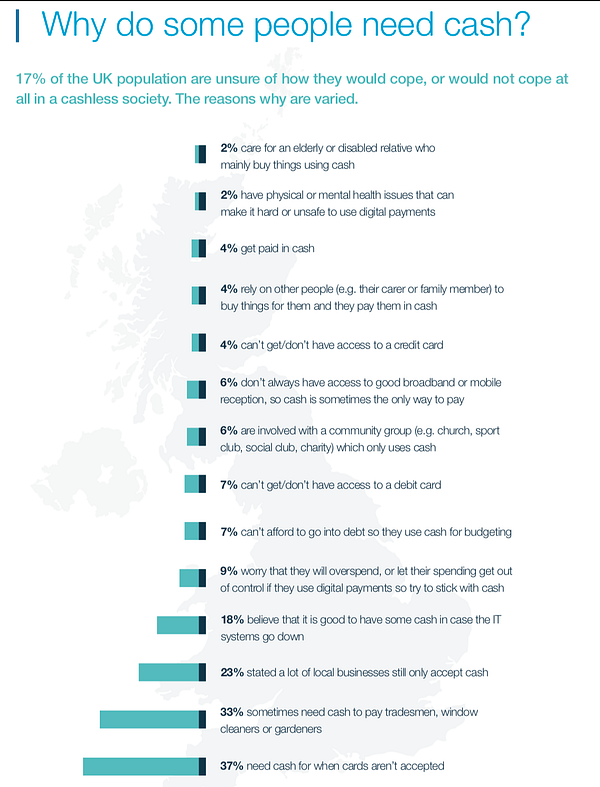
image from the Ceeney Review

In 2018 an independent review of access to cash, the “Ceeney Review” was set up in the UK. It published its final report in March 2019.

The review said that 17% of the UK’s population — about 8 million adults — would struggle in a cashless society. The reasons are complex. The report talks about multiple reasons including lack of access to the internet (particularly in rural areas), people without bank accounts, physical and mental health, financial difficulties, or fear that the computers that run the other payment methods will break.

The review found that 51% of consumers felt it would be a good idea to change the law so that all shops and services had to accept cash.

The factor with the strongest correlation to use of cash was not old age, but poverty. While a cashless society might be convenient for many it would be a struggle for some of the most impoverished people in our society.
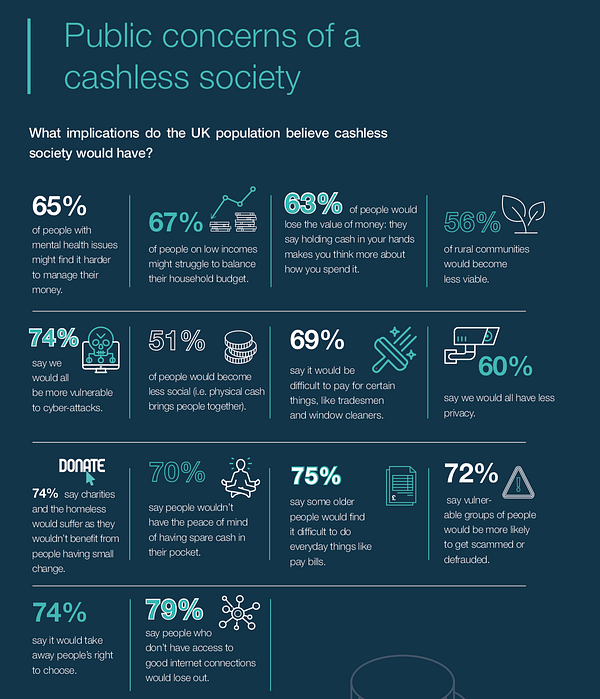
image from the Ceeney Review

Meanwhile the public also had a range of concerns about a cashless society including the needs of those who have to use cash but also including other concerns like a loss of privacy and the loss of the ability to choose how to pay.

That does not mean that a cashless society is necessarily the wrong vision for the future, it means that any transition needs to happen over a period of time, that governments need to provide support for those impacted, and that in the intervening period we need to preserve access to cash.

The Ceeney Review’s final report said that:

we recommend that essential government services and monopoly and utility services should be required, through their regulators, to ensure that consumers wishing to pay by cash can do so, either directly or through a partner

In response to this UK government said that it would:

safeguard the future of cash and ensure its availability for years to come

That sounds sensible.

GOV.UK Pay

The Government Digital Service (GDS), was set up back in 2011 to help implement the then UK government’s digital by default strategy. In July 2015 GDS announced that it would make payments [to government] more convenient and effective. This led to the announcement later in the same year of GOV.UK Pay — a free and secure online payment service for government and other public sector organisations.

This service is now part of the Government Transformation Strategy and a component in what people call government-as-a-platform. It is used by a growing number of public services in central and local government.

GOV.UK Pay is a better experience for many citizens, and for the people building public services that need to take payments, but it does not handle cash. It continues the same trend as we see in the private sector. Making it easier to handle online payments while neglecting the needs of people who need to pay in cash.

It provides no direct benefit for the millions of people who can’t (or won’t) use either online payments or online services. As well as the Ceeney Review’s finding of 8 million adults who would struggle in a cashless society, the Financial Conduct Authority reports that there are 1.3 million UK adults without a bank account. Unless a friend helps they have no way to pay money to a public service that cannot take cash.

In a response to an Freedom of Information request GDS has said that in 2015 they undertook user research on a prototype that integrated GOV.UK Pay with a cash payment service

“but not with users who typically rely on cash payments”

That was a bit silly. You need to pick an appropriate audience to test with.

Other government services (DWP and Insolvency Service) also did usability research with the actual target audience. These services felt it was a valuable payment option.

Unfortunately cash and the needs of the people who use it were not prioritised. Back in 2015 the focus was on online payments and the people who use them.

Government has a strong moral, and often a legal, responsibility to make public services work for everyone. GDS have always said that they want to benefit everyone and have an emphasis on accessibility. The Ceeney review, and government’s positive response to it, provide good reasons to revisit the strategy for GOV.UK Pay.

Broadening the scope of GOV.UK Pay to support cash

To deliver on its commitment to safeguard the future of cash government will have to make a range of interventions. Some of those will include making sure that the public sector can handle cash payments. I expect that the current GOV.UK Pay team will be able to provide a lot of help in meeting that objective while still delivering on their historic focus of better online payments.

But the benefits will not only be felt by people using public services. By making it easier for people to pay government in cash government can start to change the cash payments system for the better.

Perhaps government’s payment experts will discover that to get continued good coverage of places to pay in cash that:

  • the government will need to make it easier to pay for any public service in the local authority offices that are in town centres across the country
  • they should provide support to make it easier for shops to offer cash payment services like Paypoint
  • they can develop and share good practice for how to handle cash payments
  • there are ways to share good practice across the organisations that process cash payments to help make face-face payment services better
  • or the many many other things that will emerge with some good open-minded research into the needs of people who use cash

These things will also provide benefits to people paying cash to private and third sector organisations too. That is good. Government’s responsibility goes beyond what we traditionally think of as public services that need payment — things like paying our council tax, buying a fishing licence, paying for a car parking space, or getting a passport.

Governments have a responsibility to the whole of society. Governments should be investing in public goods that benefit everyone. Access to cash will make it easier for more people to buy food, travel around and enjoy their lives. Government should make it easier for people to use new online payment methods, but it also needs to preserve access to cash for the people who need it.

Broadening the scope of GOV.UK Pay to support cash will help government do what it said it would do when it responded to the Ceeney review, and make things a little bit better for everyone.

12 million UK adults can’t read this blog.

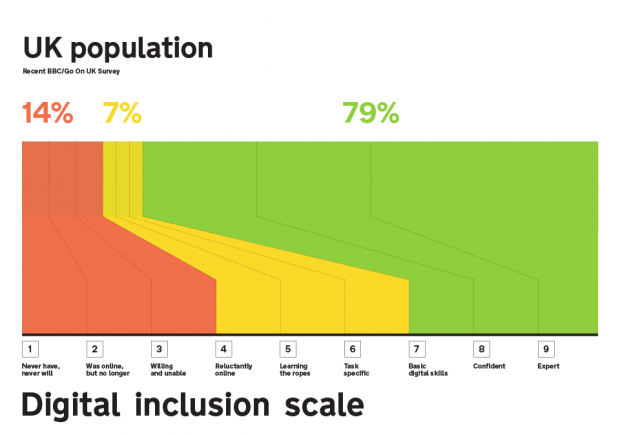
Nearly one in four of the UK adult population, about 12 million people, are what is termed ‘digitally excluded’. They cannot perform basic tasks on the internet. Many others might have the skills but are excluded because they cannot get on the internet: because the infrastructure isn’t there or because they can’t afford it.

The digitally excluded, about 12 million people, will get little to no benefit from some of the services that people who are brilliant at the internet are building unless they get assistance to use them.

When I talk to people about digital exclusion I find that the simple statistic that one in four UK adults, about 12 million people, cannot perform basic tasks online is astonishing to many. That is part of the reason I’m writing this blog. We should be aware of this fact.

I would like it if more people, especially those who are brilliant at the internet, realised how many people can’t use the internet and the problems that causes for all of us. If we realised that some of the clunky, old legacy services that some people complain about and think are holding the world back are also things that others rely on and can’t live without.

It would help all of us if we talked and did more about this challenge; if we reduced the number of people who can’t read this blog or the many other far better ones that are out there.

The internet is moving fast

I know the internet is moving fast and that software is eating the world. The internet has become infrastructure to many of us: especially if we live in a big city. It’s boring and invisible. We expect the internet to always be there and we get grumpy when it’s not.

People in the tech world are often dazzled by the services they use and the things they can use to build services for others. One year people are obsessed with design theory; the next, platform business models. This year it is blockchain technology. Next year it may be the impact of driverless cars.

I love the services we can use. I love the services we build for other people to use. I know that we know how to build better things this year than we could last year. I know that will be true next year and the year after.

But despite all of these advances, 12 million people can’t read this blog and they can’t use the services that brilliant people build and put on the internet.

Digital exclusion is really complex

There is no magic solution. The challenge is really complex because it’s mostly about people and people are complex.

The UK government’s digital inclusion scale from 2014.

The statistics show that the people impacted by digital exclusion are mostly old and from lower income groups. It contributes to the exclusion that these people already face. I believe some people ignore digital exclusion because of this. They think the digitally excluded will go away (“they’re all old) or that they’ll soon be able to choose to use the internet (“my service is beautiful, faster and cheaper so people will choose to use it”).

We shouldn’t be waiting to tackle this challenge, not least because there’s a further level to the challenge. Some people can use the internet but they can’t use all the internet.

Stories about this are all around us. In recent months I’ve bumped into people who work in the tech sector but can only get a pay-as-you-go mobile contract and so have limited access; people who live in rural areas with no internet coverage; people who don’t speak English well enough to use some services; people with disabilities which limit their ability to use the internet; people who are unable to afford access to the internet.

People are building new online services to help people get educated, to get a cheaper taxi, to book a holiday, to find a job, to write to their MP, to petition parliament and many other wonderful things but those services cannot be used by the digitally excluded unless there is some form of assistance.

Tackling the challenge helps all of us

There are huge benefits to getting people online. Both for the individuals and for wider society. The benefits are social, democratic and economic.

It’s possible, and often useful, to quantify those benefits. One study in 2014 put a financial value of getting someone online at £1064 per year per person “from having more confidence, making financial savings online, less boredom, opportunities to pursue hobbies, new jobseeking skills, and a reduction in social isolation”. The value increases as people become more digitally skilled and can use more of the services that are enabled by the internet. [Sentence added on 23/11] A report by two charities, Go ON UK and the Tinder Foundation, published in November 2015 showed a benefit of almost £10 for every £1 spent on basic digital skills.

Many people benefit from this value: government through increased tax revenues, companies through greater use of services, the companies people work for due to higher productivity, and the individuals themselves. To put it simply reducing digital exclusion will help grow the economy.

The digital exclusion statistics in the UK are worse than some other European Union countries. We risk damaging our digital economy as other nations become more digitally skilled than the UK.

And there would be other benefits from really tackling digital exclusion. We could start to turn off expensive legacy services and focus more of of our efforts on new digital services.

A beautiful — to me :) — but expensive bit of a legacy service, our broadcast television network. Photo by Mark Salisbury.

Where the service is supplied by our governments then we share the cost of maintaining legacy services. It is paid for from our taxes. We will make the public sector more efficient by reducing digital exclusion.

For private and third sector services sometimes we share the cost but sometimes we don’t. Taking the new internet-based taxi companies like Uber and Didi Dache as an example we can see that whilst the digitally included benefit from cheaper taxis the digitally excluded don’t. As other taxi services become more expensive and sparser due to lower demand then regulators will need to make a decision. Maybe there will be a surcharge on Uber and Didi Dache journeys to fund traditional taxis. Imagine the conflict that will generate. By reducing digital exclusion we will reduce the, ahem.., friction that the need for legacy services can cause for new internet-based services.

Tackling the digital exclusion challenge

There is no magic solution. Digital exclusion is a really hard and knotty problem to fix. The whole of the problem won’t be fixed without time and investment. [Sentence added on 23/11] And despite the compelling case for investment it may not occur due to conflicting political priorities for spend.

The digital exclusion challenge is more complex, and more focussed on individual people, but it may even need an initiative similar to the digital television switchover.

Most of the work to fix digital inclusion in this country seems to be being done by volunteers and the private sector. Our government does not have much data on its own work to address the challenge of digital exclusion. I find that slightly surprising. Parts of the UK government are brilliant at the internet. I would expect them to also be brilliant at tackling digital exclusion.

Thinking about the digitally excluded isn’t hard. You’re doing it now. But we need to keep reminding ourselves. We need to keep working to reduce the number of people affected and keep up the pressure on government and the private sector to do the same.

Simple things can help with this.

Government could openly publish data on digital exclusion and our performance in tackling the challenge: we can then hold government to account. Our tech press could write articles on digital exclusion as well as on the brilliant new services that are being built. We can include the digitally excluded in (un)conferences. Digital services could remind us that some people cannot use the service and encourage us to volunteer time to help. Digital people could talk about digital exclusion more often and think about whether they can design their services in a way that helps with the challenge.

We are not our users. If we ever forget this fundamental maxim the fact that one in four of our potential users cannot use the services we build should remind us of it. If we tackle the challenge of digital exclusion then it will reduce inequality and generate benefits us all.

Let’s keep building brilliant new services but let’s fix digital exclusion at the same time.

© 2026

Theme by Anders NorenUp ↑

This website stores cookies on your computer. These cookies are used to provide a more personalized experience and to track your whereabouts around our website in compliance with the European General Data Protection Regulation. If you decide to to opt-out of any future tracking, a cookie will be setup in your browser to remember this choice for one year.

Accept or Deny