A picture of some people by L S Lowry (via Flickr)
The committee is currently investigating Artificial Intelligence and whether the existing frameworks and regulations are sufficient to ensure that high standards of conduct are upheld as technologically assisted decision-making is adopted more widely across the public sector.
Big topic. After all AI is a range of techniques that uses people, mathematics, software and data to make guesses at the answer to things. It can help, and hinder, with lots of the huge array of things that the public sector does.
I represented the Open Data Institute (ODI) on a roundtable for this investigation. A couple of people have asked me what the roundtable was like and what I said. Here’s a quick blogpost.
Preparing for a roundtable
The ODI team get invited to lots of roundtables and events. We decide which ones to do and who does them based on a range of criteria. The invitation for this one went to our CEO, Jeni Tennison, she passed it to me to do. My goal was to help the committee, learn from what other attendees were saying, and test some of our ideas in front of this audience.
We did our usual preparation by sharing the questions around the team in the office and telling our network that we were going along to hear what advice they gave us. That technique provides a lot of input. It also helps me represent the ODI and the ODI’s network, rather than simply myself and my own views.
I summarised it down to a few key points to try and make, and then tried not to over-prepare. Over-preparation is the worst sin: it makes me sound even duller than normal.
Rounding a table
The roundtable itself was at Imperial College in London.
The setup was more informal and the committee was more friendly and asked more insightful questions than most similar things I’ve done. That was good. My background is technical and private sector — I previously spent 20 years working with telecoms operators building products, systems and networks — so I always worry that I’ll misunderstand or miscommunicate particular words or phrases. That would damage both me and the organisation I represent.
Anyway, I managed to get over versions of some of things that we’d prepared and/or that we regularly discuss in the office and that were relevant to how the roundtable took shape:
that there is little transparency over use of AI in the public sector and of how the UK government’s Data Ethics Framework is being used. I know that there is good and bad work being done, but mostly because I know some of the people doing it. How are the general public meant to know?
that we need to focus more on the people who design, build and buy AI services. Exploring what responsibility and accountability they should have and how we give them the space, time and money to design those services so that they support democracy, openness, transparency and accountability as well as being efficient and easy to use
that the current focus on ethical principles and AI principles do not seem to be having a usefuleffect. That instead we need to couple those top-down interventions with more bottom-up practical tools (like the framework or ODI’s Data Ethics Canvas) and more research into how the people designing, building or buying AI systems make decisions and what will influence them to comply with the law and think about the ethical implications of their actions
that control, distribution of benefits and harms, rights and responsibilities about AI models would be a useful area to explore
that eliminating bias is the wrong goal. Bias exists in our society, some of that bias becomes encoded in data and technology. AI relies on the past to predict the future, but the past might not reflect the present let alone the world we want. We should build systems that take us towards the future we want, and that can adapt as things change
I also learnt a lot from other attendees with some interesting things for myself and the team back in the office to chew over.
After the roundtable
A couple of weeks after the roundtable I was sent the transcript to review. The committee will publish that transcript openly — which is good and healthy. Attendees get to see the transcript first so they can suggest corrections to simple grammatical errors or transcription problems. That’s why I’m not commenting on or sharing what other people said.
It is important to review the transcript. There are sometimes errors. For example, in this transcript I was recorded as saying that my boss, Jeni, was “whiter than me” rather than “wiser than me”. I have no idea how I’d measure the former but I certainly know that she’s the latter. Some of the words and thoughts in this blogpost come from Jeni and others in the team like Olivier, Miranda, Renate, Jack &c &c &c.
Reading the transcript also helps me understand the difference between the clarity of my speech and the clarity of my writing. I’ve left most of my spoken errors in place. Just like the state we can’t only communicate in words and pictures that are sent through a computer. Most of us need to get better at speaking with humans.
I’ve been asked to do a talk about “data and policy”. First, an apology. I don’t speak Dutch and sometimes I speak English too fast, and sometimes too quietly. That makes it harder for people who don’t speak English as a first language. Sorry. Shout at me if I do that and I’ll speak more clearly.
I want to start by expanding on the word policy. It means different things in different contexts.
Merriam-Webster has a definition of policy that says “a high-level overall plan embracing the general goals and acceptable procedures especially of a governmental body”.
That is a classic definition but there are other meanings and contexts.
Within organisations there will be policies for compliance with data regulation, like GDPR, or for how data should be collected, used, stored, shared or opened. Businesses, civil society and not-for-profit organisations will also have public policy positions on “government policies that affect the whole population”.
At the Open Data Institute lots of members of the team deal with all of these meanings of policy in different contexts. Most of my work is on public policy, but I’m trying to influence both governments and businesses.
The ODI is not-for-profit. We work globally, our headquarters are in the UK. We were founded by Sir Tim Berners-Lee, the inventor of the web, and Sir Nigel Shadbolt, an AI pioneer. We are not partisan but we are political. Data is a political topic. Open is a political statement. Our mission is knowledge for everyone.
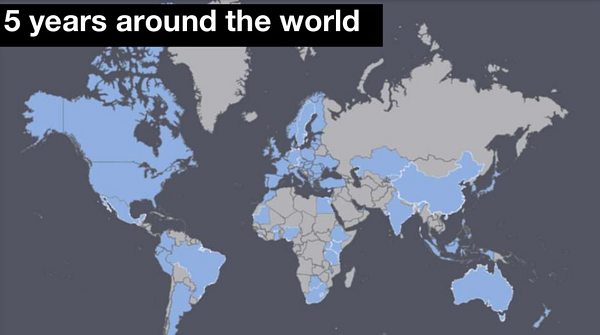
A (hopefully) comprehensive map of where ODI has done work, where nodes have formed and where members are.
It’s our 5th birthday this year. Yay us 🙂 I’m going to share some policy lessons from those 5 years. The lessons have been learned from our work around the globe, our peer network of nodes and our network of members.
Policy is one of the capabilities we use to help us deliver our mission and strategy. We also do a lot of work with technology, training people, gathering evidence, building communities and incubating startups.
First, let’s talk about open data. Open data is vital and incredibly important but we learnt that if we only talk about and use open data then we can’t deliver our mission. Instead we work across the data spectrum.
The data spectrum is about access. Who can get to data so they can use it or share it or etcetera. Some data should be kept closed within an organisation, like sales reports. Other data should be shared: the police need to be able to see your driving licence, medical records can help with research, twitter data can help us understand how social media is impacting our societies. Lots of data should be open data, things like bus timetables, maps and addresses.
At the ODI we learnt that we need to talk about and use the full spectrum of data to both get more open data and deliver on our mission.
We also learnt that we need to combat the very strange view that data is oil or coal or other types of fossil fuels.
I can, and often do, talk in economic theory about the different qualities of data and oil, but there is a more important difference. It creates the wrong mentality. People fight over control of oil. They want to hoard it for themselves. They want to sell it for huge amounts of money. This is not the way to get the most value from data, an increasingly abundant resource. The thinking generated by treating data like oil reduces innovative use of data and causes loss of trust by societies in how data is used.
Instead we need to turn data into infrastructure. It is already heading in that direction but we need to strengthen that momentum. Great infrastructure is boring, reliable, safe and easy to use. It’s there when we need it. Data is decades away from being boring, trust me *pause for ironic, self-knowing laughter*, but that’s the direction to head in. Turning data from every part of society — especially the public and private sectors – into safe, trusted and easy to use infrastructure that underpins every sector of our economy and our societies.
And that infrastructure will be built on a foundation of datasets that are made available as open data, for anyone to access, use and share. That foundation of open data makes it easier to publish and use other data.
The third lesson is about goals. Sometimes it can feel to other people like the goal of the open data movement is only to publish more open data or to put data on portals. That’s the wrong goal.
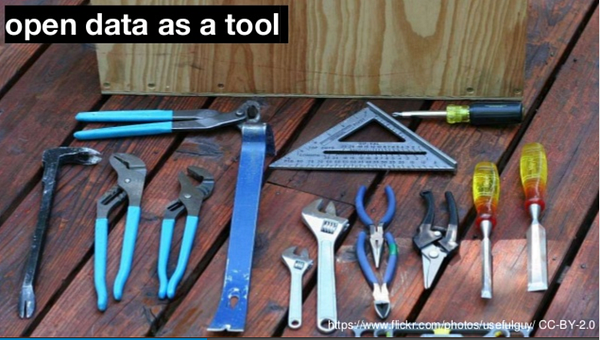
We think, talk about and use open data as a tool. One of several tools in the toolbox.
A toolbox that we, and others, use to tackle problems. Like finding a job that you enjoy, combatting corruption, finding your way around a city, responding to the threat of anti-microbial resistance, helping with house planning and building, or understanding the growth of new sectors and business models like the sharing economy (something we’re looking at in our new R&D programme).
The fourth lesson is about chance. Chance is great. Very unexpected things happen when you open up data. One of my personal favourites is that the UK government opened up radar data that was originally gathered for planning flood defences and people used it to discover both new places to grow wineand new Roman roads that criss-cross parts of the country. Fantastic. But that doesn’t always work.
Instead we learnt that we need to put more focus on creating impact by design. Looking for problems, working with people who are experts in tackling it and helping them to use data as one of the tools in their toolbox. When we do that then chance can also happen, but we also have a much higher chance of impact, and impact is necessary for sustainable change.
So those lessons are some of the ways we learnt to think about data over the last 5 years — about the full spectrum of data, about data as a tool, about impact by design, and about data as infrastructure. Those mental models are part of our approach to public policy.
But through our work and delivery we have also learnt some of the most effective levers that we have to create impact. In our policy work we amplify those levers and encourage others to use them or build their own.
First, practical advocacy.
Over the years we’ve developed a set of guides and a toolbox. They’re openly licenced. Anyone can use them, or fork them and change them. That can be a challenge for an organisation that needs to bring in revenues but it’s the right thing to do for a mission with an an open culture and a big mission. We don’t want to do everything, even if tried we wouldn’t be able to. We want to make it possible for other people to do what we do.
The practical advocacy tools keep on expanding.
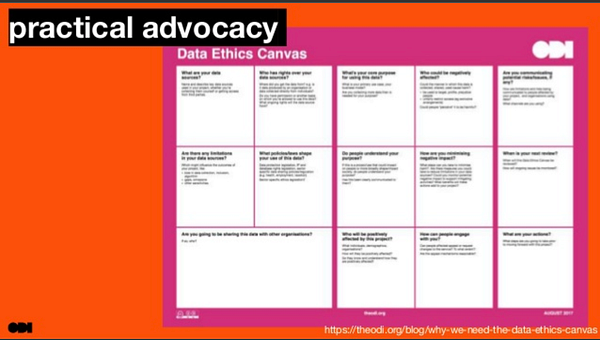
We recently launched the first version of a data ethics canvas to help organisations using data understand, openly debate and decide on ethical issues about collecting, sharing and using data. Interestingly when we looked into data ethics we found that most of the debate was about personal data in the closed and shared parts of the data spectrum. People had missed the ethical issues around open data and non-personal data. The canvas might help fix that.
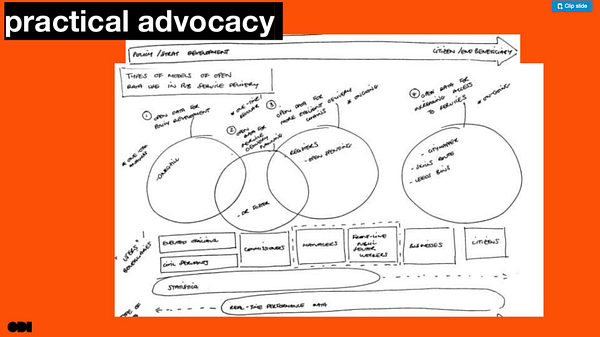
As part of our research & development programme we’re exploring how open data is being used in public sector service delivery and how it could be used more. There are some famous stories about open data helping to reimagine public services but we are still seeing the same old stories and not enough momentum. We’re hoping that through our research we can help understand the barriers to change, and build some methods and patterns that will help people do more things to use data to improve public services.
Patterns are important. We’ve also developed a set of design patterns for policymakers that use data to help them create impact. While data policy people might know data, many other policymakers don’t. We need to reach them and put data into their context, in language they understand and helping them understand how it can help them tackle their problems.
Through approaches like evidence-based policy many policymakers have realised that data can help inform policy, but these patterns also help show policymakers how data can help deliver policy. Whether that policy is reducing costs, improving an uncompetitive market, or helping consumers switch between service providers.
The next big lever is networks, peer networks in particular.
Peer networks are horizontal organisational structures with members who share similar identities, circumstances or contexts. We run global, African and European peer networks for open data and have seen their power in developing learnings and creating change. We’re learnt from how they have grown and how the people in them interact.
We’ve been seeing peer networks start to emerge in other work they do. Things like ODINE (open data incubator Europe), Datapitch (another Europe-wide startup incubator), and the sector programmes.
We believe that fostering other peer networks: in sectors, in particular disciplines (like policy), or in particular geographies will help build a better future faster. We’ve published a method report that we, or others, can use to do that.
Finally, sector programmes. We’ve been working with whole sectors to help them work together to use data. We can get more done if we work together.
Most people are familiar with organisations like the Open Government Partnership. Less well known are groups like GODAN (the Global Open Data for Agriculture & Nutrition) initiative that brings together governments, businesses and farmers to open up agriculture data to solve problems.
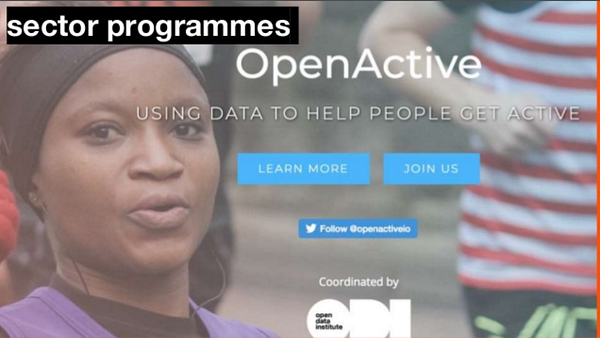
OpenActive is opening up sport data to make people more physically active. Places that offer a whole range of sports: football, squash, badminton, table tennis, running are opening up data and they’re also building an ecosystem of organisations that will use that data to make it easier for more people to play the sports they love.
In an initiative called open banking the UK retail banking sector is opening up data about products, locations and cash machines and creating open APIs so that people can choose to share data held about them by banks with people that they trust. We hope it will make it easier for more people to create better services for bank customers. It could also improve national statistics, help improve the UK’s identity framework, help tackle financial inclusion or many other things. We’re talking to other countries on multiple continents about helping them implement open banking too.
There are more sectors, like transport, coming together as they start to see the power of working together to solve common problems. We need to encourage sectors to understand and unlock the value of open data by focussing on infrastructure, skills and open innovation.
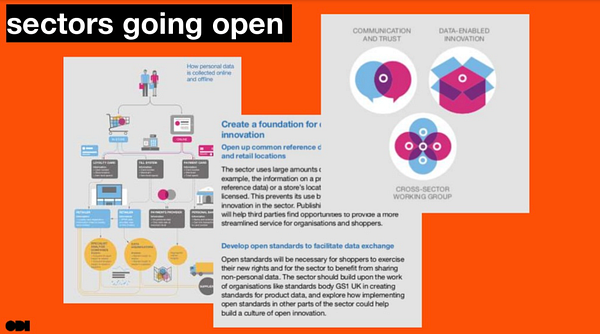
Finally, we’re launching a report today on the grocery retail sector and GDPR based on consumer research, sector interviews and our thinking about sectors. We want to encourage the retail sector to work together to focus on opportunities, and to use the data they hold in ways that both builds trust in shoppers and gives them better services.
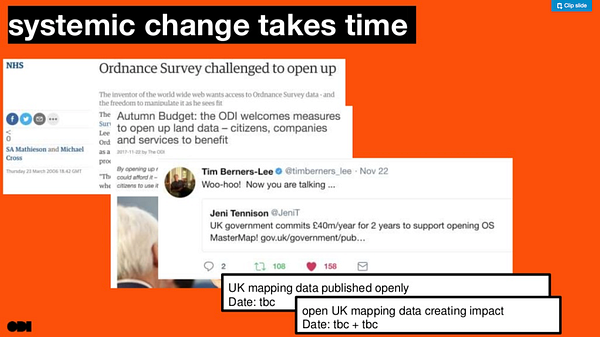
But there’s an important point to understand with all of these levers. We are not building a new product or smartphone game. We are changing systems. This takes time. We are only a few decades into a large wave of technology driven change that will take many more decades to see through to the end.
And that’s why there’s another vital lesson. Having fun. Being optimistic. Sometimes it can feel like things are moving slowly or in a bad direction and that things will never get better. But just as open is a political statement, so optimism is a political act. Having fun helps me be optimistic. Choosing to be optimistic both helps the day go faster and creates the momentum we need to help create a better future.
A new report by Webroots UK on the cost of online voting in UK national elections was published last week. The report was backed by politicians from four large political parties — Labour, Conservatives, SNP and the Liberal Democrats. It is about one of our most fundamental democratic rights. It deserves debate.
The report argued that online voting would increase the number of voters and reduce costs by 26% per vote. Unfortunately it missed significant risks and argued for saving costs by making it harder for millions of mostly disadvantaged UK citizens to exercise their democratic rights. Rather than arguing to reduce the cost of democracy, we should be arguing to make it better.
The risks and decisions of online voting
One of the classic lines about online voting is that people can safely bank online so they should be able to safely vote online. An analogy that sounds useful but is unhelpful. Banking and voting are very different problems, carry different risks and societies make different decisions about them. To give three examples.
We are comfortable that banks and governments know us and can see how we spend money but want our votes to be secret. We choose to accept the risk that governments and banks might mistreat our finances, but are prepared to accept very little risk that governments and people might mistreat us because they know how we voted.The damage that could be caused is bigger and harder to undo. The risk is higher.
Meanwhile the damage caused by mistakes or manipulation of national elections is higher than in other types of election. The reward for successfully manipulating a national election will attract malicious attackers who will act for their own reasons at their chosen time.
Finally, there are risks alongside online voting. Multiple countries have seen online social media used to spread disinformation during elections. We are only just starting to understand how this happened, let alone understand the damage and what actions could reduce it. There is a risk that online voting will provide new ways for disinformation to have an impact.
These are the type of risks that people who want to introduce online voting for national elections need to consider and debate with society. We should make conscious decisions on whether or not to accept them.
4.7 million people or 15.2 million people
But even if we find an acceptable le online voting safe, or choose to accept the risks, there is another implicit argument in the report. That online voting will make it easier for up to 4.7 million people and reduce costs by making voting harder for up to 15.2 million people.
The report used a survey to argur that online voting would increase the number of voters by up to 4.7 million. These are people who do not currently go to polling stations (the places where people can vote in person) but would vote online. This would lead to a cut in administration costs by reducing the number of polling stations or reducing mailing costs by moving election material online. We will need less of these as some people vote online.
It failed to discuss how many people do rely and will continue to rely on paper voting and electoral information. As the UK’s Goverment Digital Service recently said “paper isn’t going to go away”.
A report published by the Good Things Foundation said that 15.2 million people in the UK are either non-users, or limited users of the internet, that 7.5 million of those people are under the age of 75, and that 90% of non-users can be classed as disadvantaged.
The cost reduction measures in the Webroots report will make voting harder for these millions. They will have further to travel and find it harder to get information about who to vote for.
Politics is about choices. What gets done and what does not get done. Who wins and who doesn’t. I’m surprised that politicians from these major parties appear to favour the advantaged over the disadvantaged. Why they find it appropriate to reduce the quality of service for so many.
Rather than arguing for an online service or cost reduction, argue for a better service
The Webroots report is fundamentally starting from the wrong place. It is arguing for an online service that will reduce cost, rather than arguing to improve the quality of service. Unfortunately this is a common approach when using modern technology to improve existing public services.
The UK Parliament’s new e-petitions service only offers the ability to share a petition via social media and provides no way to combine online petitions with paper petitions that are hand-signed in communities. While the logical conclusion of wanting to make elections cheaper is to simply “do less” and cancel elections. Perhaps we could use an algorithm and some data.
Doing the hard work of research and experimentation to discover how to improvr democracy using modern technology in a number of ways, as organisations like Democracy Club do, is more useful.
We will find that we can and should use modern technology to improve democracy for everyone such as through online voting, better designed forms, making it easier to find a polling station, tools to help polling station staff, and a whole host of other things that might make democracy better.
As we make those improvements we should take the opportunity to have a more informed debate over the risks and who benefits, but we shouldn’t focus solely on online services and cost reduction we should make democracy better for everyone.
Some of the changes which people have told us would make registering to vote and voting easier would cost more money. But we would like to see things changed so everyone can register to vote and vote.
You can send a form letter to your MP about the debate using the VoteFootball site but it is more likely to be effective if you send a personal letter using the WriteToThem site produced by the lovely people at MySociety. It is likely to only take 5 or 10 minutes. Write about what you know and feel. Be concise. Give links to more detail and evidence. Be polite. Ask for a specific action.
On 9 February the House of Commons will be debating the following motion:
That this House has no confidence in the ability of the Football Association (FA) to comply fully with its duties as a governing body, as the current governance structures of the FA make it impossible for the organisation to reform itself; and calls on the Government to bring forward legislative proposals to reform the governance of the FA.
Can I ask you to attend the debate and support the motion?
There have been many governance failures of the FA, and other English governing bodies. I am particularly concerned about the lack of representation for fans and the lack of action against the owners of football clubs who act against the interests of the game, the fans and the communities in which the clubs are rooted.
There are numerous current examples of fans protesting against and boycotting their clubs because of the actions of their owners. For example, Charlton Athletic, Coventry FC, Blackburn Rovers, Leeds United and my own Blackpool FC.
Reformed governance of the FA which provides transparency, accountability and gives power to fans will help alleviate the situation at Blackpool, and other clubs, and can reduce the chance of similar cases happening again.
Please support this motion to help make that happen.
Data is becoming increasingly important to our societies. We live in an age of data abundance and, without many of us realising, data has become a new type of infrastructure and a critical one at that. The age of data abundance has led to brilliant new services and can help our societies tackle challenges such as climate change and population growth, but it also creates risks to privacy and concentrations of power.
Societies need to be able to debate what this age of data abundance means for them. People need to make decisions about the relationship between individuals, communities, societies and data. We need to pick a future vision for our relationship with data and then make steps towards it. Many governments and societies are having this debate now.
In my job I put forward the Open Data Institute’s position on those decisions while also trying to encourage a more public debate. I want a debate because I, and the lovely people I work with, want the decision to be made by societies around the world.
To make this debate as broad and informed as possible, I need what I say to be understandable by as many people as possible. I try to use plain language and frequently test new language and concepts to see if they are understandable. Sometimes I test things through tweets or blogs, like this one, at other times by talking with people from differing backgrounds and perspectives.
By testing, listening and learning I have made some of the language more accessible but I’ve also realised that something was more important than I first thought: politics. Both my politics and that of others.
I was talking about the ideas in that blog with a left-wing British politican who stopped me mid-sentence and asked if I was a Blairite nowadays. No, I replied. “Then why are you using the language of Blair’s choice agenda?”, they asked.
Further testing of the language caused another person to recoil and suggest that if I kept talking about choices I might be accused of being a secret Thatcherite pushing the theory of public choice. Hmm….
I’d used the word ‘choice’ because I thought it was plain language but it was clear that the decision risked putting in place a political barrier for some of the other ideas in the blog. This is a problem.
Data is political
When thinking about and debating technology and data with other technologists it can be easy to fall into a trap of thinking that every decision can be based on empirical evidence, that there is a single right answer and that we can make that right answer a reality by designing and building the right technology. This is nonsense.
In our debates about data we need to decide issues of access, ownership, regulation and the relationship between citizens and the state. These are political decisions.
Whilst we might have individual opinions about data we need a state and legal system to help put decisions into practice. States will allow technologists to innovate and try things out but there comes a time when existing legislation will be more strongly applied or new legislation will be put in place as society’s needs change. This happened and continues to happen with road traffic, it will happen with data.
By broadening the debate we are helping that decision to be made democratically. Democracy might have seemed under strain in some countries in 2016 but as Churchill said:
Indeed it has been said that democracy is the worst form of Government except for all those other forms that have been tried from time to time
The “white heat of technology” makes me think of Harold Wilson and the 1960s UK Labour party. Because of my political history I have positive feelings about the phrase despite the speech being followed by the scrapping of several high-profile technology projects. Image copyright PA.
Some words carry a particular meaning in the present because they have been used in a political context in the past. Marx said it more poetically:
The tradition of all dead generations weighs like a nightmare on the brains of the living.
The word “choice” resonated amongst some people involved in British politics that I spoke to because of those traditions and their political history. It will have bought back nightmares for some and heavenly dreams for others.
Data is not about left or right wing politics
In economic terms each of these cakes is rivalrous: only one person can eat them. Cake is not like data, multiple people can use data at the same time. Picture of cake by Hani AlYousif, CC BY-NC-ND 2.0
Our societies and political systems are used to making political decisions about many types of resources, for example oil or water, but data has different qualities to the physical resources that are embedded in our political systems, debates and legislation.
To give two regularly used examples: data is non-rivalrous, unlike a piece of cake many people can use data at the same time, and data benefits from network effects, it becomes more valuable as more people use and maintain it.
These differences are one of the reasons the team at the Open Data Institute talk about data as analogous to roads:
Data is infrastructure. Just like roads. Roads help us navigate to a location. Data helps us make a decision.
The “data is roads” analogy breaks people out of the traditional mindset. It helps open their minds to thinking differently.
But it will be harder to get people to think about the decisions along that closed-open axis if our words and ideas cause them to think of old left and right wing political battles.
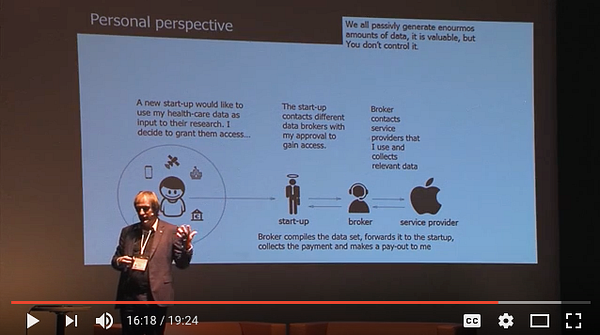
Much of the current debate about data is dominated by personal data: the stuff which is about identifiable people. Many people believe that there is an asymmetry of power and privacy as data about us is controlled by governments and corporations.
Tav Kotka, the Chief Information Officer of Estonia, recently gave a talk in which he broached the idea of adding a fifth freedom to the EU’s existing four freedoms for free movement of goods, workers, services and capital. The talk was mostly about personal data and the concept of personal data stores that could allow individuals to control how data about them is used.
Whilst I agree that more personal control over personal data is important the talk bought up memories of Margaret Thatcher and my teenage political nightmares. The talk did not mention society’s need to access and use that data. Taking back control of data by giving control to individuals misses out the challenges of digital inclusion and the role of other important parts of society like families, communities and nations. Different levels of control, rights and responsibilities are likely to need to given to these different groups. To give just one example vital medical research and national statistics need to use large amounts of personal data, this can’t be neglected or left solely to the decisions of individuals.
But, as I realised, this time I was the one allowing my political history to do the interpretation for me and I was the one who wasn’t listening to the underlying argument. Tav Kotka was using language that built on his political history while talking in English to a Finnish audience. Even though I work for a global organisation my initial reaction was from a UK perspective. My bad.
The political debate about data is happening now
The EU is currently discussing complex concepts such as data control and data ownership through the free flow of data initiative. Major geopolitical organisations, like the EU, can have a large impact on countries outside their membership, the UK government has committed to following current EU data protection regulation after it exits the EU. That EU debate involves politicians from multiple countries, each with their own rich histories and perspectives. There are many other debates in countries around the world.
If you want to help build a great future for data then as well as building new services you may want to get involved in either this or other multinational, national and local debates.
But if you do, remember to think about politics: both other people’s politics and your own. That way you will be best placed to help people think about the decisions not in terms of traditional left and right-wing politics but instead in terms more suited to the different challenges and possibilities of data.
Both the EU referendum in the UK and the presidential election in the USA have generated a lot of debate over what influenced the results. They were close campaigns. There are many things that could have led to a different outcome. I’ve been particularly interested in the debate over the role played by technology, the web and data.
I think the debate is missing how politics risks becoming driven by data rather than informed by it.
Technology-driven progress, globalisation, fake news, social media, malicious and mischievous actors
Technology is a major strand in the debate about globalisation, nation states, jobs and inequality. The web and data are at their best when they are world-wide, open and know no boundaries but it is essential that we use technology-driven progress to build a better society for everyone.
Whilst debate about hacking and bots continues in other countries, such as Germany, this story seems to be at risk of slipping off the radar in the UK and USA. A more informed debate about their effects and purpose would seem useful.
But there’s a fourth element that I’m barely seeing debated at all. Data-driven politics.
Data-driven politics
Politics has always gathered and used data to help it make decisions. This data comes from door knocking, censuses, opinion polls, focus groups and election results. In our current age of data abundance there are ever more and cheaper ways for anyone to gather and use data. Some of the uses by political parties seem to be at risk of copying the worst excesses of online marketing.
In the UK Labour leadership contest in 2016 organisations such as Momentum and Saving Labour talked of capturing email addresses and the reach of their social media channels. Neither group has been open about who is in control of this data, whether it is secure from hacking or how it is used.
Following the UK’s referendum on the EU one of the Leave organisations, Vote.Leave, talked of its superior use of data and how it was used for targeted advertising. The BBC reported that:
“Their dream was of a system that could put information from Twitter, canvassing, polls, websites, apps, into one giant IT programme that would then churn out extremely sophisticated models that would reveal the areas most likely to vote Leave, down to the street.”
Other campaigns and political parties debunked their claims on twitter and proudly said their data tools collected more information. No one questioned whether either was appropriate or healthy for democracy.
The New Statesman reported on the plans of a UKIP funder to start a new political party saying he claimed that Leave.EU’s email database was “a goldmine to anyone doing digital campaigning”. No one asked if it was either legal or right to transfer this “goldmine” to a new political party.
In America the Trump campaign was talking about its heavy use of data before the campaign finished. One insider on the data team said:
“There’s really not that much of a difference between politics and regular marketing.”
I hope I’m not alone in thinking there should be a difference between politics and marketing.
This increase in the use of data to both listen to and influence people in political debates raises a number of issues.
There are biases in data and in how we use data
Data has biases. This might occur because there are gaps in how we collect data: for example ~10–20% of the UK and US population are not online because of issues such as cost, disability, location or motivation. Data also includes the biases in society such as those affecting gender and race. Bias can also occur through the people who decide how to analyse data and code the algorithms. People write code and people are biased.
If our political parties increasingly use the web and data to get them over the electoral winning line then they are likely to focus their efforts on winning over groups that are well represented in the data and predictable by the algorithms. Other people may be ignored.
National slogans, targeted adverts
The recent campaigns hint at a trend towards very broad brush national slogans (Make America Great Again!, Take Back Control) coupled with targeted campaigns aimed at particular interest groups.
Someone working in the car industry living in the Northeast of England might see an advert telling them that a political party is supporting car factories in Sunderland but see nothing else about that party’s policies or beliefs. The political party can see how that person responds to the advert — whether they comment, share, like, or retweet it — and use that data to tailor their next advert.
Some of these campaigns will come through official channels but targeted campaigns will come from through social media adverts, local (sub-brand in marketing speak) or unoffical channels. Coupled with the ongoing loss of funding for and trust in national journalism this will make it ever more difficult for a coherent national debate where a society makes an informed choice about its future. Instead political parties will tell different groups of people what they think they want to hear based on data.
We risk becoming more fragmented and the importance of values and principles in politics could become ever weaker as politics becomes more data driven.
Now some of this type of political advertising occurs already but technology, the web and data allow it to happen at a larger scale and at a cheaper cost. I can only imagine the voices in political campaigns saying that this is a race and that the process must become faster and more automated through “smart” algorithms. As we have already seen in other sectors these algorithms risk embodying and multiplying the biases in the data.
Use of data in political campaigns will influence how politicians govern when in office
Finally, there is an ongoing debate about the use of data by governments and the private sector. This debate concerns the rights and responsibilities that people and organisations have when data is collected and used. There are calls for greater control by people and more scrutiny by regulators.
This debate needs to include political parties.
If our political parties believe that the only way to get elected is through the use of data and algorithms then they will use them. If that use is not questioned and people are not held to account then that use could be normalised. Politicians might carry those normalised beliefs into office and it risks affecting how they govern and how they legislate.
Data-driven politics
Politics can be improved by new technology, the web and data.
The web offers ways for more people to be engaged in politics and it gives them more tools to influence politics. The web can help with a transfer of power from the centre to communities and people. Data can provide better evidence for policies and make it possible for us to trial new policies before they are implemented on a large scale and at a big cost. Better use of data can help improve public services and the economy.
These things can be dazzling. But we need to recognise the risks. Not just that some technology innovation is pointless but also that some uses of technology are actively harmful. That they can harm individuals and communities and that copied wholesale into politics they can damage democracy.
Rather than being driven by data we need to encourage politics to be informed by data, to be open about how it uses data and for political parties to use data and technology to help people engage with politics and make better decisions based on both evidence and their values and principles. It’s up to all of us, particularly those of us with knowledge of technology and data, to help make sure that this happens.
Image courtesy of a Blackpool fan — let me know who and I’ll credit 🙂
At most clubs a boycott might be due to bad performances on the pitch, and given their second relegation in a row it is clear that Blackpool are dreadful on the pitch, but in Blackpool’s case the boycott is due to the owners, the Oyston family, and how they treat the fans, the club and the community.
Despite this the town council and its leader, Simon Blackburn, stay silent. How curious.
The town marched, the politicians were absent
Over 3000 people marched through Blackpool in protest last month. My family and I were in that march. We marched alongside Blackpool fans, fellow football fans from across the country and fans from abroad.
A Fortuna Dusseldorf fan on the march. Image author’s own.
My sister came on the march. She doesn’t like football. She was there for the town. Blackpool should be proud of that march. It was peaceful, joyous and united in a determination to change the town and club for the better.
But despite the turnout, there was something missing. Local councillors and their leader, Simon Blackburn. Despite the disgrace being heaped on the town he is curiously silent and the council is curiously passive.
Some local councils and politicians choosing sides
Most football fans are used to the times when councils praise their team’s occasional success. Both Leicester and Merton council leaders have rightly praised Leicester for winning the English league and AFC Wimbledon for their promotion.
But local councils also intervene when things are going bad or might go bad. Leeds council spoke up before Massimo Cellino bought the club and asked the FA to check if he was a fit and proper owner. Coventry council have asked questions about the leasing arrangements between the football club and the rugby club. Newcastle council complained about Mike Ashley trying to rename St James Park to Sports Direct Arena. There are many more cases. I expect that in some cases I would agree with the council and some I would not.
Politicians choose sides. It’s what they do. They don’t just display their choice of sides by passing legislation. Politicians also tell us about their choice of sides by speaking out about issues that concern them to try and improve things. Soft power can help make things better.
Politicians from across the political spectrum are tackling the wealthy businessmen behind the collapse of BHS whilst, to give a Blackpool example, Simon Blackburn recently joined the protests against the increase in the cost of bursaries for nurses.
Labour, the political party Simon Blackburn belongs to, intend to pass legislation to give fans more control over football clubs but have not been able to persuade the government to allow them to put the bill forwards. Despite this the local Conservative and Labour MPs as well as the leader of the Conservative opposition on Blackpool council have spoken out in support of the Blackpool fans that boycott the club and their call for change. It is the council, Simon Blackburn and the local Labour party that stay silent.
But perhaps they know something about Blackpool football club and the Oystons that we don’t? Perhaps there is a good reason for Blackpool council choosing to do nothing?
Blackpool Council know nothing
When the Blackpool Supporters Trust spoke at the council meeting Simon Blackburn said that he would not disclose the details of his meetings with the Oystons. That surprised me as much as the statement about not taking sides. We expect our politicians to be open and transparent. It makes democracy better.
A Freedom of Information (FOI) request showed that, despite his claim to meet Karl and Owen Oyston “from time to time”, that he had only met members of the family twice in the last two years. Curiously the council held no record of the discussions in either meeting.
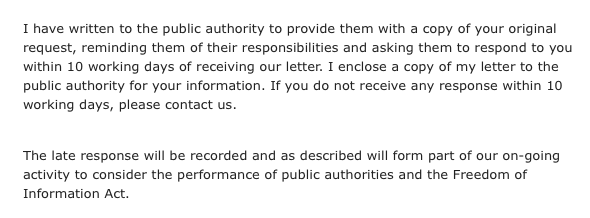
A snippet from the ICO mail confirming that they had chased Blackpool council for a response.
A follow up FOI request — that only received a response when the Information Commissioners Office intervened — showed that Blackpool Council hold no documents relating to the impact on the town of the relegation of the club from the Premiership. This is despite the North and Western Lancashire Chamber of Commerce claiming that Blackpool’s 2010/11 season in the Premier League was “worth about £30m to the local economy”.
It seems strange that the council would not care about such a loss to the economy. With the lack of notes about meetings and lack of research into the club it appears that the council knows nothing.
The curious silence should cause people to ask questions
can a council leader really go to war with one of the town’s most wealthy business families? Rightly or wrongly, his approach is understandable.
It was a bizarre statement from the council but it was also a strange stance from the local newspaper. It is clear that a council can take sides and it is also clear that politicians can choose to tackle wealthy families. They do this to stand up for the people they represent. Perhaps there is a good reason that Blackpool council and the council leader choose to do nothing. That they choose not to stand up for Blackpool fans or the town. That they chose to not even turn up for that protest march to talk with 3000 people concerned about the club and the town.
People on a protest march to Bloomfield Road. Image author’s own.
Maybe the council are more concerned with supporting the Oyston’s housebuilding plans on the edge of town. Perhaps they are scared of legal action from the Oystons. Or simply disagree with the fans and think the issues are unimportant. I’m a fan of Occam’s razor and suspect that this is a cockup rather than a conspiracy but whatever the reason may be, the council and Simon Blackburn are choosing not to be honest and share it with the rest of us. How curious.
Whilst the legal actions and disputes around Blackpool football club continue, the residents of Blackpool and the newspapers should be asking more questions about the curious silence of Blackpool council and its leader.
Allowing citizens to freely access data related to the institutions that govern them is essential to a well-functioning democratic society. It is the first step towards holding leaders to account for failures and wrongdoing.
Jack Hardinges echoed this call recently discussing the upcoming Fifa elections and saying that transparent governments publish open data and Fifa should be no exception. He argued that it:
would not only help a new Fifa president to mark the start of a new era for the organisation but, more importantly, help to bring about the true reform it so desperately needs.
Football fans would do well to heed this message and the need for true reform.
Premier League fans need a change in governance
Following the walkout by 10,000 fans the Telegraph said that “enough is enough, English football should hang its head in shame”. Both the price of a ticket to go to a game and the price of subscription to watch football on television continue to rise. Fans are being priced out of the game.
The clubs hold both the information and the decision making power rather than opening it up to others. Fans can see the effects of ticket and television subscription rises on their own bank balances but they can’t see where the money is going or influence those decisions.
They should be calling both for a price freeze and a change in governance to clubs that are partially or wholly owned by fans.
Blackpool: a club that won’t listen and a council that is closed
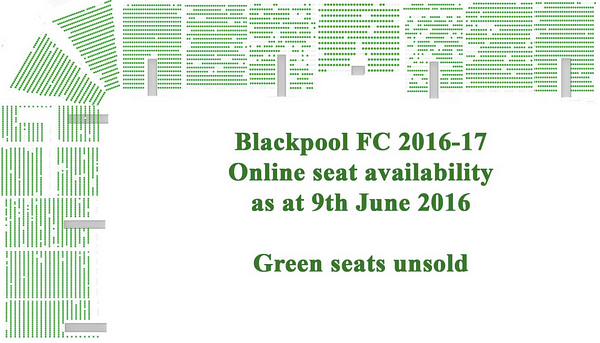
In Lancashire there are other problems. Thousands of Blackpool fans don’t walk out in the middle of matches. They don’t even go in the stadium. They have chosen to boycott their club.
Last month the trust addressed Blackpool’s town council. If they were not concerned about the fans perhaps the fact that local business are complaining and the loss of an estimated £30m a year of extra revenue would catch people’s attention.
Because of the owner’s actions many Blackpool fans will never be able to trust them again but they will also struggle to trust a politician whose first choice is to keep things private rather than to open things up or a politician that is not willing to challenge those with power.
Go and listen to the fans
Football and governments have problems globally, nationally and locally. All of these things are connected. Liverpool, Sepp Blatter, open government and Blackpool. They share common faultlines and the need for change. We need to make sure that fans and voters have both information and the power to use it. Unless we deliver these things we cannot increase trust.
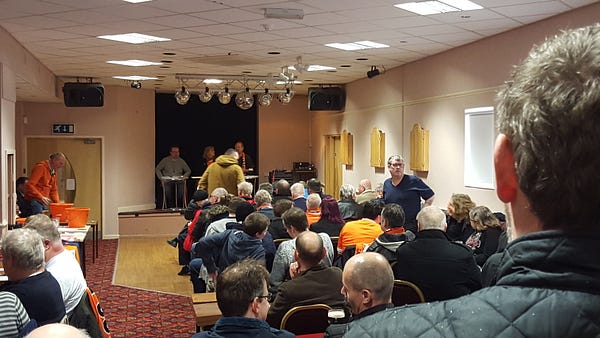
Image by author of the January 2016 Blackpool Supporters Trust meeting.
When I was writing this I kept thinking back to a recent meeting of the Blackpool Supporters Trust. There were over 100 fans passionately debating the future of their football club and a nervous undercurrent in parts of the room due to the fear of legal action. Despite that fear those fans were still there and still fighting for their club and their community.
I didn’t expect any of the club’s staff to be there. They ignore the fans. But as I thought back I remembered that despite the Blackpool fans’ prominent battles over many years there was not a single politician present to listen to them, talk with them and debate some ideas. If politicians want fans to trust them to help tackle football’s problems perhaps that is the first thing that they need to do.
Would it be useful to know whether complaints about welfare payments are rising or falling? Or to understand more about the jobs that our politicians do?
There is data that can help answer both of these questions and many others. Unfortunately it’s not open.
If this data was open we could make more informed decisions about where to target housing support, how to improve our welfare system or who to vote for.
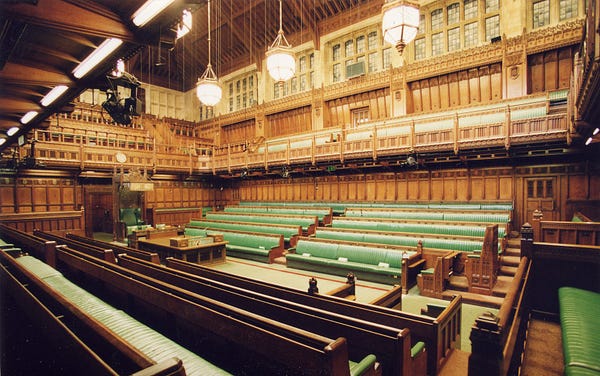
The chamber of the House of Commons. There are no MPs in sight. That might be because their work in the chamber of the House of Commons is only part of the job. Image (c) Parliament. CC BY-NC-ND 2.0
Politicians do casework for the constitutents they represent. They help people by solving problems: an issue with welfare benefits, a difficult immigration claim, a housing problem. Someone might ask a politician for help by writing to them, phoning their office or by going to meet them.
Casework is vital. It is one of the ways that politicians understand the challenges faced by their constituents.
Whilst politicians may have no legal obligation to do casework I suspect that most choose to. It is a little understood but vital part of a politician’s job. Publishing data about this work can help voters understand more about the job that politicians actually do. It will help politicians explain their job, and its challenges, to voters and should help voters make more informed decisions when they choose who they want to represent them.
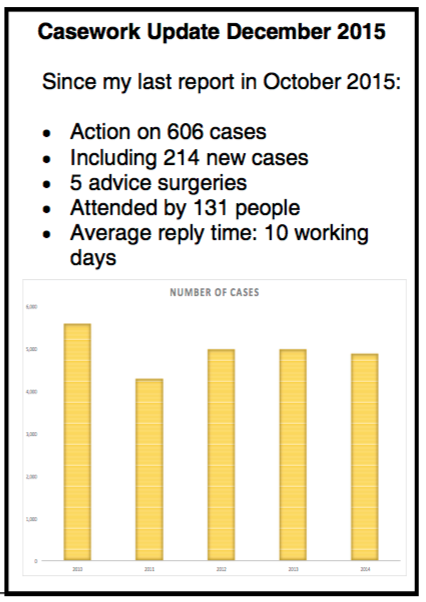
Harriet Harman’s casework statistics, reportedly the largest volume in the UK. (source)
It is suprising how few politicians publish data about their work. Here in the UK Chi Onwurah publishes data and some others, like my own MP, Harriet Harman, publish it but in a form that is not easy to use. Many others, even those who either noworpreviously have had responsibility for open data, publish nothing. Politicians will benefit from going open and learning from the technology, the data protection challenges and the cultural benefits that openness brings. They will benefit from showing voters that their job is different from many people’s expectations.
There are more politicians than those in the House of Commons. Our representatives also work in Edinburgh, Belfast, Cardiff and the hundreds of council chambers and parish councils up and down the country and they also do casework to help their constituents. All of these politicians could publish their casework data, gain the same benefits and help fix the cracks in society. This is a non-partisan issue. If politicians from all parties and all layers of government open up their data in a standard open format then it can be combined to create a more accurate picture.
Making the data open will help fix the cracks
People contact their MP for help when the system has failed. We will all benefit from the root cause of the problem being solved and the system being improved. Publishing this data should lead to targetted action and better services.
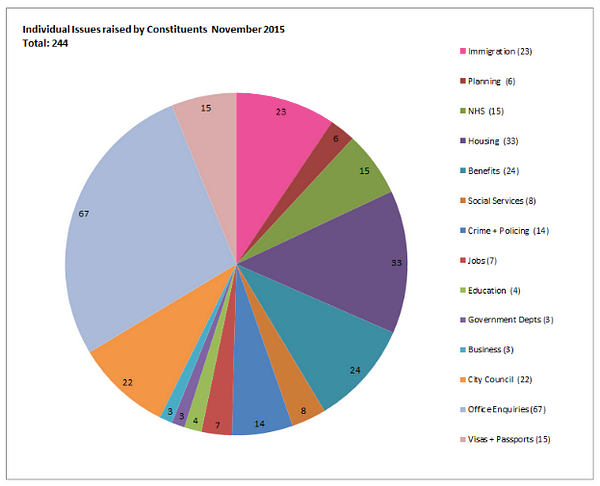
One month of Chi Onwurah’s casework statistics. Are the volumes comparable to other cities? Are the trends up or down? (source)
The data might show general trends or it might point to specific issues that can be resolved. A fall in benefits casework might show that the system is improving whilst a rise in casework on housing in a given location might show that services are being increasingly stretched and that action is required to investigate it and build a solution.
By making data about politicians’ casework open we will make politicians better and help fix some of those cracks in our society.
If you know of other politicians publishing casework data then I’d love to see it. If you think this is a good idea then why don’t you write to the politicians that represent you and ask them to publish some data? If you don’t think it’s a good idea then do tell me why. I’m @peterkwells on twitter 🙂
On Monday I got a little depressed when I saw the job advert for a new Director of Digital for the Labour Party . It looked like a marketing job for yet another centralised political party. But then a couple of things happened to make me hopeful again:
James Darling, aka @abscond, who worked on the Jeremy Corbyn campaign published a great piece on what he learnt during the campaign and some ideas on how to build an open Labour party.
James’ thoughts aligned with many of my own.
I got involved in the Labour Party in 2014 as a volunteer working with Chi Onwurah, her team and a group of volunteers running an open process to review digital government. I’m not a policy wonk by trade, it was my first ever policy work, so it’s over-long and a bit dull in places but I did manage to sneak in a few easter eggs along the way….
I left a couple of thoughts on James’ post based partly on his writing and partly on my own thoughts and the discussions I’ve been having with various Labour and digital democracy people over the last year. Another James (this time James Smith, aka @floppy) suggested that I expand on those comments.
Inclusion
10.5 million UK adults lack the basic digital skills to go online. Lack of basic digital skills is most prevalent in the DE socioeconomic groups. According to the last census 138,000 people in England and Wales do not speak English with 4 million not having English or Welsh as their main language. I could go on with many many more exception cases.
The existing Labour institutions and processes may be old and creaking but, as difficult as they are to understand, and as much as they need to be simplified, they have grown to try and cater for this complexity. The processes are obscure but they do allow lots of people to get involved in and contribute to the party, its policy development and the campaigns it runs. There are accountability checks and balances.
So, whilst we need to modernise and give world class digital tools to people, we also need to be conscious of inclusion and inequality in all its forms.
In one of my own specialist areas, digital inclusion, due to the political choice of austerity the current Government has done little to tackle the issue. The challenge has been left to charities, businesses and volunteers. Even Parliament’s new petition system shows no awareness that so many people are not online.
Online meetings have barriers just like in-person meetings. The Labour Party’s crowdsourcing exercise for PMQs fell into the same design trap as Parliament’s petition system by not recognising that it provided no way for people without digital skills or access to contribute.
But the challenge of inclusion and equality in a party is so much more than digital inclusion, and if we modernise the party we need to recognise those challenges.
I want to see the Labour Party website supporting multiple languages. I want to see people able to contribute ideas and thoughts anonymously. I want to see Labour Party members and volunteers given digital training and helping others to get online. I want to see proper accessibility for disabled people. I want to see routes to contribute to policy that mix online and offline. I want to see a fully inclusive Labour party regardless of gender, sexuality, race, faith, age or skillset. I want to see everyone, no matter how shy or how loud, encouraged and supported to contribute to open policy discussions.
Local government and locally delivered services are important, so are our members, local parties and councillors.
Most people’s experience of the public sector is local. Cleaning up dogshit, emptying bins, cleaning roads these are all things that local government is doing for us every day. It is local government that administers many benefits and that is working with the NHS to integrate health and social care. Local government budgets have been heavily cut by Treasury. This will impact services.
Devolution is now happening with massive transfers of power and responsbility to local regions. Labour runs many of those regions. In some cases extremely well. The gap between the centre of the party and local government has been growing, it’s becoming increasingly urgent that we fix that problem.
In a smarter state many policies can be trialled and rapidly iterated. This approach can’t be used in every case, rapidly iterating foreign policy may be slightly counterproductive…, but there are many public services where these agile delivery and policy development techniques can be used.
If ideas developed through Labour’s open policy discussions can be trialled locally then even when Labour is in opposition in Whitehall it can continue to use the Labour movement to improve people’s lives.
To give some examples. Collaborative ways for teachers to develop lesson plans to reduce effort and give better outcomes for children. Practical ways for communities to tackle broadband issues so more people can get online. Testing whether a basic income gives better results than a new minimum or living wage. Rethinking mass transit. The possibilities are actually quite exciting.
If the policies work then the Labour Party should celebrate the local government success and help other regions to adopt them.
Members should be challenging local government, just as they should be challenging the central party, but an open and modern Labour Party needs to build a culture that can accept these challenges and that is open to ideas. A movement where ideas from members and the centre can be tested locally and where the centre of the party is receptive to ideas that emerge locally and are better than their own.
Open by design
We should go further than publishing data open-by-default. The Labour Party should become open by design.
Openly publishing Labour’s processes: dates of meetings, local groups, voting history of MPs and Councillors, campaigns and candidate elections is absolutely right but as we enter the world of open Labour we need to make conscious decisions about how we use data and when we publish it openly.
The crowdsourcing exercise for PMQs got 40,000 responses. With a well-communicated data usage policy the Labour Party could arrange to publish all of the ideas after PMQs. Or analyse them to discover common themes, perform sentiment analysis, understand whether they were from members (or not) and then publish the results as openly as possible.
There will be times when Labour should choose not to publish data but there was nothing exclusive about this batch. Other parties can gather much the same ideas. The more eyes we have poring over those ideas the more value we can glean from it and the better understanding we have of what people want. We can lead by example and challenge Government to do the same with the ideas it gathers from the public sector.
Unfortunately the PMQs page did not even have a basic privacy policy, let alone a data usage policy. That should not happen again. We need to clearly tell people how we will use their data and ideas.
Labour needs to be open by design.
Work together to build a better politics
Finally when building an open and digital party we need to be careful not to imagine that we are creating a ‘minimum viable party’ and iterating from there. The Labour Party already exists and parts of it work pretty well.
Jeremy Corbyn and Jon Trickett used open policy to build the Northern Futures policy document. Angela Eagle and her team ran a massive open policy exercise, YourBritain, during the last Parliament. Stella Creasy helped people start and run campaigns during her deputy leadership run. Chi Onwurah publishes open data on her constituency visits and ran an open process for the 2014 digital government review.
There are party members, councils and councillors up and down the country who are doing similarly great stuff. Camden Council have openly shared their work on digital transformation whilst Theo Blackwell, the councillor in charge, engaged his citzens a series of articles on how the council was tackling its budget cuts. Elsewhere Newcastle Council run participatory budget exercises. There are vibrant communities of Labour thinkers and doers running campaigns, writing up ideas and getting stuff done up and down the country.
Whilst these are all good they do need to improve. Better use of digital design and modern technology can improve things massively but we need to work with people. Seeing them and their communities as building blocks that will help form an open Labour party.
As well as building some new services from scratch we should also research where bits of open Labour already exist. Understand who the communities are, what needs they and the people they represent have, what lessons they have learned and then collaborate with them to iterate and improve and iterate and improve and iterate and improve.
I’m excited about an open and modern Labour Party. It’s a cultural change, not a technology one, but it’s a change that the party can make.
A party that uses modern technology and is designed to be inclusive and accountable. One that thinks and innovates locally and rapidly. A party that is open by design and that works together to build a better politics.
If we all recognise the opportunity and work together to grab it we can both build and be part of this new kind of party. It will make Labour more responsive to people’s needs and make the country a better place for everyone.
Just like James I recognise the opportunity, I hope you do too.
About me
Hello. This is the personal website of Peter K Wells. I do politics, policy and delivery to try to make data and technology benefit everyone. I also do bad jokes and music references.
This website stores cookies on your computer. These cookies are used to provide a more personalized experience and to track your whereabouts around our website in compliance with the European General Data Protection Regulation. If you decide to to opt-out of any future tracking, a cookie will be setup in your browser to remember this choice for one year.