Tag: research

Experimenting with using Replit to build a postal address validator

In some spare time, and with some spare cash for the fees…, I’ve been experimenting with some AI-enabled code generators recently.

Here’s some things I learnt from using Replit to build two tools, a UK postal address validator, and a French postal address validator.
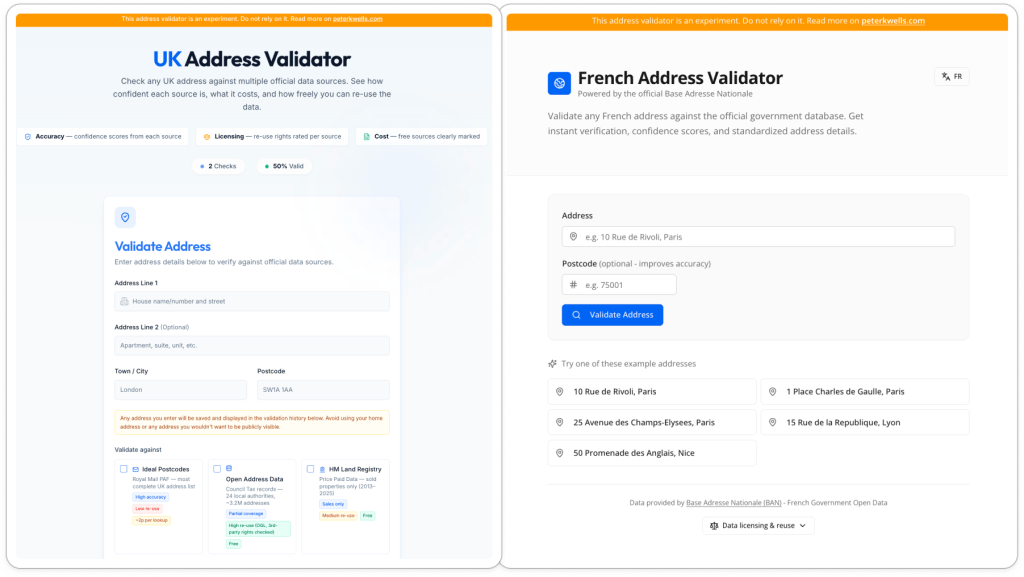
The two address validators.

Both of the experimental tools I built are publicly available – and are on github, here and here – but do be aware that they are experiments. They are not guaranteed to be either reliably useful or legal. I’ve not looked at the code and have particular concerns over how the UK version handles copyright.

With those reservations in mind, here’s some thoughts I had after using Replit to build those two tools:

  • the experience of building the tools was pretty easy, and at times astonishing,
  • but Replit didn’t give me confidence that the tools would be reliable and
  • it neither checked, or encouraged me to check, whether what I was doing was legal.
  • It was a heck of a lot easier to build an address validator for France than the UK.

The experience of building the two apps was pretty easy, and at times astonishing

I am *not* a software engineer but I can do some coding, understand software engineering practices, and have some experience working with public sector data like addresses. Within that context the tool development experience was pretty straightforward and at times astonishing to my tiny mind. 

I could both use the chatbot-like interface to tweak small things – like content on the front-end – and large things – like working out how to download and make use of specific address data sources that it was pointed at. That latter bit felt astonishing.
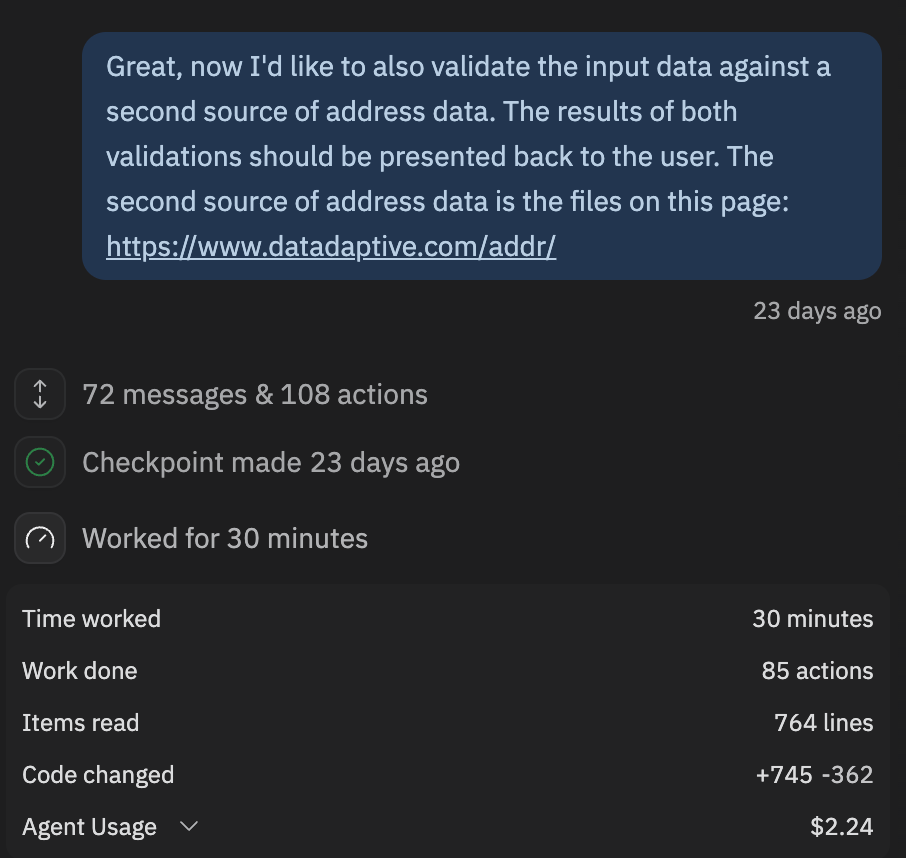
Replit taking on the task of integrating data from Datadaptive 

At one point I needed to go and create an API key, but didn’t feel the need to go and look under the hood at the code or database.

But Replit didn’t give me confidence that the tools would be reliable

At the start of the build process for the UK address validator Replit said it had built something that worked, but it obviously did not. It took three cycles of me saying things like “that doesn’t work, look harder” before the tool started working and even then it had not done what it had been asked to do.
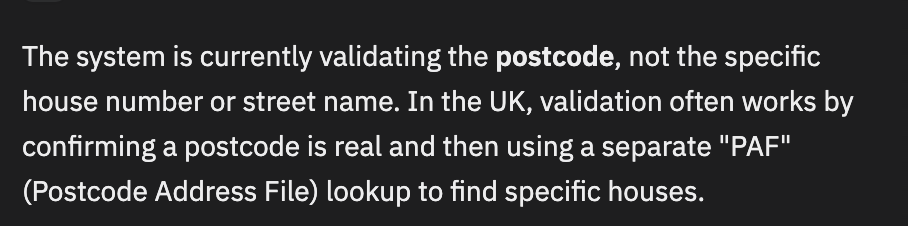
Replit had been told to build an address validator, but instead it built a postcode validator

After that initial confusion Replit reported that it was running more tests, but it never showed the results. I had to specifically ask it to show test results before it reported that it was loading a testing skill and running some tests.

Despite this Replit had been happy to publish the app with no indication either to myself or to potential end users of the app that it might not be reliable.

Replit might give the feeling, but not the reality, of reliability. They should try to fix that.

And Replit neither checked, or encouraged me to check, whether what I was doing was legal

Replit struggled to understand or communicate data protection risks, which are important in France, or copyright risks, which are important in the UK.

It happily built functionality to collect and republish the addresses that people validated using the tool without telling me this should be made clearly visible to users. Eek. Don’t test it with your home address!

When I suggested Replit should use some public sector data containing addresses that was released under the UK’s OGL (Open Government Licence) it told me that using the data was fully permitted. This misses that the UK OGL contains exemptions both for personal data and for third party rights. 

This is an incomplete summary of the legal position. The UK OGL has a set of exemptions that are important to understand.

There have been multiple cases in the UK where people have been threatened with legal action over infringements of copyright when using address data. Replit had even suggested I use a service – https://getaddress.io – that recently closed because it lost a court case over third party rights in address data. Silly Replit.

To look deeper into copyright complications Replit was told to look at the UK Land Registry’s Price Paid data. This data is published under the UK OGL and has an explicit warning that the Royal Mail and Ordnance Survey reserve some rights.

This time Replit communicated the restrictions but suggested they could be worked around by showing the residential property price when validating the address. I don’t think the courts would agree with this interpretation.  

The purpose of the tool was to validate addresses, not to provide residential property price information.

After a bit of prompting I got Replit to start communicating the various data protection and copyright risks to potential users of my experiment, but it did leave me wondering.

  • How many other Replit users are happily producing apps that unhappily break the law with risks to themselves and other people? 
  • Whether as well as the law potentially needing to become more machine-readable that these new coding tools need to get better at communicating legal requirements and risks to the people that use them?
  • And should governments play a role in making that happen?

After all, the increased ease of using this wave of coding tools seems likely to increase the number of people who produce software, whether it be in tools like Replit or in real-time when using an AI agent. I suspect it will be increasingly important that AI-generated software and the humans that are responsible for it follow the law. 

It was a lot easier to build a French address validator than a UK one

Finally, there was just one more thought. One that is likely to be obvious for anyone who works with UK geospatial data.

It took me several hours of to and fro to produce a useful looking UK address validator that did not completely rely on expensive licences and that could communicate to users the legal requirements that came with reusing the data. And I already knew quite a bit about how to do that.

It took me just 10 minutes to do the same for France, and that came with considerably less risk.

This is partly because the French government has already put in the operational and technical work to build an open address database and provide an API that tools like Replit can use. But it is also because the French government has put in the legal and financial work to ensure that they could provide this data for free and under an open licence which is more permissive than the UK’s OGL. The French government – and others – have done this for many other public sector datasets too.

If we are moving to a world where AI-enabled coding tools, like Replit, are more widely used then the work that countries like France have done could prove invaluable in helping many more people produce software tools that work, are reliable and are legally safe to use. The UK has some catching up to do.

The emotional weight of digital proofs

My Dad died recently. I went to the registration office in the local town hall to officially register his death.

The registrar was polite, caring, and thoughtful.

They also said something that particularly struck home and made me think about the emotional weight of digital proofs. 

A typical registration office in the UK. Prompt: “an office within a UK town hall, the office contains a single desk, the town hall was built in the 19th century, the office has wood panelling, the desk has an old computer on it”, DALL-E 2

Death certificates are physical proofs

I live in the UK where you need a physical copy of a death certificate to do many of the necessary bits of administration, like closing bank accounts, canceling shop loyalty cards, transferring pensions, etcetera ectetera etcetera.

These physical copies are provided by the registrar as a proof of death. This proof gets mailed to organisations who need to be notified of the death.

Like many people my parents are disorganised. We did not know how many organisations would need to know.

So, as a family, we agreed to get lots of physical death certificates. We could then mail out the proofs as we discovered a need for them.

A proof of death can be upsetting, many years after the event

The registrar advised against this as some people had been upset by physical copies of death certificates. Not only in the period immediately after the death, but in the following months and years.

The physical copies of the death certificates are returned to people. They get put into boxes and piles of paperwork, alongside old school records, birth and marriage certificates. 

The registrar told me that some families said they could see or feel the presence of these death certificates.

They would come across them unexpectedly, or even just think about a box full of certificates, and get unhelpfully reminded of the complicated set of emotions that accompany any death. A larger number of copies increased the chance of this unhelpful reminder.

Ten pieces of paper may not weigh much physically, but they can carry a large emotional weight. 

Prompt: “a pile of paper, sitting in a loft, digital art”, Dall-E 2

More people and organisations are using digital proofs

Recently I wrapped up a bit of work with Projects by IF that included building digital proofs responsibly and by design.

A digital proof is an equivalent of a physical certificate. Rather than being physically shared a digital proof can be electronically shared between people and organisations.

Digital proofs can be designed so that both the proof and the act of sharing it are trustworthy. For example to verify that the certificate has not been altered, or that only the minimal amount of information is shared.

A well-known example of a digital proof is the proof of Covid vaccination that people who travelled internationally have needed to show for the last few years, but there are many others.

Some countries, issue digital proofs of immigration status, others have digital proofs of driving licences, and so on. These schemes say that they will modernise services and make it easier for people to get things done.

Many of these schemes have been controversial. For example, when the introduction of digital proofs is used to extend the number of services where people need to provide a proof before they can use it, or when the use of physical proofs is reduced in favour of digital proofs.

But it seems very likely they will become more common.

Digital proofs are now being built into smartphone operating systems – such as in Apple’s digital wallet. Lots of the initial focus is on credit cards, but both businesses and countries are exploring how to use them to share data and how to move a range of legal proofs into the digital world.

Apple Pay within Apple Wallet, Apple

What will the emotional weight of digital proofs be?

There are lots of long-term implications of building digital proofs.

From the controversies we see in the current implementations, issues of privacy and control, through to a growing reliance on weakly regulated digital infrastructure – like smartphone operating systems.

But what the registrar said about my dad’s death certificates made me think more about the emotional weight of those digital proofs. 

  • What will it feel like to carry a range of digital proofs with us? And into all of the places where we take our smartphones?
  • How will it vary by the type of digital proof? A school record or proof of age may feel quite different, to a vaccination record, an immigration status, or the proof of death of a relative.
  • Will the accumulation of proofs matter to people? To reduce the risk of unpleasant feelings will we need different places to store proofs that we need regularly, like a driving licence, to places where we store proofs that we rarely need?
  • How will the feelings and needs vary for different people and at different moments in their lives?

Some of these questions are things that will be researched and designed in particular services, others are ones that we can learn about from the people who already have to carry them, but some are questions that will only be answered in the aggregate, and over time.

As more digital proofs get created, as more people store them in their phones, and as our smartphones become an extension of that box in the loft containing information about ourselves and other family members.

Just like the paper-based death certificates I talked about with the registrar, digital proofs will not weigh much physically but their emotional weight could be much bigger.

prompt: a dusty box in a dusty loft, on top of the box is a smartphone, the smartphone is pristine and shiny, DALLE-2

© 2026

Theme by Anders NorenUp ↑

This website stores cookies on your computer. These cookies are used to provide a more personalized experience and to track your whereabouts around our website in compliance with the European General Data Protection Regulation. If you decide to to opt-out of any future tracking, a cookie will be setup in your browser to remember this choice for one year.

Accept or Deny