Five years ago I published a post with a map of open address data across Europe. There was a stark contrast between most of Europe, lit up by millions of dots of addresses, and the UK with nothing.
Since then the situation has gotten worse. Take a look at this new map that was produced when I used AI coding tools to build an address validation service for Western Europe. The UK is red and in the most restricted tier.
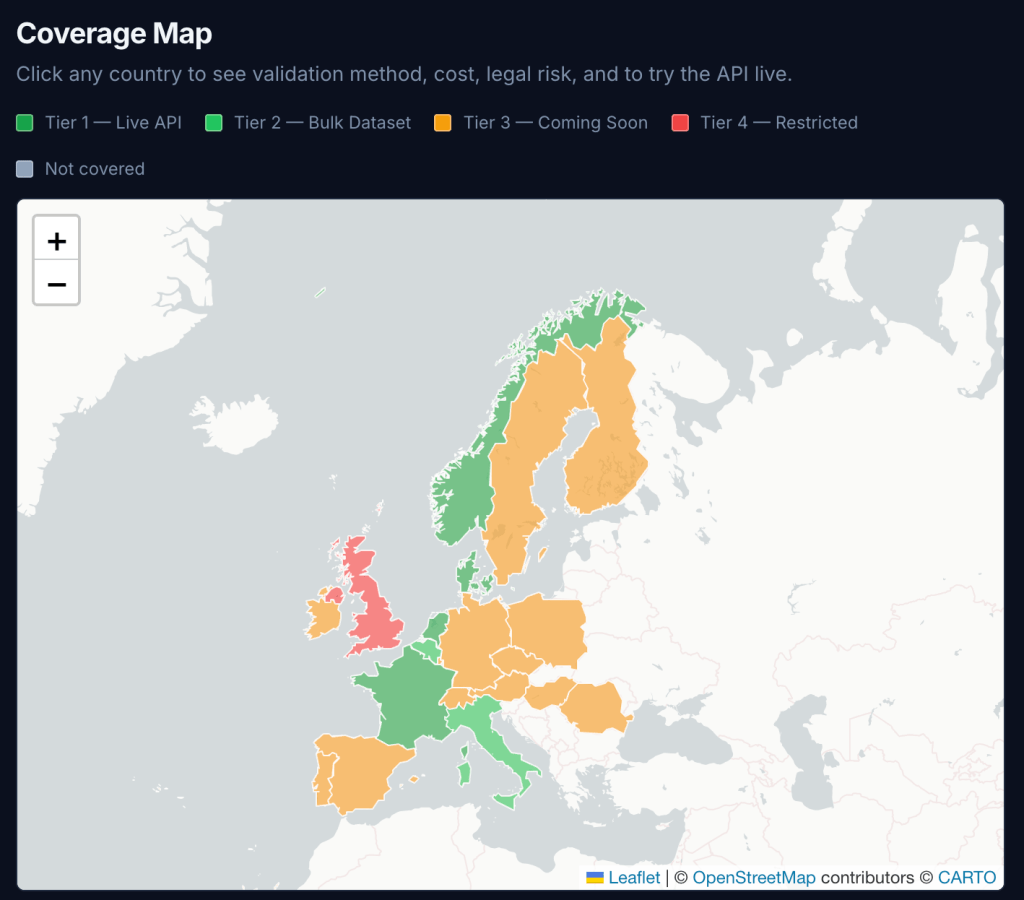
The map is part of a simple service that can check if an address, such as a house or business office, exists in the official records of addresses published by governments. The type of function that exists inside thousands of products from pizza delivery firms, to banks, to voter registration services.
The service was built in a couple of hours using a couple of AI coding tools with the lowest tier of subscription. It works. Feel free to play with it.
I built it as part of some work exploring how product development is changing due to AI. One way is that over the next few years more products will be developed with more support from AI tools. If the efforts to put agentic AI into consumer products are successful then the change will become even more pronounced and more visible to users.
Software is obviously not the only part of product development but countries where it is easy to use AI coding tools to build things will have a leg up in the future. If they use authoritative government data, like maps and addresses, then products will work better and be used by more people.
Unfortunately, in the UK it was hard to use the coding tools to legally use the UK government’s authoritative list of addresses.
Address data is not sensitive, it is not data about individuals and is unaffected by data protection law. Local authorities issue new addresses and have a legal duty to maintain lists for their areas. This data is incredibly useful for many of the products we all use every day. Sounds like the kind of data that governments should publish as a public service.
But the UK government has tangled addresses, and other kinds of geospatial data produced by the state, up in a horrendous mess of copyright issues, partial privatisations, and legacy business models that reduce the value this data could create. Previous governments promised to unlock the hidden value of geospatial data through the Geospatial Commission, but the commission failed to tackle entrenched interests.
This tangled mess is still growing. The UK government’s biggest geospatial organisation, Ordnance Survey, recently claimed that 57 UK local authorities incorrectly provided permission to reuse data they held. The OS has provided little evidence for this claim, but the case contributed to the AI coding tools placing UK address data into a high risk category.

By contrast, other countries have spent the last few years putting in place the organisational capabilities to openly publish national sets of geospatial data, with legislation to provide confidence that it will be legally safe to use and continue to be maintained to a high quality.
That’s why the map shows the tool working in most of Europe, but not the UK.
There are forecasts of significant economic value from the ongoing work across Europe on high value public data. The type of economic value that successive UK governments have said they want and are focussing on data and AI to help achieve.
The current UK government has a new set of data initiatives with familiar goals to “drive better public services and economic growth”. If these initiatives are going to be successful they will need to listen to lessons from the past and tackle the legacy business models that are holding the UK back.