Tag: accountability

Designing AI for accountability in public services

Metropolitan Police Station, Harrow Road, by whatlep via Wikimedia Commons

A police officer from Derbyshire in the UK is under criminal investigation over their use of AI. Initial reports said there was:

alleged use of AI systems by an officer to create evidential material in a number of cases

Later reports provided a bit more detail, saying that the officer gave:

biased prompts to an AI chatbot” to “generate paperwork slanted towards outcomes that the police wanted”.

The type of behaviour alleged in this case is not new and is not always alleged.

But this is not just another story of police misbehaviour or AI misuse, it’s a reminder that AI tools in public services need to be designed for accountability, not just productivity or efficiency.

Why accountability exists

Significant miscarriages of justice over the years have caused innocent people to be jailed, guilty people to go free, and victims to be let down. Two UK police forces have been found to be institutionally racist. This behaviour harmed the people they serve and reduced trust in the police and the broader justice system.

Legislation, like PACE and CPIA, along with professional standards for police officers, have been introduced and strengthened over the years. These types of legislation and standards are not perfect – nothing is – but they exist to make criminal justice processes fairer, reduce opportunities for abuse, and increase the chance of accountability when standards are not met.

There are similar pieces of governance across both the broader justice system, for example for barristers, and other types of services. Particularly public services where both the power imbalance between individuals and the state and the price of failure can be enormous.

Most recently, the UK’s Hillsborough Law (or, more precisely, the Public Office (Accountability) Bill) is expected to introduce a statutory duty of candour for public authorities and officials. This aims to ensure that organisations are open, transparent and accountable when things go wrong.

As the UK’s public services face ever-increasing pressure to redesign public services with AI, it’s important that the goals of this kind of governance continue to be met.

Designing AI tools for accountability

This is not only the responsibility of the professionals who use these AI tools, it is also the responsibility of the people who deliver them

So, as well as understanding their users and the purpose of their service, teams need to understand the surrounding governance and design their tools to support, rather than undermine, those safeguards.

For digital teams that means working closely with operational delivery teams to design both AI tools and working processes together. Designing tools that make it easier for users to meet their professional responsibilities. Ensuring there is meaningful and appropriate human sign-off on important decisions. Versioning models and designs, and recording which versions were used for which case. Putting in place ongoing monitoring to recognise opportunities for improvement and correct any issues that may be caused by the tool. 

It will also mean working with teams and regulators that enforce those professional practices. Tools and processes should automatically record enough evidence of how outputs were produced and decisions were made to allow people to verify that professional standards were followed and identify when they were not. Those records need to be tamper-evident, so that they can be reliably used in courts as evidence to either hold people accountable or to demonstrate that tools and people worked and acted appropriately.

Regulating systemic risks

Regulators can help delivery teams by setting clear expectations and providing practical guidance for how to design new AI tools and monitor their usage, but they also need to address the new systemic risks that AI tools introduce.

We already recognise that individual professionals, like police officers, can be biased or act improperly. AI introduces new systemic risks, such as the biases that can be inherent in AI models, flaws in AI tool design, or biases and organisational incentives in the people and organisations who deliver AI tools. 

AI tools can be deployed across entire organisations, so flaws in their design or implementation can affect many more cases than the actions of a single individual. One lesson from the UK’s Post Office scandal is that when poor technology is deployed at scale and misused by organisations then many people can be significantly harmed.

We need mechanisms to detect similar failures early and hold organisations accountable when they occur.

Making institutions more accountable

Because humans can behave in ways that harm others, societies developed governance mechanisms to hold professionals and institutions accountable for their actions.

The success of AI in public services should ultimately be judged not just by efficiency gains, but also by whether it makes those institutions more accountable to the people they serve.

The GOV.UK app should take more responsibility

The UK’s Government Digital Service (GDS) launched a Beta version of its gov.uk app recently.

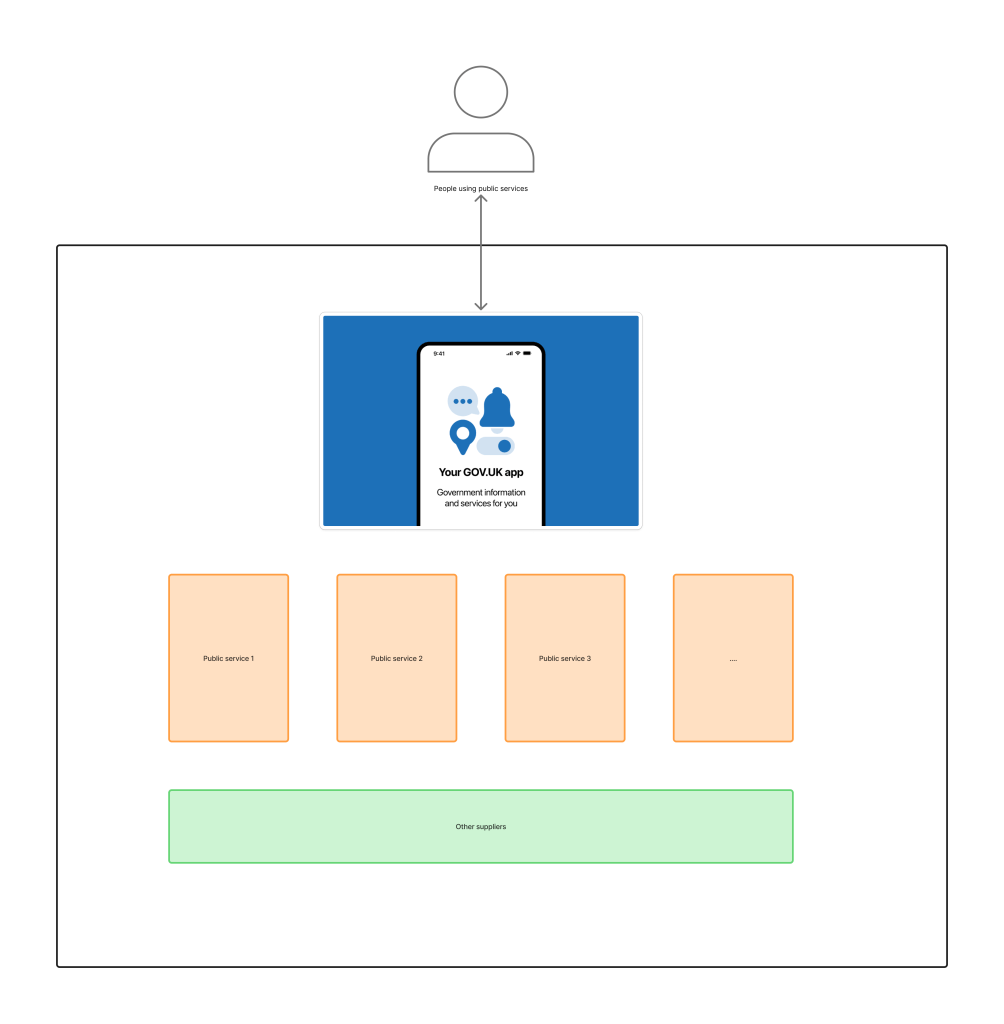
The app is intended to provide another way to access public services alongside other places like job centres, town halls, schools, telephone call centres and the gov.uk website.

Ideally people will be able to choose what route to use based on what works for them, the friends and family they help to access public services, and the particular services they need at the time they need them.

In the circles I work in there’s been lots of discussion of the app

One thing I’ve not seen mentioned is that the app tries to avoid legal responsibility for providing a decent public service to people. It even recommends that people take separate professional advice rather than relying on the services and information provided by the GOV.UK app.

It would improve public services across the sector if the app took more responsibility and encouraged other public services to do the same.

Responsibility by Nick Youngson CC BY-SA 3.0 Alpha Stock Images

The disclaimer section reads like a commercial service, not a public service

The app has a set of terms and conditions that reads like something you’d see in a commercial service, not a public service.

The disclaimer section says:

we do not provide any express or implied guarantees, conditions or warranties that the information available via the GOV.UK app will be:

+ suitable for your individual requirements 
+ available 
+ current
+ accurate

So, the government is unwilling to say that public service information provided by the government is accurate?

We do not publish advice on the GOV.UK app. You should get professional or specialist advice before doing anything on the basis of the content [published on the app].

So, if I used the app to look for government advice on how to get a UK driving licence then I should also speak with a lawyer before applying to the government? 

we’re not liable for any loss or damage that may come from using the GOV.UK app. This includes, but is not limited to, the loss of your:

+ income or revenue
+ salary, benefits or other payments
+ business
..[there’s more]

So, if I used the app to sort out something to do with my parent’s pension, there was a mistake in the app and my parent lost their pension then the government would not help me or them out?

Seriously?

How do things like this happen?

There’s a few things that could have led to this kind of disclaimer being added to the app. For example:

GDS might worry about taking responsibility for other public sector organisations. Even in its beta stage the app includes bits of public services provided by multiple public sector organisations. Perhaps GDS didn’t want to be held responsible for other organisation’s mistakes? Or even to be responsible for working out who is responsible? But part of the app’s job is to help people understand and deal with the many public sector organisations within it. Not to try to shift responsibility around and leave it to the public to work out how to hold organisations who fail them accountable for those failures.

Traditionally gov.uk has focussed on information. The proposition says that gov.uk does not offer advice on what the user should do, unless users need advice in order to complete their task. The app is due to have a chatbot, called GOV.UK Chat, added to it and chatbots can both add more complex supply chains and provide information in ways that more users will experience as advice. GDS may also be nervous about AI chatbots’ susceptibility to technical malfunctions, like ‘hallucinations’. But, let’s be honest, the point when information becomes advice has never been a clear one and as GDS’s AI playbook says “Ultimately, responsibility for any output or decision made or supported by an AI system always rests with the public organisation”. Sound advice.

When does information become advice?

GDS aren’t used to delivering apps and apps often have terms and conditions. GDS’s One Login app has a similarly strong disclaimer and says there is no liability for “loss or damage arising from an inability to access or use GOV.UK One Login“. Hardly a reassuring statement when millions of people will need to use One Login to get access to things like tax payments, state pensions, disability and unemployment benefits. One Login has already had at least one serious security vulnerability. Who will be liable if, or when, a hacker takes advantage of the next one?

Lawyers gonna be lawyers. It’s easy to imagine some lawyers recommending these kinds of terms and conditions, and people managing the app deciding they need to follow that advice rather than challenge it. If you look then you find that since 2013 gov.uk has also had a set of terms and conditions that don’t guarantee the government will provide accurate information and tell people to read the terms and conditions of all the public services they access through gov.uk. It’s important to support people to understand how public services work, but you can’t do that in a set of legal terms and conditions. Yuck.

The app should encourage the public sector to take more responsibility

GDS is not providing a commercial service that can hide behind contracts and lengthy terms and conditions. In the private sector you find backstop compensation schemes – like the Financial Services Compensation Scheme – when organisations fail. There is no equivalent for public services and, to put it politely, the UK government does not have a great record of running compensation schemes for its failures.

Instead the backstop for responsibility is ultimately things like administrative law and politics.

Would the app’s Ministers really want to stand up in Parliament and say that the app does not provide accurate information? That people should pay for professional advice after reading advice provided by the government? That the government isn’t liable for its own mistakes?

Not quite the vision being sold by Peter Kyle, and DSIT’s blueprint for a modern government, of more public services that work across institutional boundaries and do the hard work to make things simpler for people.

So, if government lawyers are the ones recommending contractual terms and conditions then both GDS team and its Ministers should say no.

By taking clear, legal responsibility at the app level, and tidying up responsibility on gov.uk too…, GDS can encourage other public sector organisations and their suppliers to take responsibility for providing better public services by making clear their actual legal and democratic responsibilities and ensuring they have clear liability before their services are made available.

The GOV.UK app can shape an ecosystem of other services and suppliers to take responsibility for providing better public services to people.

Given the government’s push on using more automation and technology clear responsibilities and liabilities will only become more important. It might reduce the chance of the government having to create more compensation schemes that can cost billions of pounds

A culture of responsibility across the public sector would mean that more public services work for people, and fewer public services that fail the people they serve.

© 2026

Theme by Anders NorenUp ↑

This website stores cookies on your computer. These cookies are used to provide a more personalized experience and to track your whereabouts around our website in compliance with the European General Data Protection Regulation. If you decide to to opt-out of any future tracking, a cookie will be setup in your browser to remember this choice for one year.

Accept or Deny