Tag: Digital Government

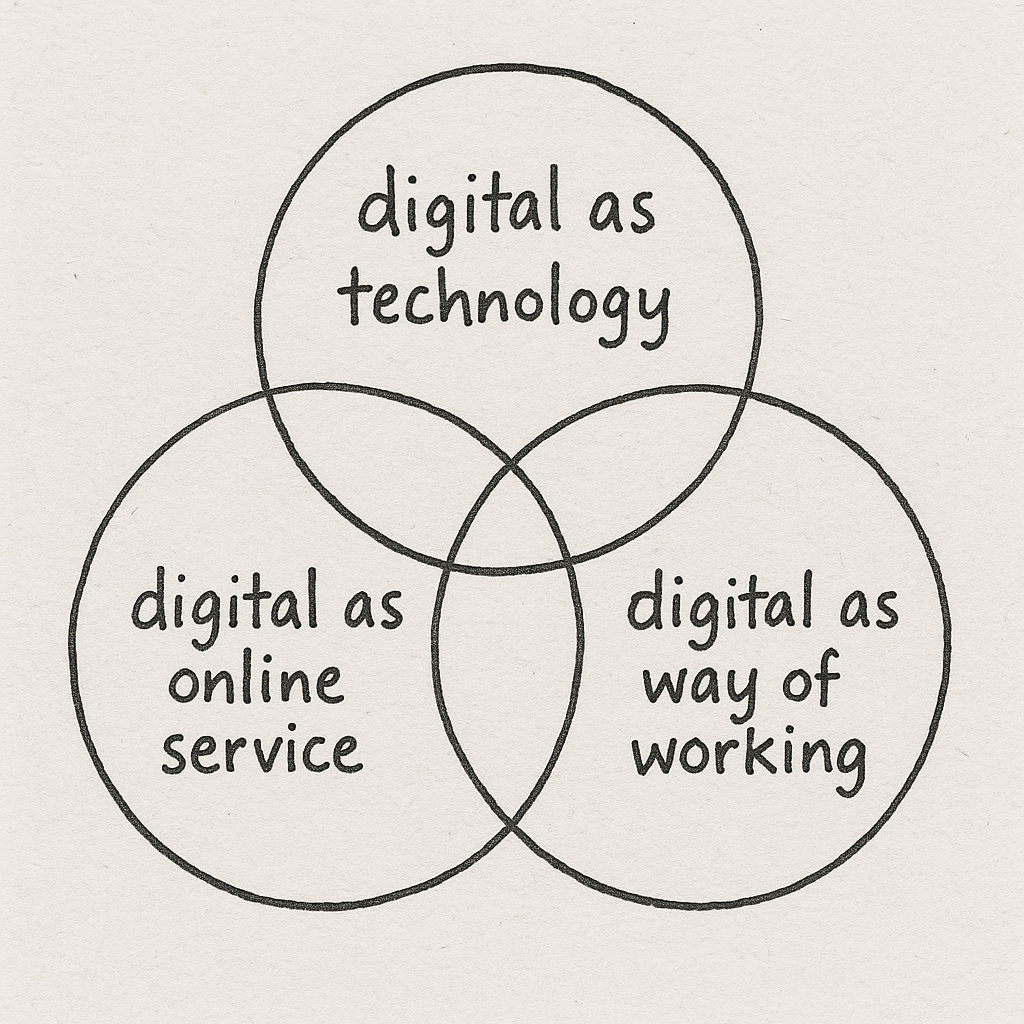
The three definitions of digital in UK digital government

When I work within teams, talk with people and read policy and strategy documents, particularly around the UK public sector, I find it useful to quickly align on what people mean by some words so that we can get stuff done. “Digital” is one of those words. 

Many words have multiple meanings. Words can gain and lose those meanings over time as us humans do one of our human things and try to communicate concepts to each other.

Originally a Latin word for fingers and toes, “digital” became part of the phrase “digital computer” when electronic computers were invented in the 20th century. 

But digital has acquired several more meanings in the last few decades.

When I ask people what they mean by it there’s different definitions that I regularly hear in the world of digital government policy and public services:

  • Digital as a type of technology
  • Digital as an online service
  • Digital as a way of working 
Image drawn by chatGPT as my handwriting is mostly illegible, my drawing is worse and I didn’t want an image that looked too formal. (NB: like most Venn diagrams, the centre is not necessarily a thing to aim for…)

Sometimes these meanings get combined, which can be confusing. I find that disentangling them is useful.

Obviously ‘digital’ is not the only word which gets tangled up in this way, but given its importance it’s a useful one to align on.

1. Digital as a type of technology

Digital can be used to describe any technology related to electronic computers.

This was part of what was happening with the term ‘digital computer’. The original ‘computers’ were humans who added up numbers, it was the addition of technology that made the original computers ‘digital’.

A roomful of human ‘computers’, courtesy of the US Library of Congress. Note how they are all female. Programmed Inequality is a good read on the history of women and digital computers in the UK.

You see this definition used in terms like the ‘digital revolution’ – to indicate the changes happening as the world adapts to computers, internet and the web – or ‘digital infrastructure’ to talk about telecoms infrastructure and data centres. 

Implicitly this definition can exclude other forms of technology like physical machinery, roads, wheels, and paper.

2. Digital as an online service

The second usage is digital to mean online services that are only available over the internet or web. It might even be something that only works on a smartphone, like an app. I’m not sure how or why we’ve ended up calling these ‘digital services’ rather than ‘online services’.

Facebook is often called a “digital service” or Google a “digital company”. The UK has a Digital Regulation Cooperation Forum (DRCF) whose purpose is to “deliver a coherent approach to digital regulation for the benefit of people and businesses online” for regulating these kinds of services and companies.

While Facebook/Meta and Google obviously exist in the physical world – just think about one of their many offices, data centres, undersea cables or the tens of thousands of people who work to moderate content – when people talk about their ‘digital services’ they tend to think about the bits that are only visible online.

If you work in similar places to me you don’t need another image of a ‘digital service’, so here’s a GIF of a scary rabbit chasing a cat instead

Similarly the term ‘digital service’ can be used in digital government circles to mean the bits of a public service that are interacted with over the internet and web.

An online service like this is rarely the entirety of a public service – there are many reasons why governments can’t just build websites and apps – but they have become an increasingly important and visible part of public services.

I say rarely, because sometimes governments can reasonably decide that a service will only be accessed online, but there are limits. For example it might be appropriate to require large businesses to pay taxes online but it would be inappropriate to require individuals to pay taxes online unless there was a larger service that provided support to enable everyone to do it.

3. Digital as a way of working

Third, there’s digital as a way of working.

Tom Loosemore of Public Digital talks about digital as ‘applying the culture, processes, business models and technologies of the internet-era’ which is a pretty good description.

No, I’m not going to try and further define digital as a way of working. So, courtesy of Wikimedia, here’s a picture of a roughly organised wall of post-it notes as a way of getting it across.

It emphasises things that are not only technology and indicates that ‘digital as a way of working’ can be used to improve not only ‘digital as online services’ but also a wider set of services and institutions.

Some people take this kind of definition further to talk about who or what ‘digital’ is for. For example Public Digital’s description talks about using digital ways of working “to respond to people’s raised expectations”.  I don’t think everyone has raised expectations.

I tend to encourage teams to decide their purpose in their context.

If the context is delivering general public services then the purpose might be “to meet everyone’s needs”, if the context is tackling issues caused by lack of trust then the purpose might be “to deliver trustworthy services”, etcetera, etcetera, etc.

The definitions can get combined

Finally, it’s important to be aware that many people combine the definitions. 

Perhaps they’re using digital ways of working and digital technologies to deliver a digital service. Or perhaps it’s a policy or strategy paper where someone has liberally sprinkled the word digital into all sorts of places in the hope it will make the organisation look modern. Perhaps they’ve invented a wholly new definition, *gulp*.

This young man likes digital

Sometimes I even find people that don’t even realise that they’re limiting the potential usefulness of their modern ways of working by only applying it to computer technologies and only to bits of services that are visible online on the web and internet. That they’ve ended up accidentally prioritising a subset of the population and the method they need to use to access public services.

So, separating out the different meanings of the word digital can reduce confusion and enable teams to meet a larger set of needs.

Digital is not the only word that has multiple meanings

And finally. Obviously digital is not the only word that can be loaded with multiple meanings. Just try asking people what they mean by terms like ‘AI’, ‘product”, ‘policy’, ‘personalisation’ or ‘digital identity’ if you really want to have my kind of ‘fun’.

But ‘digital’ is one of the key ones and there’s at least three definitions regularly in use. Understanding what other people mean by it and aligning on a common meaning can be a useful thing to do.
Let’s make GOV.UK Pay support cash

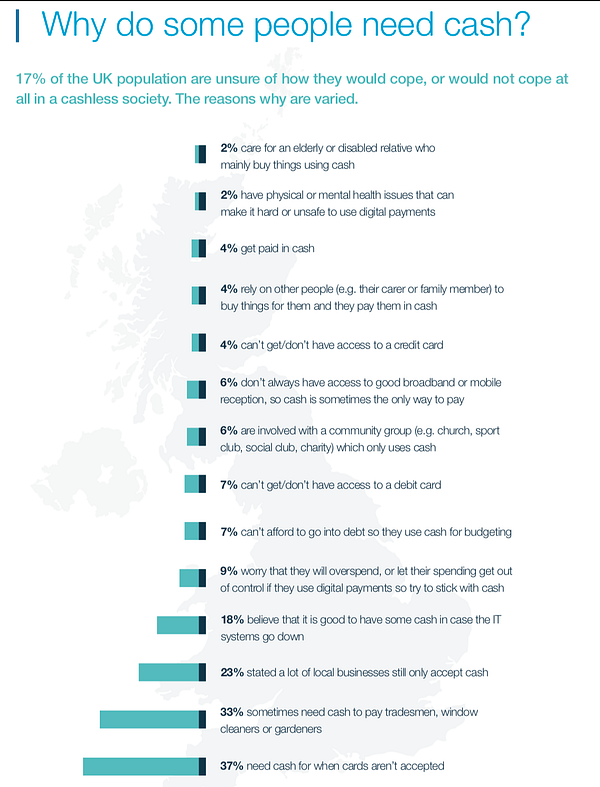
17% of the UK’s population — about 8 million adults — would struggle in a cashless society. To meet the needs of everyone it is essential both that public services give people the opportunity to pay in cash and that government help private and third sector services to take cash payments. Government can play a role in helping make this happen by broadening the scope of its payments platform and team, GOV.UK Pay, to support cash.

The need for access to cash

Cash use has declined in recent years. It has become ever easier for most of us to buy things using other methods — for example credit and debit cards, direct debits, or through online payment services like Paypal or Apple Pay.

In 2017 direct debits overtook cash as a form of payment. These other payment methods are more convenient both for the people making payments and for people taking them — there is no pesky cash to count and send to the bank at the end of the day. Some call for a rapid transition to a ‘“cashless society” where cash would not be used. Left unchecked it seems likely that it will become ever harder to use cash as shops, buses, taxis, pubs and even public services favour these new payment methods as it saves them money.

image from the Ceeney Review

In 2018 an independent review of access to cash, the “Ceeney Review” was set up in the UK. It published its final report in March 2019.

The review said that 17% of the UK’s population — about 8 million adults — would struggle in a cashless society. The reasons are complex. The report talks about multiple reasons including lack of access to the internet (particularly in rural areas), people without bank accounts, physical and mental health, financial difficulties, or fear that the computers that run the other payment methods will break.

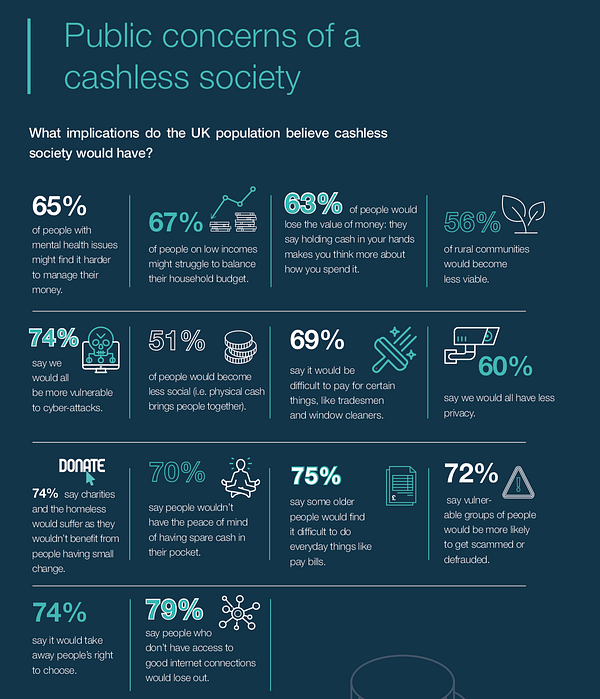
The review found that 51% of consumers felt it would be a good idea to change the law so that all shops and services had to accept cash.

The factor with the strongest correlation to use of cash was not old age, but poverty. While a cashless society might be convenient for many it would be a struggle for some of the most impoverished people in our society.

image from the Ceeney Review

Meanwhile the public also had a range of concerns about a cashless society including the needs of those who have to use cash but also including other concerns like a loss of privacy and the loss of the ability to choose how to pay.

That does not mean that a cashless society is necessarily the wrong vision for the future, it means that any transition needs to happen over a period of time, that governments need to provide support for those impacted, and that in the intervening period we need to preserve access to cash.

The Ceeney Review’s final report said that:

“we recommend that essential government services and monopoly and utility services should be required, through their regulators, to ensure that consumers wishing to pay by cash can do so, either directly or through a partner“

In response to this UK government said that it would:

“safeguard the future of cash and ensure its availability for years to come”

That sounds sensible.

GOV.UK Pay

The Government Digital Service (GDS), was set up back in 2011 to help implement the then UK government’s digital by default strategy. In July 2015 GDS announced that it would make payments [to government] more convenient and effective. This led to the announcement later in the same year of GOV.UK Pay — a free and secure online payment service for government and other public sector organisations.

This service is now part of the Government Transformation Strategy and a component in what people call government-as-a-platform. It is used by a growing number of public services in central and local government.

GOV.UK Pay is a better experience for many citizens, and for the people building public services that need to take payments, but it does not handle cash. It continues the same trend as we see in the private sector. Making it easier to handle online payments while neglecting the needs of people who need to pay in cash.

It provides no direct benefit for the millions of people who can’t (or won’t) use either online payments or online services. As well as the Ceeney Review’s finding of 8 million adults who would struggle in a cashless society, the Financial Conduct Authority reports that there are 1.3 million UK adults without a bank account. Unless a friend helps they have no way to pay money to a public service that cannot take cash.

In a response to an Freedom of Information request GDS has said that in 2015 they undertook user research on a prototype that integrated GOV.UK Pay with a cash payment service

“but not with users who typically rely on cash payments”

That was a bit silly. You need to pick an appropriate audience to test with.

Other government services (DWP and Insolvency Service) also did usability research with the actual target audience. These services felt it was a valuable payment option.

Unfortunately cash and the needs of the people who use it were not prioritised. Back in 2015 the focus was on online payments and the people who use them.

Government has a strong moral, and often a legal, responsibility to make public services work for everyone. GDS have always said that they want to benefit everyone and have an emphasis on accessibility. The Ceeney review, and government’s positive response to it, provide good reasons to revisit the strategy for GOV.UK Pay.

Broadening the scope of GOV.UK Pay to support cash

To deliver on its commitment to safeguard the future of cash government will have to make a range of interventions. Some of those will include making sure that the public sector can handle cash payments. I expect that the current GOV.UK Pay team will be able to provide a lot of help in meeting that objective while still delivering on their historic focus of better online payments.

But the benefits will not only be felt by people using public services. By making it easier for people to pay government in cash government can start to change the cash payments system for the better.

Perhaps government’s payment experts will discover that to get continued good coverage of places to pay in cash that:

  • the government will need to make it easier to pay for any public service in the local authority offices that are in town centres across the country
  • they should provide support to make it easier for shops to offer cash payment services like Paypoint
  • they can develop and share good practice for how to handle cash payments
  • there are ways to share good practice across the organisations that process cash payments to help make face-face payment services better
  • or the many many other things that will emerge with some good open-minded research into the needs of people who use cash

These things will also provide benefits to people paying cash to private and third sector organisations too. That is good. Government’s responsibility goes beyond what we traditionally think of as public services that need payment — things like paying our council tax, buying a fishing licence, paying for a car parking space, or getting a passport.

Governments have a responsibility to the whole of society. Governments should be investing in public goods that benefit everyone. Access to cash will make it easier for more people to buy food, travel around and enjoy their lives. Government should make it easier for people to use new online payment methods, but it also needs to preserve access to cash for the people who need it.

Broadening the scope of GOV.UK Pay to support cash will help government do what it said it would do when it responded to the Ceeney review, and make things a little bit better for everyone.

© 2026

Theme by Anders Noren — Up ↑

This website stores cookies on your computer. These cookies are used to provide a more personalized experience and to track your whereabouts around our website in compliance with the European General Data Protection Regulation. If you decide to to opt-out of any future tracking, a cookie will be setup in your browser to remember this choice for one year.

Accept or Deny