Tag: Open Data (Page 3 of 3)

Building financial data infrastructure through open banking

Notes from a speech at a Thomson Reuters-hosted ODI Futures events on the future of financial data infrastructure. The event also included the launch of an ODI Labs paper on blockchain technology.

Data is infrastructure. Just like roads. Roads help us navigate to a location, data helps us make a decision. In the industrial revolution we learnt how to build good road infrastructure. In the digital revolution we need to learn how to build good data infrastructure.
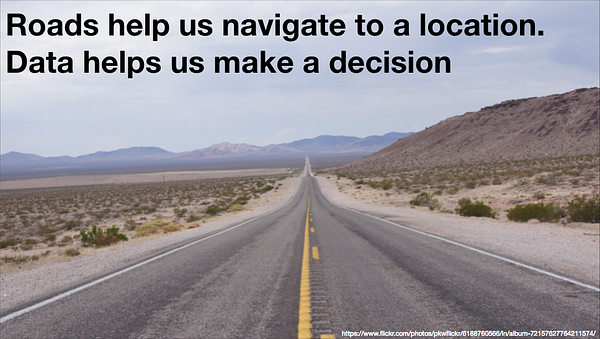

Our road infrastructure is more than just the roads. It includes road signs that describe a particular piece of road. The highway code that tells us how we should all behave. Organisations that maintain roads and make sure they’re there when we need them. When there are potholes and road blockages, there are people whose job it is to fix those problems. Today, we can help too. Apps like FixMyStreet let us take pictures of potholes and send them to our local councils.
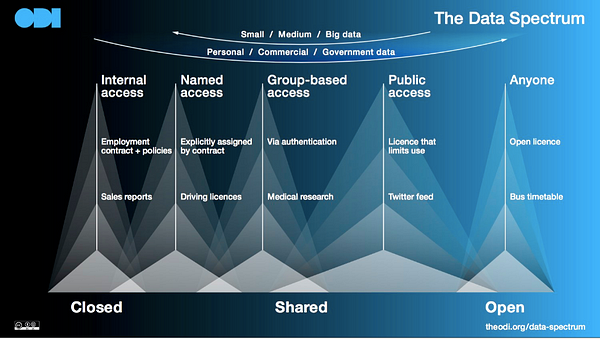

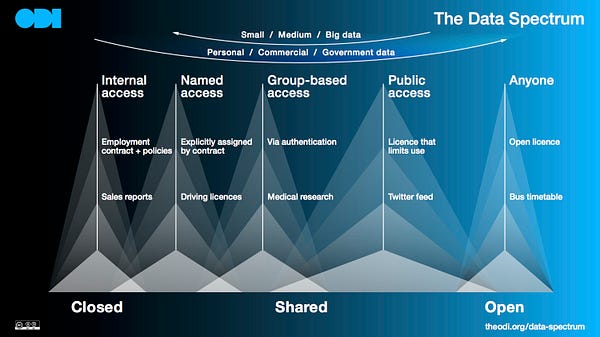
Similarly, our data infrastructure is more than data. The data is important — and that data comes from across the spectrum of closed, shared and open data — but data infrastructure includes the technology, processes and organisations that help us publish, discover, maintain and use that data.

Technology such as blockchains and open APIs. Processes such as data protection legislation or training to help people understand how to use data ethically. Organisations such as the ODI or each of you in the audience today. I suspect that everyone here today either maintains or uses financial data infrastructure. If you have a bank account then your data is in that infrastructure.

Data infrastructure connects multiple sectors. To give some examples from around the financial sector. Economic statistics are used by banks to make decisions about investments. Flood maps are used by insurance companies to set premiums. Property ownership records are used to understand credit risk. Informaton about mortgage products is used by banks, regulators and customers to make decisions.

But we need to learn how to strengthen data infrastructure. There is too much data that is poorly maintained, inaccessible or that costs too much money to access.

When strengthening data infrastructure people, businesses, governments and societies will face choices. These choices might lead us to different data futures.
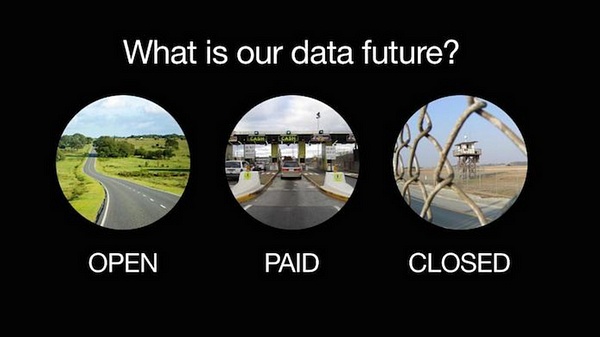

We might choose a locked-down future. One where organisations misuse data in ways that we find creepy whilst we continue to see hacks and security breaches due to poor security. This leads to people choosing to withdraw their data and reducing how much they interact online. Think of it as a data infrastructure dominated by missing roads and communities with padlocked gates. It creates the least value from data.

Or a paid future. One where everyone expects to pay for access to data and to be paid for access to their data. Imagine the costs of managing all of those transactions and licences. It’s a data infrastructure with toll booths every 100 yards. This may be the future we are heading towards right now. It’s flawed.

At the ODI believe we should choose something else: an open future. One where our data infrastructure is like our road system. The data infrastructure is as open and navigable as possible. Open data will be maximised, while privacy is respected. We believe this future creates the most value. It creates a virtuous circle from which everyone can benefit.

But analogies only go so far. We won’t build better data infrastructure using the same techniques we use for road infrastructure. To give a simple example the M25 was first proposed in 1937 in Sir Charles Bressey’s and Sir Edwin Lutyens’ The Highway Development Survey. It was completed 49 years later in 1986.
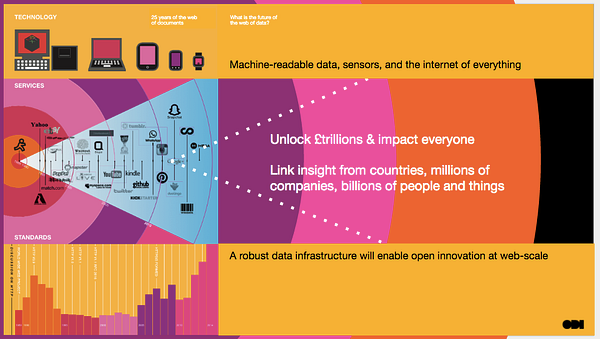

None of us can take that long to plan and build better data infrastructure. The web moves too fast. The web has only been around for 25 years and look at what it has delivered. The web of data is the next stage in its evolution.

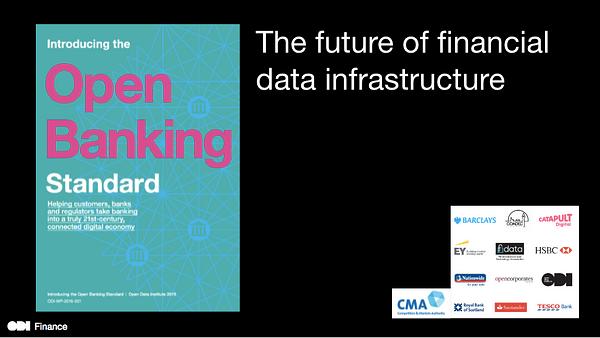
Lots of people are helping building this open future and the web of data with the open banking standard. Last year about 150 people from a huge range of organisations collaborated and worked in the open. In just 3 months they agreed a way to make retail banking data as open as possible whilst keeping private what should be private.

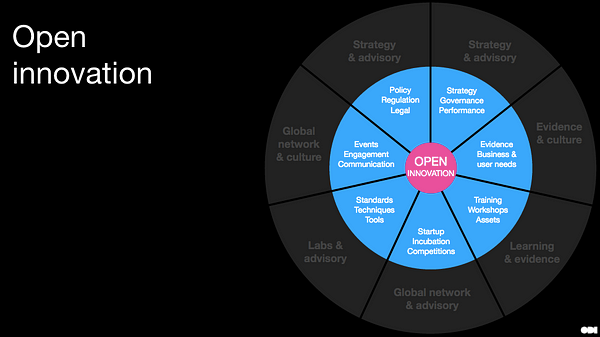
To implement the framework the community will need to work together to understand the needs of differing stakeholders, develop open standards, publish open data about products and branches, create open APIs for sharing personal data with people in control, develop guidance for compliance, rollout training, to run innovation challenges to test the standard and stimulate the market and communications to make sure everyone knows what’s happening.

The prize for completing this work is big. A data infrastructure which is as open as possible, such as the one developed by the open banking standard, will enable open innovation at web-scale.

The standard will help customers to look for a mortgage more easily, banks to find customers matched to a new product, and businesses to share data with their accountants. The uses won’t be limited to the UK retail banking sector. People have talked about using the data in the UK’s decentralised identity framework; or to help people who move country and need to create a new banking account or rent a flat. The standard will allow these, and many other services, to be built whilst respecting privacy, putting customers in control of their data and creating trust.

People want those services and open innovation creates opportunities for businesses. Good data infrastructure which is as open as possible is a competitive advantage for organisations, cities, sectors and nations.

The open banking standard helps build that infrastructure and is part of that competitive advantage. It’s part of the open future for financial data infrastructure.

City data marketplaces are a distraction, let’s improve data infrastructure

I chaired a debate at the Open Data Institute (ODI) titled “What does a good data market look like?” on 29 April. It was a timely debate.

Data is infrastructure at city, national and global levels. It is vital to our societies. It is important to strengthen it. Stable, reliable and well-maintained data infrastructure helps us make better decisions, it brings us new services and it supports innovation.

There are voices arguing that we need to move beyond the open data portal. Nesta have argued that the Mayor of London should build a city data marketplace and Hitachi are building one in Copenhagen.

At the ODI we are keen to learn — and to share what we learn — so we arranged a debate to discuss the idea of a city data marketplace. The panellists were Eddie Copeland the Director of Government Innovation at Nesta; Leigh Dodds a founder of Bath:Hacked and ODI associate; and Yodit Stanton the founder of Open Sensors, a startup building IoT data infrastructure. Questions were taken from the audience in the room whilst those watching the live-stream asked questions via the #ODIFridays hashtag.

Chairing the debate firmed up my views.

A city data marketplace is just another centralised website, we need to move beyond that model and improve how we can discover data on the web. At the same time we can build a better market for data and spend more time experimenting and learning about the role of governments and cities in that market. A better market for data can help strengthen our data infrastructure.

Better and more open data infrastructure will help both cities and the organisations that work in them solve problems and deliver services.

A city data marketplace is different to a market for data

A city data marketplace has previously been described as “an online marketplace that connects organisations and individuals that have useful data with those that want it.”. During the debate it was also described as an “appstore for data” and a “TaskRabbit or eBay for data”. The marketplace would support both open data and data shared for a fee. It would support data publication and exchange between the public and private sector. A city data marketplace is in one place, on one platform and focussed on a city.

The data spectrum.

By contrast, the market for data uses the web where organisations publish data and APIs. The market for data supports the full data spectrum. Like the city data marketplace it includes both open data and data shared for a fee; and supports data publication and exchange between the public and private sector. The traditional open data portal helps people discover public sector open data in the market for data but the market for data is mostly decentralised, just like the web. The market for data already exists.

Data marketplaces have failed before

Leigh Dodds shared his experience as product manager of a company that tried and failed to build a sustainable data marketplace.

He related the tale of multiple other organisations that have tried or failed with only those focussed on specific sectors, such as social media data, living to tell the tale. The debate did not surface other examples of successful data marketplaces, certainly not one that supported more than a single sector. A city supports multiple sectors.

The debate recognised that existing web publishing capabilities and search techniques were not always making it easy to find data in the market whether it be published by governments, city authorities or businesses.

Laura Koesten, a PhD student based at the ODI, is researching this problem. It is a hard one. As Benedict Evans has observed “All curation grows until it requires search. All search grows until it requires curation“.

There were some user needs that people thought weren’t being met by data portals

The debate discussed some user needs that existing open data portals may not be adequately meeting. I was unconvinced that a city data marketplace would help meet these needs any more than the existing market for data.

Even seemingly simple needs such as discovery are affected by a number of factors including the literacy of the person searching for data and how the data has been described during publishing.

More complex needs such as sharing a common problem to get others to help fix it — whether the problem be in banking, housing, jobs or education — is similarly complex. It requires a range of on and offline activities that can take years to complete. Whole new institutions might need to be built to fully address a problem.

There is a team at the UK’s Government Digital Service (GDS) that are researching the user needs for the data.gov.uk portal. Opening up that research and considering it alongside research on city data portals will help everyone learn more about what needs exist so we can design better services to meet them.

The role of government was unclear

The panel discussed the role of government. The views included government building and hosting a city data marketplace, using the marketplace to publish its own data, using the marketplace to buy data, encouraging use of open standards and recognising that the data that government holds is data that it holds on behalf of society.

In general, the role of government in a data marketplace or a market for data was under-discussed. As the chair I take full responsibility as we ran out of time! I think this would have been the most important bit of the debate.

I believe we need to think harder about government’s role

Our governments have chosen to actively shape technology markets: for example by encouraging the uptake of open standards and open source. They are also being active by choosing to use and publish open data.

The UK government, like many around the world, recognises that “It is critical that businesses have the ability to create new and innovative products without being hampered by cost, by licensing conditions, or the inertia caused by uncertainty and doubt.”

But the plans in Copenhagen and the ones that Nesta have floated for London include a marketplace that helps people buy and sell data. Paid for data often has a licence that restricts how you can use it: for example some Surrey councils can’t publish planning applications as open data because of their data supplier. This reduces the value that people can create from the data. Governments and cities that are open-by-default should not be encouraging paid data models.

As Jeni Tennison recently said:

Using data to make a decision is like travelling on a series of roads. To get from point A to point B without open data is like stopping at toll booths at each road junction.

Some journeys you just wouldn’t want to make because they are too much of a pain. So some decisions you will not be able to make because that data is too difficult to access.

Perhaps people think it is necessary to pay to get the private sector to provide data but many businesses, whether it be large enterprises or startups like Guru Systems and Open Sensors, and, as Yodit pointed out, the customers of Open Sensors are making the same choice as governments. They choose to publish some data as open data as it helps their businesses grow, solve problems and deliver services.

Good governments and cities will, where it is useful, use this open data to improve their services. Better ones will go further and encourage more open data.

Government could encourage mobile phone operators to publish the aggregated footfall data that they use for network planning or credit card companies to publish aggregated consumer spend data that they already collected and aggregate. Cities could choose to encourage taxi firms or, in the future, driverless car operators to publish aggregated open data such as traffic congestion or road maps. More open and collaborative mapping models can reduce costs for businesses and the public sector.

To take London as a specific example: the Mayor has responsibility for transport. Wouldn’t aggregated open data from private sector transport firms help a city meet the needs of citizens regardless of who owns the tube train, bus, black cab, car, or bicycle they happen to use? A more efficient transport market is better for the citizens that use it, the public and private sector firms that provide services in it, and the politicians that have democratic responsibility for it.

By encouraging a more open data infrastructure governments and cities won’t just deliver more efficient public services they will support innovation, transparency and accountability; help everyone get better services and grow our economies in the process.

We need to think more about our market of data

I came away from the debate unconvinced by the idea of a data marketplace as it was described. I do not think that our market for data needs another centralised website owned by a single organisation. The web is at its best when it is as open and decentralised as possible, so is our data infrastructure.

The debate did help me deepen my thinking about the market for data and its importance for the future though. If we are to strengthen our data infrastructure and make it as reliable and open as possible, so that it can help support innovation whilst respecting better principles for personal data usage, then we do need to improve that market and encourage it towards openness. Rather than building city data marketplaces perhaps our cities should experiment and learn how to improve the market and their data infrastructure by getting open data out of more organisations and making it easier to discover.

I’d love to hear more thoughts on this topic and talk to other people thinking about and, ideally, helping build better markets for data and more open data infrastructures.

Drop me a note or leave a comment if you can help.

Panama, open data, personal data, open Panama

We’ve been talking about the Panama Papers at the Open Data Institute. This is the second part of a blog that came from discussions with some of the lovely team there.

The first part looked at the Panama Papers through the lens of data infrastructure. This, the second part, looks at it through the lens of personal data and privacy.

The Panama Papers are not open data. They contain leaked, or hacked, information some of which has been placed in the public domain, but it is clearly an important story and one where data plays a vital role and where openness can help improve trust.

In the UK the release has led to renewed stories about the personal tax affairs of the Prime Minister’s family. The opposition leader has pledged to publish details of how much he pays in tax and called for the Prime Minister to do the same. As well as debating tax and open government the Panama Papers should also make us debate personal data and understand that both privacy and openness create trust.

Personal data, privacy and openness

Whilst open government data often focuses on non-personal data some societies have chosen to openly publish personal data about their politicians. Just as we expect high standards of openness from our governments we also expect it from the politicians who represent us. People believe that open data about politicians will improve trust, reduce corruption and help voters make better decisions about who represents them.

In saying that politicians should openly publish this data we are saying that they should have less privacy than the rest of us, that the benefits to society of openly publishing politician’s personal data is sufficient to override this part of their human right to privacy. Society would not be saying that politicians should publish all of their personal data but that they should publish more personal data than other people.

In the USA presidential candidates are expected to release their medical records and tax returns. In the UK we have become used to seeing details of politician’s expenses whilst in the run up to the 2015 general election a group of activists started collecting and publishing politician’s CVs. You can even find the CVs of the candidates for the next UN secretary general online. Whilst we may not all get a vote for the UN secretary general, having access to information about the candidates helps open up the process and improves the debate about the decisions being made by our representatives.

Perhaps the calls for publication of politician’s tax returns is a logical next step for the UK, and maybe medical records will follow, but these steps should include an informed debate that goes deeper than party political arguments may allow.

We should recognise that data is not always used in the way we expect or want. Publishing data can lead to more informed debate but sometimes it can be a challenge. In the UK the release of MP’s expenses highlighted many issues where politicians fell far below the standards that voters expected or wanted, but there were also cases where behaviour that was perhaps reasonable was highlighted as incorrect. Some politicians claim that this will drive good people out of politics. This is a bad argument. This is not closed or shared data where we can control its use and stop abuse. This is data that society has decided should be open and that anyone can use for any purpose. Politicians should expect their open data to be used in ways they may not want or expect but rebut these cases by honestly and simply explaining what the data contains, or doesn’t. Publishing the data openly allows this debate to happen in the open. An open and honest debate can improve trust in politicians.

Second, whilst we frequently, and mistakenly think, that all personal data is “my” data this debate would need to recognise that personal data frequently concerns more than one person. My tax and medical records refer to my wife, myself and the institutions that we deal with. My tax records refer to joint savings accounts. My medical records would show that my wife and I had a couple of, unsuccessful, rounds of IVF treatments a few years ago (*). If we want people to understand and control how their data is shared then would I need to gain consent from my wife before releasing the records? Would being unable to release tax or medical records prevent people from becoming a, successful, politician (**)?

Third, the debate will need to recognise that data is not always trustworthy. How are we to know if a tax record is accurate and has not been altered? How are we to know if the record is complete or that a politician is not due to receive funds in the future or has not benefited from illegal practices in the past?

Systems will only ever be as trustworthy as the data that is put into them but, perhaps, new technology, like blockchains, could assist? If we are to explore distributed ledger technology for tracking personal financial transactions across the globe then we will need to be wary of the challenges of putting personal data in blockchains and that the design patterns for privacy on a blockchain are complex and subtle. It would be interesting to end up in a transparent society because of a design flaw, rather than by choice.

If technology does become part of the solution to tax avoidance then we also will need to consider whether we are designing something for the whole world, or something that accepts that different people, societies and cultures make their own choices and that those choices change over time. The need to tackle tax avoidance is worldwide. Only a few societies hold the same standards of openness for citizens as they do for politicians, yet any citizen can choose to try and become a politician at a point during their lives. Whilst different cultures still make different moral choices any move for greater transparency for politicians is likely to need to allow for different people, societies and cultures to choose their own mix of privacy and openness for personal data.

Whilst the party political arguments will continue we still have an opportunity for a debate that covers these points and the many others that the Panama Papers raise. Privacy is a human right. Like any human right it needs a vigorous and informed debate if we are to sacrifice some of it. We should be having a more informed debate about data.

The Panama Papers can lead to better data infrastructure for anti-corruption and a more informed debate about data

The Panama Papers highlight the urgent need to make progress on getting people and organisations to pay a fair amount of tax.

In the first part of this blog I looked at the papers through the lens of data infrastructure and said that the next steps in building a more reliable and open data infrastructure for anti-corruption should include a global register of beneficial ownership. The register will improve our efforts to combat tax avoidance and other forms of corruption.

It should also include an environment where politicians are more open with the people they represent and where we have a wider and more informed debate about the role of data in our society.

The debate about how much personal data should be open to stop corruption could be complex and nuanced, but it will be useful. The choices we make about data are vital to our future. We need better, more informed and wider debate about data and how we bring together privacy and openness.

(*) Yes, of course my wife gave consent to me to publish that line in this blog but I didn’t ask my doctor or hospital. Should I have?

(**) To be very clear, there are many, many other things that would stop me being a politician. My own complete and utter lack of desire or capability to be a politician being the most significant ones 🙂

Panama, open data, infrastructure data, open Panama

We’ve been talking about the Panama Papers at the Open Data Institute. This blog came from discussions with some of the lovely team there.

This part looks at the Panama Papers through the lens of data infrastructure, the second part looks at it through the lens of personal data and privacy.

The recent leak of records from Mossack Fonseca, a tax firm specialising in offshore transactions (also known as “the Panama Papers”) has put the issue of how much people and corporations pay in tax on the front pages of our newspapers. The Prime Minister of Iceland has resigned. The Chinese government has censored online discussion. There have been reactions and investigations across the world.

The story is also about data. The Panama Papers are not open data. They contain leaked, or hacked, information some of which has been placed in the public domain, but it is clearly an important story and one where data plays a vital role.

People want everyone to pay what we think is a fair amount of tax. People want to be represented by politicians that they trust. People are angry because they think that global tax avoidance is leading to people not paying fair amounts of tax and they are losing trust in their politicians because they feel politicians are benefiting from global tax avoidance rather than trying to stop it.

Societies across the world want their governments and politicians to be more open, openness can help create trust. Open data’s origins are closely related to the open government movement. Amongst many other things the open parts of our data infrastructure underpin transparency and accountability and can help reduce corruption.

Open data, open government and infrastructure to reduce corruption

Open data has been shown to improve our governments in many ways. Last year open data for election results helped improve confidence in the fairness of Burkina Faso’s election. This year people are experimenting with improvements to the way that the UK publishes election results.

Organisations like Spend Network (*) and tools like 18F’s Calc bring together contracting and procurement data, making it simple for anyone to search and use. Journalists and citizens can look for corruption and challenge their governments on how they are spending data whilst different parts of government can make better decisions and check they are being charged similar sums to their peers. Publishing the spend increases transparency. Using the data improves accountability and efficiency.

Open Corporates (*) collect together data published by governments and corporations across the world to help us understand how corporations, such as Goldman Sachs, are structured. On their site any of us can search for corporations where Mossack Fonseca are an officer. Linking together the data in the Panama Papers with data from Open Corporates and information on company and property ownership (unfortunately both of which are information that can be challenging to find and use in even countries that are the most enthusiastic endorsers of open government…) allowed journalists to start to discover the real owners of some of the property owned by companies based offshore.

In countries, like the UK, where the price of property is a major political issue the Panama Papers should help us all understand the benefits of a beneficial ownership register and start making steps towards its implementation at both national and global levels. This will not be simple. Company structures can be designed to obscure ownership. People will need to match up and link data from many jurisdictions. But progress can be made.

Journalists, citizens and governments have used other lists to analyse the Panama Papers. Wired reported that the German newspaper Sudeutsche Zeitung used lists of known criminals, politicians and famous athletes. Various government’s financial sanctions list will have provided another way to analyse the data.

Lists of politicians, criminals, people under sanctions, property ownership and beneficial ownership are not ‘just datasets’. When used to analyse leaks of data like the Panama Papers these lists become part of a global data infrastructure for anti-corruption. The UK, and its overseas dependencies, will be important contributors to this infrastructure.

Making this infrastructure as open and reliable as possible will increase how many people can use the data. This will improve every country’s efforts to combat tax avoidance and other forms of corruption.

Transparency alone will not solve the problems caused by global tax avoidance but it is a step in the right direction.

The Panama Papers can lead to better data infrastructure for anti-corruption

The Panama Papers highlight the urgent need to make progress on getting people and organisations to pay a fair amount of tax.

The next steps in building a more reliable and open data infrastructure for anti-corruption should include a global register of beneficial ownership. It will improve our efforts to combat tax avoidance and other forms of corruption.

In the next part I’ll touch on some of the personal data and privacy issues raised by the Panama Papers and how I hope it leads to a wider and more informed debate about the role of data in our society.

(*) a former ODI startup

Football attendance figures are inaccurate and don’t tell the whole story


It can be useful to know how many people attend a football match but the official figures are not accurate. Blackpool fans have been collecting data and working out more accurate attendance figures for their team. They hope it will help them oust the football club’s owners and help a fan-owned club to emerge. The footballing authorities should encourage clubs to publish the more accurate data that they already collect. In the meantime the technique could help fans of other clubs.

Lots of people want to know attendance figures but it is not easy to get hold of accurate data

The police, and other services need to know the attendance figures so they can help maintain safety or in case of an emergency. The home team need to know to keep track of finances, look after health and safety and make sure there’s enough pies and bovril available. The away team might need to know the number so that they get a share of gate receipts. The local council might want to know so they can plan transport or understand the number of visitors coming to their town every other week. The football authorities want the numbers so they can proclaim how important the sport is. Fans want to know the figures too.

A snippet from the Millwall-Blackpool programme from 5th March 2016. Attendance figures are in the 6th column.

An attendance figure might be announced at a match. Printed in a programme. Published in a match report. Gathered on football stats websites with information about clubs, leagues or across the globe. The attendance figure you see in these places is typically wrong.

https://twitter.com/WillWatt/status/699679468760203264/

In England the rules of the premier league say that attendance figures that are publicly reported should be the number of tickets that are issued or sold. Not the number of people who actually attend. (I understand the football league rules say the same, although I couldn’t find the precise clause.)

The actual attendance figure can be quite different to the number of tickets that are issued or sold. Season ticket holders may not turn up for a midweek game. Complimentary, i.e. free, tickets could be issued but not used. People might even walk out in the middle of a match as a protest.

In the case of my club, Blackpool FC, fans wanted to know more accurate figures due to their own protests.

The Oystons, Blackpool, bids for the club and a boycott

The owners of Blackpool football club, the Oyston family, have loaned millions of pounds from the club to other companies, taken legal action against fans, taunted them and abused them by text. Unsurprisingly most Blackpool fans want the Oystons to leave.

In 2015 there were two bids to buy the club. One from an unnamed consortium of bidders. The other from the democratically run Blackpool Supporters Trust. The second bid would have created a fan-owned club. Both bids were rejected. Until the Oystons go many fans have chosen to boycott the club.

Without accurate attendance figures it’s tricky to understand the impact of the boycott. Whilst the fans can speak eloquently of the damage the Oystons have done to them it might be tricky for a bidder, or the local council, to understand the damage that has been done to the club and town due to the dreadful mismanagement of the Oystons.

Crowdsourcing better figures

So, using four people and a couple of hours of effort per game, we worked out better attendance figures.

254 people in Blocks D and E during the Blackpool-Coventry game.

Two people in the ground took pictures of every block. Two other people then used a fairly simple and manually intensive, but effective, technique to count the number of objects in a photo. A small percentage, 5%, was then added to cater for some people not being in their seats at the time of the pictures.

The actual attendances for three home games were as follows:

  • Blackpool v Shrewsbury (February 13): official figure 6,873 (including 790 away fans), revised crowd count 4,289— that’s 62% or 2,584 less than the official figure.

Blocks D and E during a game at Bloomfield Road in 2006. Picture by Matthew Wilkisnon, CC-BY-2.0
  • Blackpool v Bradford (February 27): official figure: 8,780 (including 3,063 away fans), revised crowd count 6,100 — that’s 69% or 2,680 less than the official figure.
  • Blackpool v Coventry (March 12): official figure 8,869 (including 3,000 away fans), revised crowd count 5,845 — that’s 66% or 3,024 less than the official figure.

Before the boycott the home stands were full. As the Blackpool Supporters Trust say:

Blackpool FC states that there are currently 4,600 season ticket holders. These accurate crowd counts would suggest that over half of the season ticket holders are already boycotting home matches.

Undoubtedly this will have serious implications for next season — people not using tickets they have already paid for are unlikely to purchase new ones.

The Oystons are destroying Blackpool football club.

Data helps us make better decisions

All of the turnstiles at Blackpool, like many other clubs, have a system that scans tickets on entry. The club’s owners have access to more accurate data than they publish. We have to hope that all football clubs are sharing this accurate data with each other, with local councils and with the emergency services. Perhaps as well as calling for more transparent publication of data to stop abuses of power at Fifa the footballing authorities should ask all clubs to publish as open data both the real attendance figures as well as the number of tickets sold. It will help lots of people make better decisions. In the meantime if fans of other clubs want help in working out more accurate attendance figures then get in touch.

For Blackpool fans though the immediate decision is the choice they are making about whether or not to support the owners by spending money and time going to their football club. I’ve made my choice. I won’t go back. I hope that my boycott will help persuade the Oystons to go.


I will be joining a community march and demonstration organised by the Blackpool Supporters Trust and the Tangerine Knights on Saturday April 30. Blackpool fans are hoping to get 10,000 people to come along.

It doesn’t matter if you’re a Blackpool fan, or even a fan of football. The issues at Blackpool go beyond football. They affect many parts of the town and include concerns about transparency and accountability in the local council. What matters is that you care about people and communities and want to make things better.

Why not join us and stand up for a community fighting to get their football club back?

Politicians should open up casework data

Would it be useful to know whether complaints about welfare payments are rising or falling? Or to understand more about the jobs that our politicians do?

There is data that can help answer both of these questions and many others. Unfortunately it’s not open.

If this data was open we could make more informed decisions about where to target housing support, how to improve our welfare system or who to vote for.

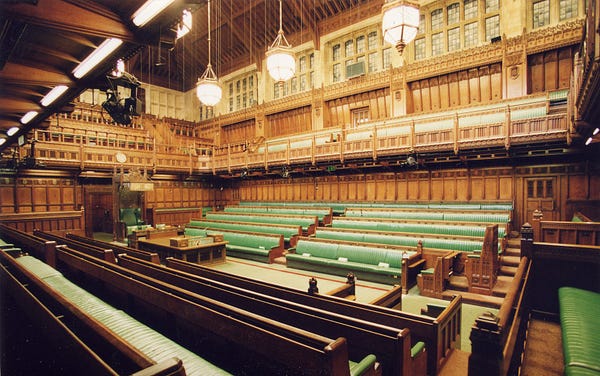
The chamber of the House of Commons. There are no MPs in sight. That might be because their work in the chamber of the House of Commons is only part of the job. Image (c) Parliament. CC BY-NC-ND 2.0

Politicians do casework for the constitutents they represent. They help people by solving problems: an issue with welfare benefits, a difficult immigration claim, a housing problem. Someone might ask a politician for help by writing to them, phoning their office or by going to meet them.

Casework is vital. It is one of the ways that politicians understand the challenges faced by their constituents.

As an ex-assistant to a UK politician put it:

What many people don’t realise is that in many cases an MP’s office is a last port of call for those who have fallen through the cracks of civil society.

We can open up data on casework whilst protecting privacy. Some MPs already do this.

Making the data open will make politicians better

There is a lot of data that politicians could choose to publish but casework data seems a very useful dataset. It might even be an easy one if they use a digital service to manage casework and that service published the open data.

Whilst politicians may have no legal obligation to do casework I suspect that most choose to. It is a little understood but vital part of a politician’s job. Publishing data about this work can help voters understand more about the job that politicians actually do. It will help politicians explain their job, and its challenges, to voters and should help voters make more informed decisions when they choose who they want to represent them.

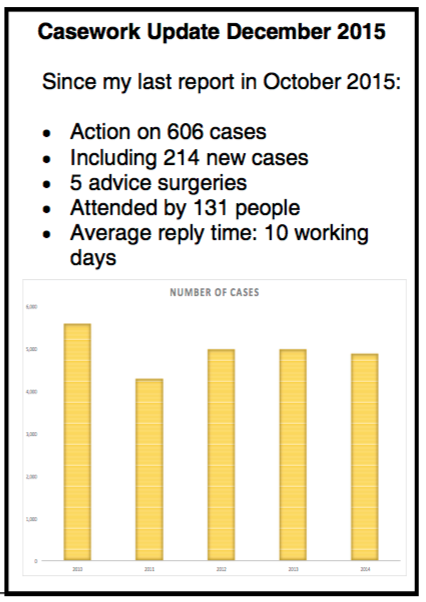
Harriet Harman’s casework statistics, reportedly the largest volume in the UK. (source)

It is suprising how few politicians publish data about their work. Here in the UK Chi Onwurah publishes data and some others, like my own MP, Harriet Harman, publish it but in a form that is not easy to use. Many others, even those who either now or previously have had responsibility for open data, publish nothing. Politicians will benefit from going open and learning from the technology, the data protection challenges and the cultural benefits that openness brings. They will benefit from showing voters that their job is different from many people’s expectations.

There are more politicians than those in the House of Commons. Our representatives also work in Edinburgh, Belfast, Cardiff and the hundreds of council chambers and parish councils up and down the country and they also do casework to help their constituents. All of these politicians could publish their casework data, gain the same benefits and help fix the cracks in society. This is a non-partisan issue. If politicians from all parties and all layers of government open up their data in a standard open format then it can be combined to create a more accurate picture.

Making the data open will help fix the cracks

People contact their MP for help when the system has failed. We will all benefit from the root cause of the problem being solved and the system being improved. Publishing this data should lead to targetted action and better services.

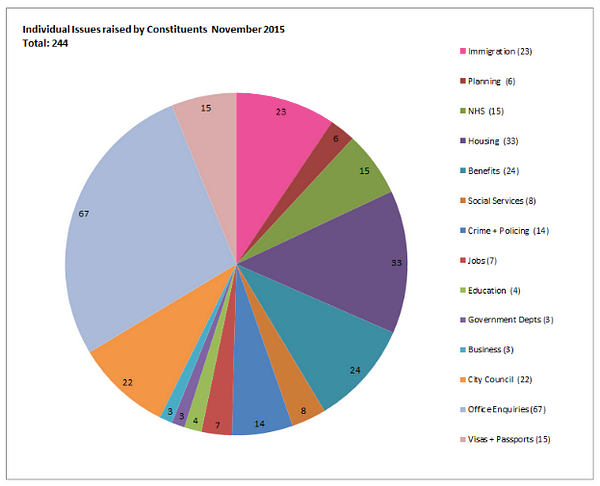
One month of Chi Onwurah’s casework statistics. Are the volumes comparable to other cities? Are the trends up or down? (source)

The data could be combined with other information about an area to help all of us understand the challenges it faces. It could be combined with other data, such as that published by the Citizen’s Advice Bureau and local authorities, to inform national debate.

The data might show general trends or it might point to specific issues that can be resolved. A fall in benefits casework might show that the system is improving whilst a rise in casework on housing in a given location might show that services are being increasingly stretched and that action is required to investigate it and build a solution.

By making data about politicians’ casework open we will make politicians better and help fix some of those cracks in our society.

If you know of other politicians publishing casework data then I’d love to see it. If you think this is a good idea then why don’t you write to the politicians that represent you and ask them to publish some data? If you don’t think it’s a good idea then do tell me why. I’m @peterkwells on twitter 🙂

Newer posts »

© 2026

Theme by Anders NorenUp ↑

This website stores cookies on your computer. These cookies are used to provide a more personalized experience and to track your whereabouts around our website in compliance with the European General Data Protection Regulation. If you decide to to opt-out of any future tracking, a cookie will be setup in your browser to remember this choice for one year.

Accept or Deny