Tag: Politics (Page 2 of 2)

The people’s railway will need to start soon

Railway ticket prices in the UK have risen by 25% in the last 5 years. This yearly rise in prices, and continued complaints over punctuality, has led to the usual yearly rise in news stories about the UK’s railways.

There were 1.6 billion passenger rail journeys in the last 3 months. In addition to passenger journeys railways also transport the food we eat, the material that is used to build our houses and our post and parcels around the country. More than 190,000 people work on the railways to deliver these services.

In 2014 60% of the public were in favour of railway nationalisation believing that it would lead to greater accountability, cheaper prices and better services.

Nationalisation will take at least a decade. Technology driven change in transportation is moving faster than this. The UK needs to look for a different path.

The UK debate over public or private ownership of railways

Railways are a highly efficient and environmentally friendly form of long distance mass transit. The UK led the way in innovating and building railways during the industrial revolution.
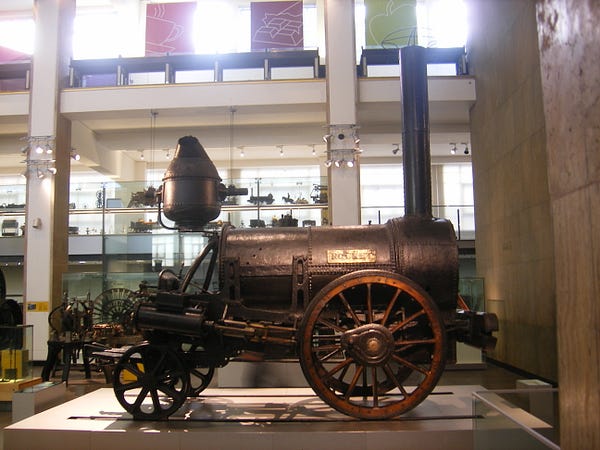
Early and marvellously innovative train Stephenson’s Rocket on display in London’s Science Museum. Image by Paul Williams CC-SA-2.0.

In recent years, with the exception of Northern Ireland (*), the UK’s long distance railway network has operated with a model of publicly owned tracks used by privately owned train franchises that lease trains from other companies. This model is not generating the right results. The incentives are flawed. The parts do not work together for the common good. The whole is less than the sum of the complex parts.

In 2015 we also had a mid-year rise in news stories about railways. Following his recent victory in the Labour Party’s leadership election Jeremy Corbyn confirmed Labour would renationalise the railways if it won a general election victory in 2020 by building railways that are cooperatively run by government, workers and passengers. Labour has stated that nationalisation will lead to cheaper and better services.

Many other countries successfully run their railways under full or partial public sector ownership. The East Coast mainline was run very well by the public sector until recently. The previous owner of the franchise, National Express, walked away as they were not making sufficient profit. The public sector took over, successfully ran the franchise and made a net contribution back to the Treasury. Contributions from publicly owned transport can be reinvested in building better infrastructure.

The digital age will beat a steam age policy

Unfortunately beneath the headlines I expect that Labour’s plan will fail to deliver what people want: greater accountability with cheaper and better services.
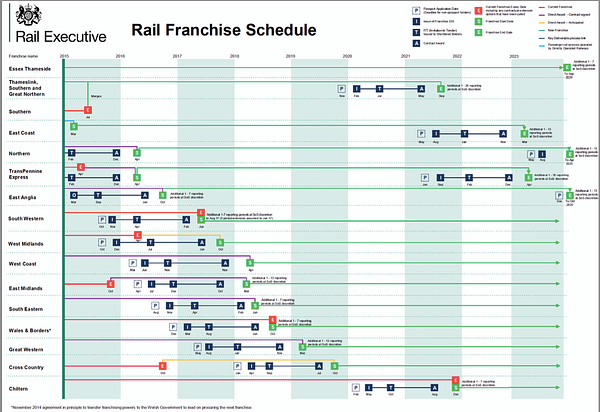
Rail franchise schedule as of November 2015 (source). The Scotland franchise is not shown in the schedule but a 10-year contract was awarded in 2014.

The policy will not have any effect unless Labour win a general election in 2020 and it will then require contracts for existing railway franchises to expire before the new government would bring the franchise back into public ownership.

Nine railway franchises are due to be awarded before 2020 and the likely 10-year terms of the contracts will run beyond a 2020–2025 parliament. Nationalisation by this approach will take decades.

It will run at the speed of the steam age rather than the digital age.

Long-distance transport in the digital age

Passengers are unlikely to wait. The move to build cheaper and better services will be faster.

The existing train services rely on passengers purchasing and showing a paper ticket at a time when a growing number of passengers have a smartphone or contactless bank card in their purse/wallet. The franchise operators have failed to invest in modernisation and building a better user experience. There is good evidence that that UK public sector knows how to use technology to transform mass transit services but, unlike the rail franchise operators, some private sector companies also know how to do this.

The technology companies that have been reinventing transportation in our cities will soon start to focus their efforts on long distance travel whether it be through personal services such as ride sharing and automated cars or new forms of mass transit.

If those services are cheaper and better than railways then people will choose them. People are currently complaining that the UK’s railways are run from France and Germany, soon they will find themselves complaining that their transport is run by technology giants in the US or China.

Some passengers will get the benefits of modernised services that are cheaper and better but we risk losing the environmental benefits of mass transit, the accountability that people say they want and benefits for all. You cannot use Uber unless you are online and many UK adults are not.

The UK Government currently has a permissive approach to regulating these services so unless the technologies companies choose to open up, be more inclusive and become more accountable to governments, passengers and workers then we need to consider a different path.

Taking the cooperative path and using the market

The franchising system allows people to organise and use the market to take power.

A cooperative could be formed that includes local government, devolved governments in Wales and Scotland, workers, freight companies and passengers. This cooperative could work together to bid for franchises as they are put out to tender. The cooperative model brings the accountability that we risk missing out on if we wait a decade for nationalisation. It can still provide money back into the public sector that can be reinvested in building better infrastructure.

Bidding for a franchise is not cheap. Experts in railways, technology and running cooperatives will need to be employed to pull a bid together. It is reported that Virgin spent £14m on their failed bid during the disastrous West Coast mainline franchising process in 2012. There were 1.6 billion passenger rail journeys in the last 3 months. Modern digital approaches can be used to crowdsource money and build scale fast. If people can crowdsource $100m for a computer game then people should not be frightened of raising money to bid for a railway franchise.

New cooperative railways could build on the expertise gained through the extremely effective running of the East Coast mainline; connect with the new Transport for North initiative; and work with city-regions to support their need to integrate national transport infrastructure with local transport options such as cars, buses and trams.

Concept image for Elon Musk’s hyperloop project by Camilo Sanchez, CC-SA-4.0. Why couldn’t a cooperatively run transport system raise money to build one in the UK? Or branch out in buses?

Even without the involvement of national government a cooperatively run railway that bought in expertise from the public and private sector could deliver on the promise of greater accountability coupled with cheaper and better services.

That is what people want and need. The new franchises can be open, inclusive, innovative and modern at a time when the UK’s privately run railways are not.

There remains the chance that government will put new requirements into the next round of franchises; that the existing rail franchise operators will modernise and become more accountable; or that the new technology companies will choose to open up.

If they don’t a people’s railway will continue to be demanded but it will need to start soon if it is to have a chance of success.

(*) curiously most UK debate over railways does not seem to recognise that in Northern Ireland the railway is publicly owned.

In 2017 there are expected to be three invitation to tender (ITT) and two annoucements of who will run rail franchises in England. (Source)

[Update 5 Jan 2017 as various news stories emerge about the usual annual increase in rail fares here is the latest rail franchise schedule from the Department for Transport. Three new invitations to tender are expected this year. I wonder if any mutual organisations will bid.]
Momentum: as a tech startup

I’ve written a longer piece about my initial encounters with Momentum. Momentum describes itself as a network of people and organisations that will continue the energy and enthusiasm of Jeremy [Corbyn]’s campaign for the Labour party leadership. That piece looked at Momentum from the perspective of a Labour member. I was concerned at what I found.

There’s another, more fun, way of looking at Momentum: they’re a tech startup that launched its product too quickly.

Momentum was founded by people who didn’t like the service they were getting from legacy products.

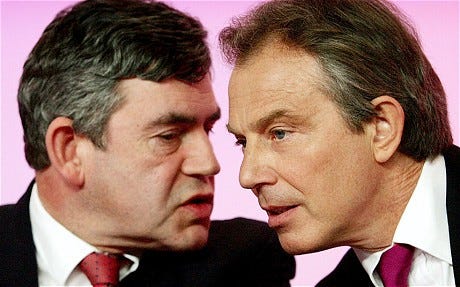
Image of Tony Blair and Gordon Brown from Getty via Telegraph. Other legacy products might exist.

The team did a quick pilot to check if there was market demand for an alternative.

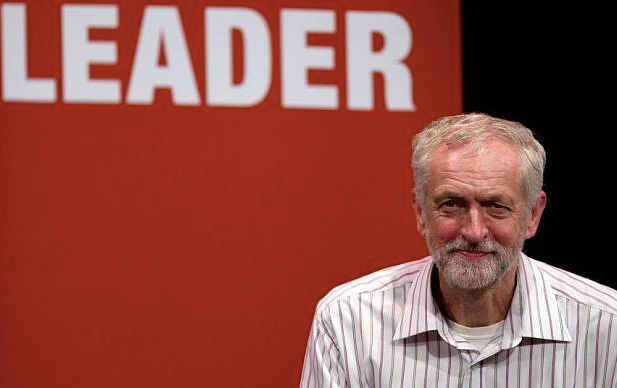
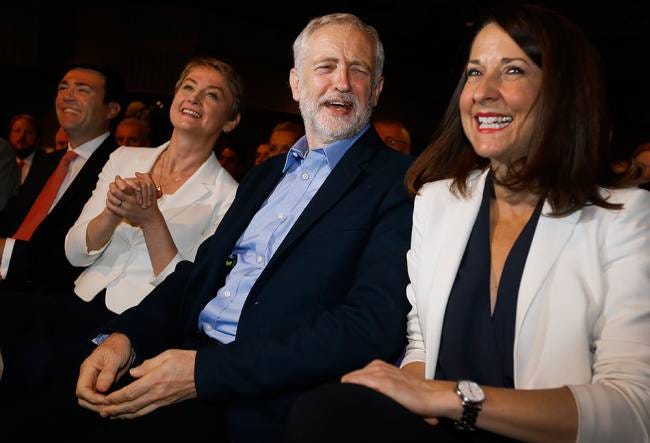
Image of Andy Burnham, Yvette Cooper, Jeremy Corby and Liz Kendall during the Labour leadership campaign from AP via NorthJersey.com

There was heavy use of modern tech to automate tasks.

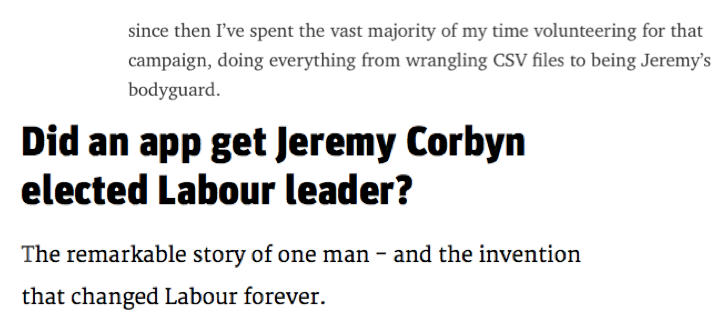
The tales of two people from the Jeremy Corbyn team.

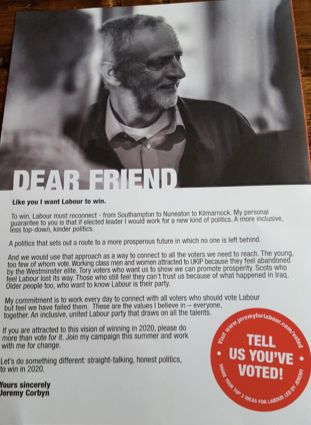
There was a major advertising campaign.

Image from leaflet posted to all Labour members during campaign.

The pilot was successful.

Jeremy Corbyn won the Labour leadership. Get used to it. It’s called democracy.

The team were so excited they took the pilot straight to a live mass market product.

Buzzfeed story on Momentum launch.

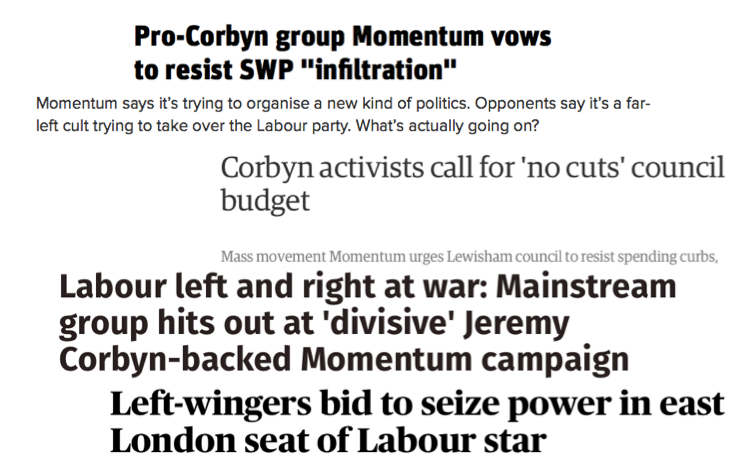
Unfortunately this quickly led to bad headlines.

Clips come from various stories. I recognise some Momentum people won’t think of all of these as bad headlines. Unfortunately I think most of the population will.

To paraphrase my longer piece in far fewer words one of the issues seems to be that Momentum’s pilot was with a particular group of people, i.e. the Labour electorate. [There are other issues with the design of the product, eg use of data, but let’s stick to Momentum’s grasp of people’s needs for now]

There wasn’t the recognition that even as you stay focussed on the core problem that you’re trying to solve that when you scale up to mass market that other types of people (yes, people not users) might have needs that need to be considered. In fact the live product risks narrowing its market even further by allowing in some of the far left groups and thinking that I experienced. Imagine a tech startup that builds a capability which ends up being used for unhelpful purposes by unintended users. If you chase after these users (some product managers think all customers are good customers…) then you risks drifting ever further away from the actual needs and purpose whilst generating more headlines, and wasted effort, like those above.

A group that engages with the non-political community, which is what I understand Momentum is/was trying to do, needs to reach out way beyond the base of engaged, left-wing political activists. The language of political theory simply doesn’t work. You need to build with existing communities and they want to see results.

Both Momentum, and other people who think of themselves as Labour, certainly need to avoid descending into political infighting. That really really doesn’t work.

Now the Momentum team might recover from this launch and build a better product that reaches this wider group of people, the People’s PPE idea is great, but there is a reasonable risk that something else will happen.

Momentum will take out some of the competition, the legacy products that Momentum wanted to replace, but in the process discover that bigger, hungrier competitors have already taken over the mass market.

Image of George Osborne by Gareth Milner CC-BY-2.0

Uh oh.

Momentum: openly including the far left.

<FYI from 14 Nov 2015— this is fairly long, Buzzfeed version is here https://medium.com/@peterkwells/momentum-as-a-tech-startup-b7851601674a>

I joined the Labour Party when Tony Blair stood down.

I voted Labour before Tony Blair became leader but didn’t vote for it for quite a while afterwards. I knew the party was doing many good things in government but, for me, the good was outweighed by the bad. The authoritarian (which leads to violent) side of New Labour did not appeal to me. The side that thinks you can solve complex problems with big solutions. That does things for people rather than building with them.

During that period it seemed you had to be New Labour or you couldn’t take part in Labour. I joined when I thought that period had ended.

Last year I did voluntary work for Labour. I found it complex and bewildering at first. Politics is hard because humans and the world are marvellously and brilliantly complex. I found most people I met to be honest, trustworthy and committed. Labour lost the general election. Earlier this year I found myself thinking of how to make Labour more open and fit for the digital age.

Now I find myself concerned again that the good things about the Labour movement are being outweighed by the bad again. The authoritarian side of Labour is coming back to prominence.

The birth of Momentum

The Labour leadership race was vicious with insults flying from all sides. I tried to avoid it. I even considered filling out my ballot in crayon.

After he won Jeremy Corbyn filled his leadership office with a team from more controversial backgrounds than normal. I was surprised at their backgrounds but waited to see if the party would open up and modernise as I, and so many others, would like to see.

Then Jeremy Corbyn authorised his leadership campaign team to set up a new group outside the Labour Party: Momentum.

National Momentum

I first encountered Momentum on social media shortly after they launched. The Corbyn campaign team had been avid users of online marketing techniques to build a supporter base and organise rallies for Corbyn supporters during the leadership campaign. So, as expected, a number of Momentum Facebook groups and Twitter accounts quickly sprang up.

When I looked at them I saw that they were often rebranded Corbyn campign groups. There were genuine, well-intentioned people in the groups but there were also people full of the rhetoric from the leadership campaign: anyone who did not support Jeremy Corbyn was from the “right” and should “go and join the Tories”. As with the leadership campaign you had to be a believer to be one of ‘us’, otherwise you were one of ‘them’.

This wasn’t one-sided. Similar rhetoric emerged from other parts of Labour who were attacking Momentum. There even seemed to be an implicit mindset in some that Jeremy Corbyn had no right to be the leader: here’s some information about democracy to help with that.

Meanwhile much of what I was reading from Momentum was about rigidly enforcing Jeremy Corbyn’s ideas rather than encouraging open minds and trying to unite a party that contains multiple viewpoints and represents people with many many more. Leaders don’t just impose their views. They listen.


English Momentum

But there were also more worrying signs.

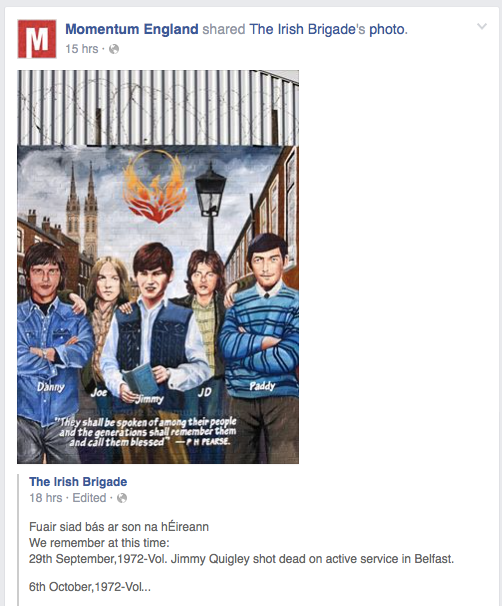
One Facebook group caught my eye in particular: Momentum England. They shared a message commemorating an IRA soldier, Jimmy Quigley, who was killed on active duty. A British soldier, Ian Burt, was killed in the same incident. Ian Burt was not mentioned in the post.


Northern Ireland is a complex place with lots of history. Jeremy Corbyn has a complex history with Northern Ireland. I like peace. I don’t like violence. I dropped the Momentum team a note to highlight the Facebook group, the post and some other similar posts that were being shared. I do try and help.

After two weeks there was no reply. At this point I was starting to wonder if this was actually how the Corbyn leadership campaign had really taken shape. Was it happy to be all things to all people: even people who had supported the IRA in the 70s? Every vote counts after all.

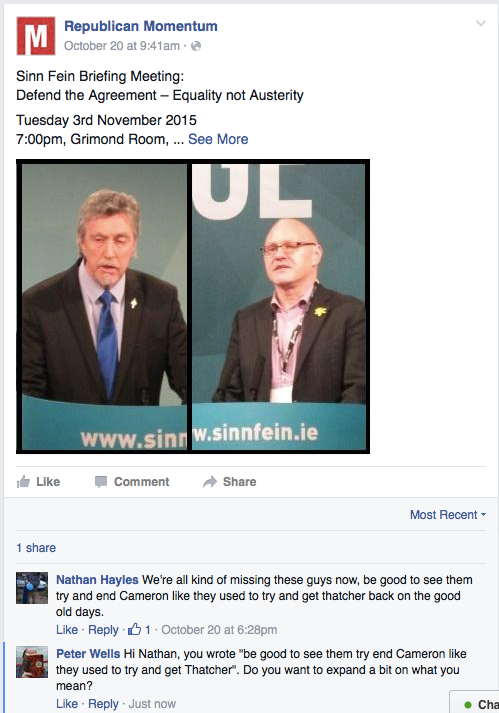
The group had changed its name to Republican Momentum when I sent a third and final note after seeing another offensive post. It had sat there for a day or two calling for Sinn Fein, the political wing of the IRA, to try and “end Cameron as they had tried to get Thatcher”. Something I took as a reference to the Brighton bomb in 1984. You know the bomb that killed people. No one commented on it but me (yeah I commented obliquely, I should have just said “you’re offensive. please stop.”).


This Momentum Facebook group had 2000 Facebook ‘likes’. That’s 2000 pairs of eyeballs that might have seen it and spoken up in a better way than I did. I didn’t see one.

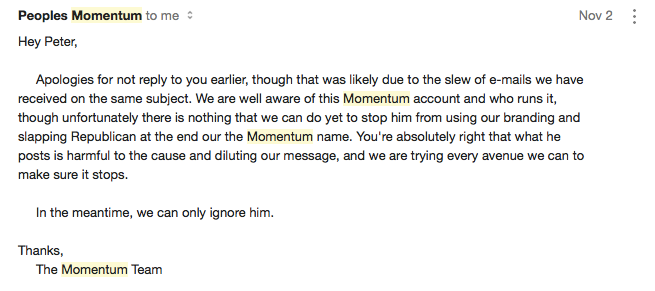
I eventually got an anonymous response from the Momentum team claiming there was nothing they could do. Cobblers.


I responded to suggest that perhaps, just perhaps, they could leave their own comments on the Facebook group to say that it breached their ethical code and doesn’t speak in their name.

The internet makes it easy to speak up. If you choose to.

The mostly anonymous Momentum team chose not to.

Local Momentum

I live in Southwark in London. My local Labour Party ran an event last weekend to welcome new members to the party. The local party has doubled (tripled?) in size over the Summer. That’s a good thing.

I went to the event. Owen Jones gave a speech and then questions were taken. I asked the first question about a living wage campaign. The next three people all started their question by declaring themselves members of Momentum. I didn’t hear anyone else declaring themselves part of a “thing” (well apart from me calling myself a plastic Northerner from Blackpool). People are volunteers they have limited time and energy: this was a meeting where the local Labour team were trying to get people’s time and energy into the party that is led by Jeremy Corbyn. Subsequently a piece of paper went round gathering email addresses for Momentum. This wasn’t a Momentum meeting. This was a Labour meeting. Momentum aren’t even in Labour. Hmmm…

By the end of the meeting all of the Momentum questioners seemed to have already left so I left a note on Facebook questioning their decision to advertise themselves. There was a slightly inconclusive debate but there seemed to be a couple of reasonably open minds so I decided to go along to the meeting.

The attendees were mostly white and male. This is not representative of Southwark.

All of the organisers and many of the attendees seemed to have been involved in the Corbyn campaign. Much of the discussion was framed as Corbyn and his supporters vs the rest of Labour. It was oppositional. Two leaflets were circulated about Southwark Council and Lambeth Council’s policies on housing and libraries. People blamed the councils. There was little awareness of the horrendously difficult choices that councils are having to make because of cuts imposed by central government.

The organisers chose topics for discussion and split people into groups. People nominated themselves as chairs for groups and reported back to the main meeting. The organisers and group chairs all seemed to know each other. Everything was fast. There was hustle and bustle and energy. Cool! But…… Structures like this work for those already engaged, not those who want to understand and think or who might struggle with the English language. It was the converted speaking to themselves. There was little listening. It was not democratic.

I joined a group to discuss “working with the local Labour party”.

Multiple people said that the people at the Momentum meeting needed to take over the Labour party and make it enact “Corbyn’s views”. That all Labour MPs and councillors should respect the democratic mandate of Jeremy Corbyn (yes) and enact his policies (no…).

Just like some of the people who are protesting against Jeremy Corbyn I don’t think these people understood democracy. Here’s a link to help with that. For those unfamiliar with politics and democracy it’s worth reading. In detail. There are many types of democracy: representative, direct, deliberative, participatory, etcetera. Different types of democracy work for different things. To my knowledge no viable society uses just one type.

Quite a few people nodded along with the views on taking over Labour. They were said loudly and with conviction. After all people are told that Jeremy Corbyn is being attacked. They see it in their Facebook feeds every day. They must fightback!

I spoke up, objected to the antagonistic atmosphere towards other members of the Labour party and questioned if the group represented the community and really wanted to work with Labour. Some people nodded along with me. Others glared daggers. I didn’t like the looks I got.

A member from the Lambeth Socialist Party was there. That’s the rebranded Militant. He declared his allegiance and no one, including the organisers, told him some views were not welcome. He knew people’s names. He was comfortable in the environment.

An organiser tried to explain to me afterwards that it was open and inclusive to include people with these views. No. No, it is not. By including view X you might exclude person Y. This is basic stuff. There are always boundaries, social or legal, in every group of people and in every micro or macrocosm of society. Boundaries have to be set. The IRA and the Socialist Party are the other side of a boundary from me.

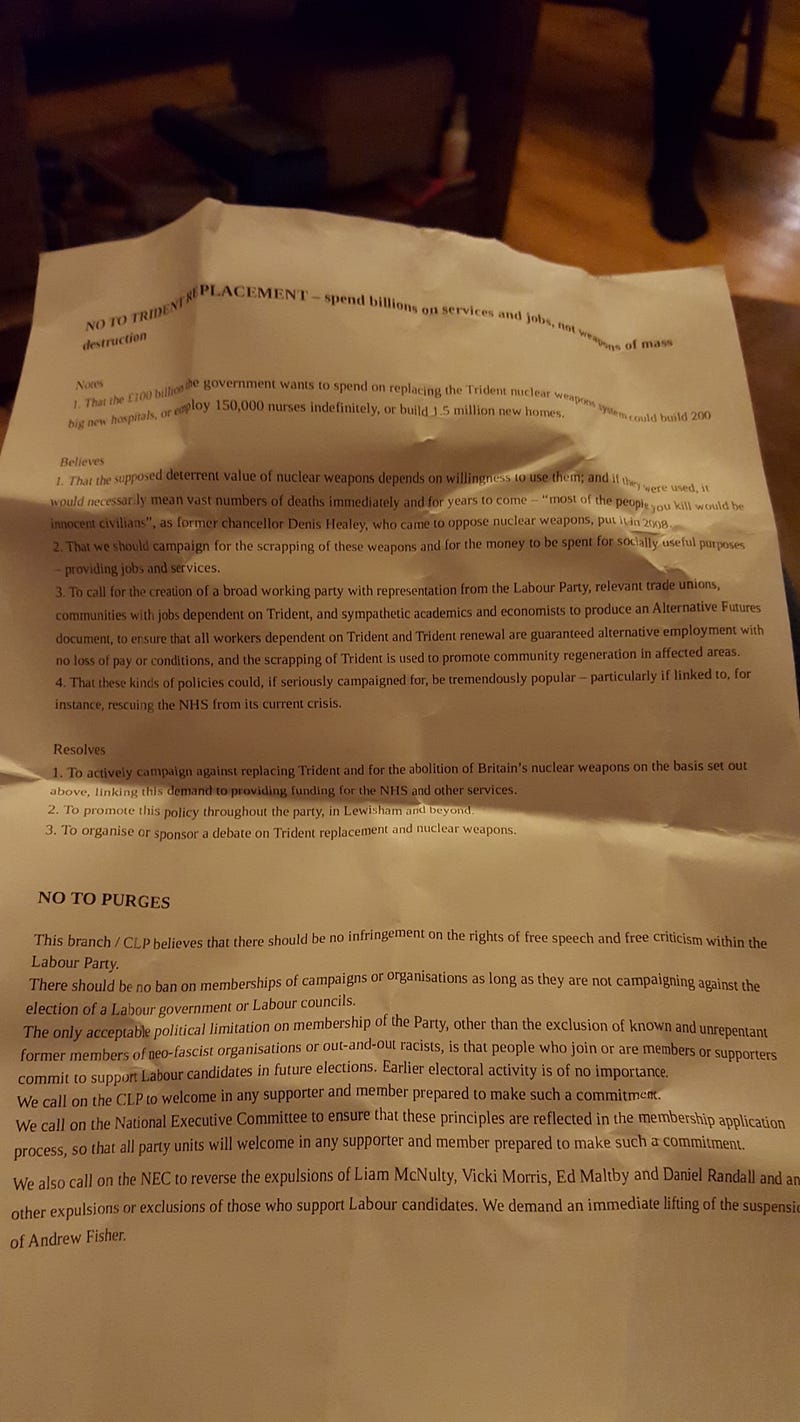
A template motion was passed round by organisers.


It had been produced by Lambeth Momentum. It protested against some recent expulsions and suspensions from the Labour Party whilst calling for anyone who wasn’t “a known and unrepentant former member of a neo-fascist organisations or out-and-out racists” to be allowed to join Labour.

I have no idea on the expulsions but the rest is Militant or the Socialist Workers Party (SWP) or the Alliance for Worker’s Liberty (AWL) or other far left parties trying to use Momentum to get into Labour then into power. No one spoke against this template.

This is scheming by the far-left. It is either naive or scheming by the Momentum organisers to allow it to happen. I don’t know which.

There was lots of talk of Labour, Syria, Trident, fighting the cuts, Labour, expulsions, the media. There was some on housing. People had answers. That surprised me, these are complex problems. Apart from housing, there seemed very little that would have made sense to most people who aren’t already engaged in politics.

It was not open or inclusive. This meeting would attract people who already believe. It did not seem to represent the needs of the local communities.

<insert>

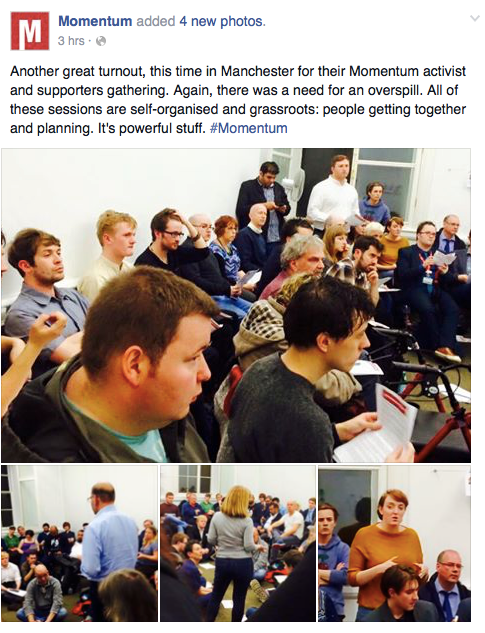
Since I wrote the above Momentum have posted pictures of their first meeting in Manchester on their Facebook page. As with the Southwark meeting that I attended it appears to be mostly white and male.


<end insert>

Momentum and data

We also have to talk about data.

Political party membership is really sensitive personal data. It can be used to discriminate. It was being implicitly gathered at the same time as the email addresses at the Labour Party meeting: everyone there was a member of Labour. Most people were blissfully aware of the implications.

At the Momentum meeting email addresses and Labour branch details were captured so people could organise. Someone even captured emails for people interested in fighting against blacklisting.

This was in the week that the Investigatory Powers bill was released. These email addresses, Labour party membership details, branch information are all being captured and placed somewhere. I wonder where the data went and how many people have it now. This data could be used for the purposes it was intended for but it could also be used for other purposes. Who has access? What controls exist? Who will have access next week or next year? This data could be used to discriminate.

Momentum may be good at using the internet for campaigning but its organisers seem to fundamentally not understand the internet and how it can be used for good and for bad.

The organisers, who mostly seem to be anonymous should have more respect for the people whose data they are gathering.

Frustration and fightback

I went home from the meeting very frustrated. I got even more frustrated when I talked to some of the Momentum people on Facebook. People who told me that it was open and inclusive to have Socialist Party/Militant contributing to Labour Party or Momentum discussions. It really isn’t. It excludes me and many many others. I am further “left” (whatever that means) than many Labour voters. I won’t hang around with Militant, the SWP or many other parts of the far left.

The Momentum organisers claim that they will set up democratic governance. This seems a strange thing to say when you are excluding people by your setup. Democracy should not look like the meetings in Southwark (and Manchester). It should look more like our wonderfully multicultural and inclusive society. I want Labour to do well because of the people it represents. Too many people in Momentum seem to be thinking of their own ideas not what people actually need.

Too many in the Labour movement are currently being idiots. They are wasting energy on infighting and squabbling over internal positions rather than working with people to do useful stuff that people actually need. Let’s cut down on protests and increase the useful activity.

Jeremy Corbyn seems like a very genuine person from what many people have said. I don’t care whether he bows, sings anthems or kisses the Queen’s hands. These things are unimportant to me. Many of the people in Momentum and at that meeting will be genuine too. Unfortunately some are naive and some are scheming. The scheming ones seem to be successfully manipulating the naive ones.

I don’t know what should happen next. There are no easy answers to complex problems like thee two that I think I found:

  1. Momentum do not represent the people Labour represents. Their meetings and groups are not open and inclusive. Momentum think they are.
  2. The far left are back, they are in Momentum, they are in Labour and they are organising.

These two problems are not the same, but they are related.

I hope the problems get solved. It is possible. There clearly are some genuine people in Momentum. I wish them luck.

In the meantime let’s remember the 1980s. Whilst they claim to be a new kind of politics Momentum seem to be heading back to that time. Lets fire up the Delorean….

http://www.theguardian.com/politics/2015/nov/12/corbyn-activists-call-for-no-cuts-council-budget?CMP=twt_a-politics_b-gdnukpolitics

Growing an open Labour Party

I was excited by the talk of opening up and modernising the Labour Party during the leadership campaign.

Both Stella Creasy, who has been talking sense about this stuff for a while, and Tom Watson spoke about it at length in the deputy leader campaign.

On Monday I got a little depressed when I saw the job advert for a new Director of Digital for the Labour Party . It looked like a marketing job for yet another centralised political party. But then a couple of things happened to make me hopeful again:

  1. Jeremy Corbyn got Labour HQ to run a crowd-sourcing campaign for his first PMQs. It’s not a novel idea but it is an important one and it’s always lovely to see someone turn talking into doing.
  2. James Darling, aka @abscond, who worked on the Jeremy Corbyn campaign published a great piece on what he learnt during the campaign and some ideas on how to build an open Labour party.

James’ thoughts aligned with many of my own.

I got involved in the Labour Party in 2014 as a volunteer working with Chi Onwurah, her team and a group of volunteers running an open process to review digital government. I’m not a policy wonk by trade, it was my first ever policy work, so it’s over-long and a bit dull in places but I did manage to sneak in a few easter eggs along the way….

I left a couple of thoughts on James’ post based partly on his writing and partly on my own thoughts and the discussions I’ve been having with various Labour and digital democracy people over the last year. Another James (this time James Smith, aka @floppy) suggested that I expand on those comments.

Inclusion

10.5 million UK adults lack the basic digital skills to go online. Lack of basic digital skills is most prevalent in the DE socioeconomic groups. According to the last census 138,000 people in England and Wales do not speak English with 4 million not having English or Welsh as their main language. I could go on with many many more exception cases.

The existing Labour institutions and processes may be old and creaking but, as difficult as they are to understand, and as much as they need to be simplified, they have grown to try and cater for this complexity. The processes are obscure but they do allow lots of people to get involved in and contribute to the party, its policy development and the campaigns it runs. There are accountability checks and balances.

So, whilst we need to modernise and give world class digital tools to people, we also need to be conscious of inclusion and inequality in all its forms.

In one of my own specialist areas, digital inclusion, due to the political choice of austerity the current Government has done little to tackle the issue. The challenge has been left to charities, businesses and volunteers. Even Parliament’s new petition system shows no awareness that so many people are not online.

Online meetings have barriers just like in-person meetings. The Labour Party’s crowdsourcing exercise for PMQs fell into the same design trap as Parliament’s petition system by not recognising that it provided no way for people without digital skills or access to contribute.

But the challenge of inclusion and equality in a party is so much more than digital inclusion, and if we modernise the party we need to recognise those challenges.

I want to see the Labour Party website supporting multiple languages. I want to see people able to contribute ideas and thoughts anonymously. I want to see Labour Party members and volunteers given digital training and helping others to get online. I want to see proper accessibility for disabled people. I want to see routes to contribute to policy that mix online and offline. I want to see a fully inclusive Labour party regardless of gender, sexuality, race, faith, age or skillset. I want to see everyone, no matter how shy or how loud, encouraged and supported to contribute to open policy discussions.

When rebuilding the Labour Party for the modern age we need to bake-in both inclusion and accountability. Sometimes the user need is democracy.

The Labour Party needs to work for everyone.

Think local

Local government and locally delivered services are important, so are our members, local parties and councillors.

Most people’s experience of the public sector is local. Cleaning up dogshit, emptying bins, cleaning roads these are all things that local government is doing for us every day. It is local government that administers many benefits and that is working with the NHS to integrate health and social care. Local government budgets have been heavily cut by Treasury. This will impact services.

Devolution is now happening with massive transfers of power and responsbility to local regions. Labour runs many of those regions. In some cases extremely well. The gap between the centre of the party and local government has been growing, it’s becoming increasingly urgent that we fix that problem.

In a smarter state many policies can be trialled and rapidly iterated. This approach can’t be used in every case, rapidly iterating foreign policy may be slightly counterproductive…, but there are many public services where these agile delivery and policy development techniques can be used.

If ideas developed through Labour’s open policy discussions can be trialled locally then even when Labour is in opposition in Whitehall it can continue to use the Labour movement to improve people’s lives.

To give some examples. Collaborative ways for teachers to develop lesson plans to reduce effort and give better outcomes for children. Practical ways for communities to tackle broadband issues so more people can get online. Testing whether a basic income gives better results than a new minimum or living wage. Rethinking mass transit. The possibilities are actually quite exciting.

Labour can innovate in local government when, because we are out of power, it will be difficult to do so in the centre.

If the policies work then the Labour Party should celebrate the local government success and help other regions to adopt them.

Members should be challenging local government, just as they should be challenging the central party, but an open and modern Labour Party needs to build a culture that can accept these challenges and that is open to ideas. A movement where ideas from members and the centre can be tested locally and where the centre of the party is receptive to ideas that emerge locally and are better than their own.

Open by design

We should go further than publishing data open-by-default. The Labour Party should become open by design.

Openly publishing Labour’s processes: dates of meetings, local groups, voting history of MPs and Councillors, campaigns and candidate elections is absolutely right but as we enter the world of open Labour we need to make conscious decisions about how we use data and when we publish it openly.

The crowdsourcing exercise for PMQs got 40,000 responses. With a well-communicated data usage policy the Labour Party could arrange to publish all of the ideas after PMQs. Or analyse them to discover common themes, perform sentiment analysis, understand whether they were from members (or not) and then publish the results as openly as possible.

There will be times when Labour should choose not to publish data but there was nothing exclusive about this batch. Other parties can gather much the same ideas. The more eyes we have poring over those ideas the more value we can glean from it and the better understanding we have of what people want. We can lead by example and challenge Government to do the same with the ideas it gathers from the public sector.

Unfortunately the PMQs page did not even have a basic privacy policy, let alone a data usage policy. That should not happen again. We need to clearly tell people how we will use their data and ideas.

Labour needs to be open by design.

Work together to build a better politics

Finally when building an open and digital party we need to be careful not to imagine that we are creating a ‘minimum viable party’ and iterating from there. The Labour Party already exists and parts of it work pretty well.

Jeremy Corbyn and Jon Trickett used open policy to build the Northern Futures policy document. Angela Eagle and her team ran a massive open policy exercise, YourBritain, during the last Parliament. Stella Creasy helped people start and run campaigns during her deputy leadership run. Chi Onwurah publishes open data on her constituency visits and ran an open process for the 2014 digital government review.

There are party members, councils and councillors up and down the country who are doing similarly great stuff. Camden Council have openly shared their work on digital transformation whilst Theo Blackwell, the councillor in charge, engaged his citzens a series of articles on how the council was tackling its budget cuts. Elsewhere Newcastle Council run participatory budget exercises. There are vibrant communities of Labour thinkers and doers running campaigns, writing up ideas and getting stuff done up and down the country.

Whilst these are all good they do need to improve. Better use of digital design and modern technology can improve things massively but we need to work with people. Seeing them and their communities as building blocks that will help form an open Labour party.

As well as building some new services from scratch we should also research where bits of open Labour already exist. Understand who the communities are, what needs they and the people they represent have, what lessons they have learned and then collaborate with them to iterate and improve and iterate and improve and iterate and improve.

I’m excited about an open and modern Labour Party. It’s a cultural change, not a technology one, but it’s a change that the party can make.

A party that uses modern technology and is designed to be inclusive and accountable. One that thinks and innovates locally and rapidly. A party that is open by design and that works together to build a better politics.

If we all recognise the opportunity and work together to grab it we can both build and be part of this new kind of party. It will make Labour more responsive to people’s needs and make the country a better place for everyone.

Just like James I recognise the opportunity, I hope you do too.

Newer posts »

© 2026

Theme by Anders NorenUp ↑

This website stores cookies on your computer. These cookies are used to provide a more personalized experience and to track your whereabouts around our website in compliance with the European General Data Protection Regulation. If you decide to to opt-out of any future tracking, a cookie will be setup in your browser to remember this choice for one year.

Accept or Deny