The public sector is facing pressure to innovate in response to changing needs, financial pressures, and emerging technologies. To innovate it needs to be trusted. The public sector can earn and maintain trust by aligning data and technology use with democratic values.
The pressure to innovate is coming from multiple directions.
Foundation models, such as OpenAI’s GPT-4 and Google’s LaMDA, underpin many recent AI services. These models — which include generative artificial intelligence and large language models- make services like OpenAI’s chatGPT and Google’s Bard possible.
There are many possible intervention points where the introduction of new measures could reduce consumer harm. In this response from Projects by IF to the CMA we argue that the most effective measures will be to require model providers to deliver trustworthy foundation models, including supporting documentation and resources, that are designed to help product teams build better services.
People are rightfully concerned about being manipulated online. One of the causes is deceptive, or harmful, design practices. Two of the UK’s regulators have published a report on harmful design practices. This makes it even more important for organisations to act, but it is not enough. Regulators and service providers need to make it easier to do good design. Here’s where to get started.
My Dad died recently. I went to the registration office in the local town hall to officially register his death.
The registrar was polite, caring, and thoughtful.
They also said something that particularly struck home and made me think about the emotional weight of digital proofs.
A typical registration office in the UK. Prompt: “an office within a UK town hall, the office contains a single desk, the town hall was built in the 19th century, the office has wood panelling, the desk has an old computer on it”, DALL-E 2
Death certificates are physical proofs
I live in the UK where you need a physical copy of a death certificate to do many of the necessary bits of administration, like closing bank accounts, canceling shop loyalty cards, transferring pensions, etcetera ectetera etcetera.
These physical copies are provided by the registrar as a proof of death. This proof gets mailed to organisations who need to be notified of the death.
Like many people my parents are disorganised. We did not know how many organisations would need to know.
So, as a family, we agreed to get lots of physical death certificates. We could then mail out the proofs as we discovered a need for them.
A proof of death can be upsetting, many years after the event
The registrar advised against this as some people had been upset by physical copies of death certificates. Not only in the period immediately after the death, but in the following months and years.
The physical copies of the death certificates are returned to people. They get put into boxes and piles of paperwork, alongside old school records, birth and marriage certificates.
The registrar told me that some families said they could see or feel the presence of these death certificates.
They would come across them unexpectedly, or even just think about a box full of certificates, and get unhelpfully reminded of the complicated set of emotions that accompany any death. A larger number of copies increased the chance of this unhelpful reminder.
Ten pieces of paper may not weigh much physically, but they can carry a large emotional weight.
Prompt: “a pile of paper, sitting in a loft, digital art”, Dall-E 2
More people and organisations are using digital proofs
A digital proof is an equivalent of a physical certificate. Rather than being physically shared a digital proof can be electronically shared between people and organisations.
Digital proofs can be designed so that both the proof and the act of sharing it are trustworthy. For example to verify that the certificate has not been altered, or that only the minimal amount of information is shared.
A well-known example of a digital proof is the proof of Covid vaccination that people who travelled internationally have needed to show for the last few years, but there are many others.
Some countries, issue digital proofs of immigration status, others have digital proofs of driving licences, and so on. These schemes say that they will modernise services and make it easier for people to get things done.
Many of these schemes have been controversial. For example, when the introduction of digital proofs is used to extend the number of services where people need to provide a proof before they can use it, or when the use of physical proofs is reduced in favour of digital proofs.
But it seems very likely they will become more common.
Digital proofs are now being built into smartphone operating systems – such as in Apple’s digital wallet. Lots of the initial focus is on credit cards, but both businesses and countries are exploring how to use them to share data and how to move a range of legal proofs into the digital world.
What will the emotional weight of digital proofs be?
There are lots of long-term implications of building digital proofs.
From the controversies we see in the current implementations, issues of privacy and control, through to a growing reliance on weakly regulated digital infrastructure – like smartphone operating systems.
But what the registrar said about my dad’s death certificates made me think more about the emotional weight of those digital proofs.
What will it feel like to carry a range of digital proofs with us? And into all of the places where we take our smartphones?
How will it vary by the type of digital proof? A school record or proof of age may feel quite different, to a vaccination record, an immigration status, or the proof of death of a relative.
Will the accumulation of proofs matter to people? To reduce the risk of unpleasant feelings will we need different places to store proofs that we need regularly, like a driving licence, to places where we store proofs that we rarely need?
How will the feelings and needs vary for different people and at different moments in their lives?
Some of these questions are things that will be researched and designed in particular services, others are ones that we can learn about from the people who already have to carry them, but some are questions that will only be answered in the aggregate, and over time.
As more digital proofs get created, as more people store them in their phones, and as our smartphones become an extension of that box in the loft containing information about ourselves and other family members.
Just like the paper-based death certificates I talked about with the registrar, digital proofs will not weigh much physically but their emotional weight could be much bigger.
prompt: a dusty box in a dusty loft, on top of the box is a smartphone, the smartphone is pristine and shiny, DALLE-2
Unfortunately the paper’s analysis is incomplete and unlikely to have any real impact.
This risks harm to people and will contribute to a failure to deliver the promised £11bn/year of economic benefits.
The paper proposes an ABC of ethical use of location data
The paper recognises that it is “vital that its use retains public trust and confidence”. It used a public dialogue, quantitive survey, and analysis from the Geospatial Commission’s team to suggest three ethical building blocks, on top of existing legislation, to help achieve this goal of public trust.
The building blocks are:
Accountability – Governing location data responsibly, with the appropriate oversight and security
Bias – Considering and mitigating different types of bias, and highlighting the positive benefits of location data
Clarity – Being clear about how location data will be used and the rights of individuals
Unfortunately, the paper’s analysis is incomplete
The paper’s analysis is incomplete, to provide just four examples it:
has a smaller set of considerations than other geospatial ethics work
implicitly assumes that all people have the same capacity to make decisions
does not discuss ethical issues about places
and does not consider the business models of the organisations that collect and provide location data
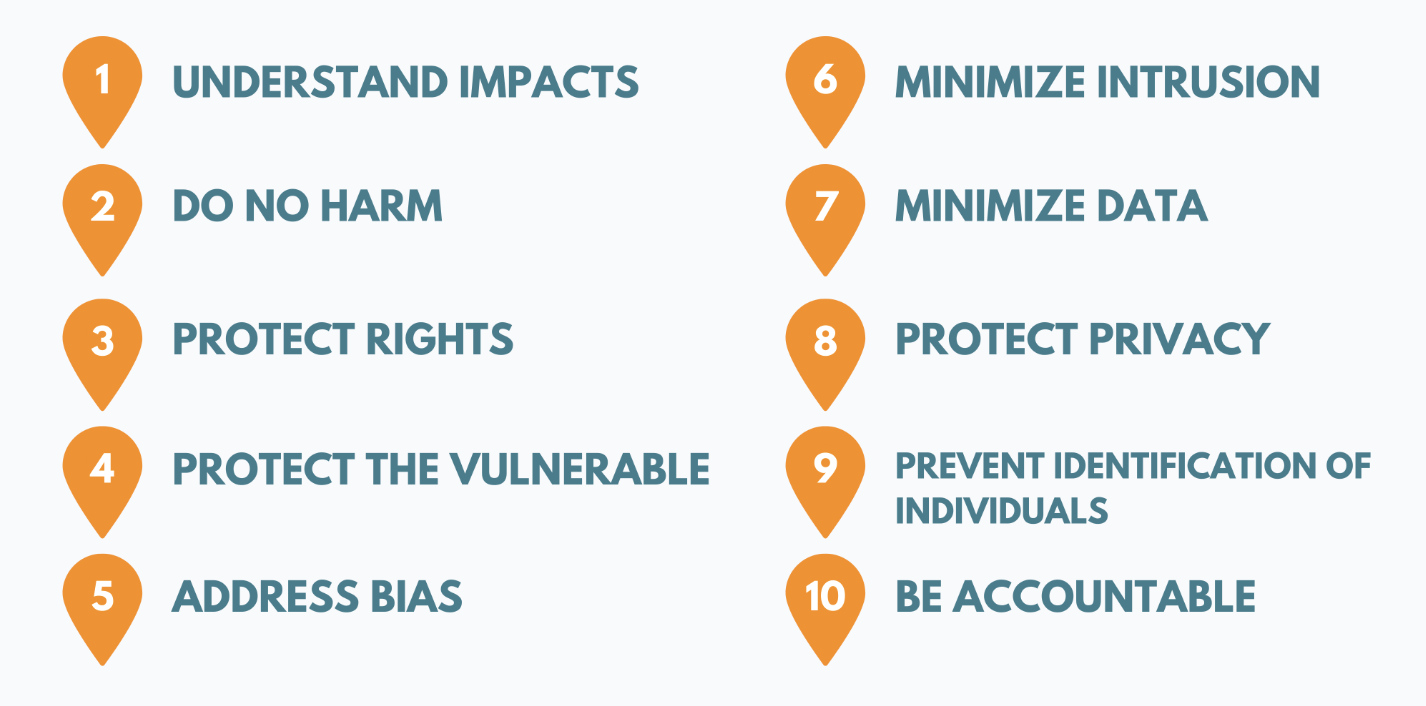
There are three ethical building blocks compared to ten principles in the Locus Charter
These building blocks are a subset of the principles captured in the international Locus Charter for responsible use of location data.
As a result the proposed building blocks do not include protecting the vulnerable, protecting rights or data minimisation.
The Locus Charter has 10 principles, the Geospatial Commission covers accountability (#10), bias (#5) and adds clarity.
Several UK organisations, from the public, private and third sectors, participated in the global work that created the Locus Charter.
The paper does not explain why this existing work has not been reused or why only a subset of the Locus Charter has been included.
Not all individuals or decisions are the same
The paper states that it wants to help individuals make “more informed, meaningful choices” but does not recognise that not all individuals or decisions are the same.
There is no consideration of factors such as someone having no choice in whether to use a service, having low skills, being busy or stressed when they make a decision, how people’s decisions can affect other people, or how some people may be more at risk than others.
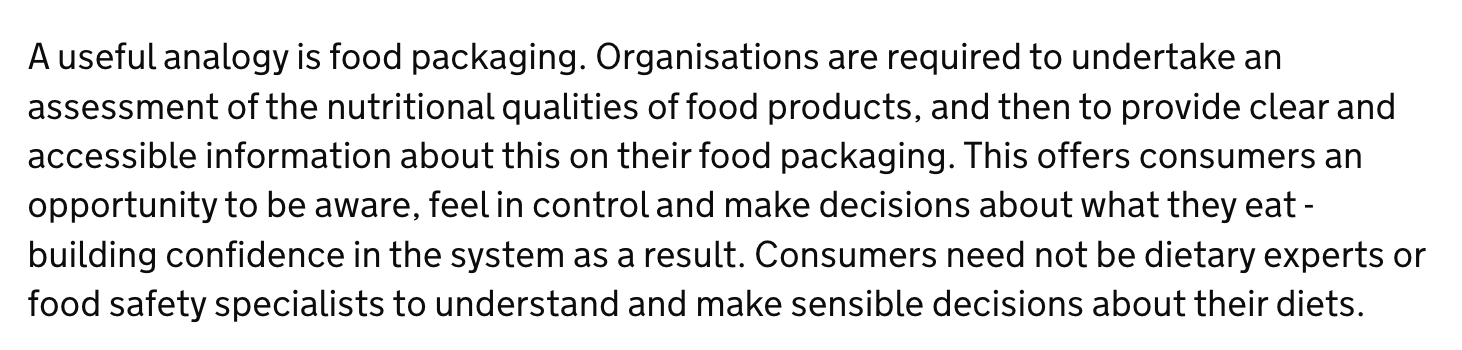
This analogy forms part of the Geospatial Commission’s guidance. It is not a useful analogy. Making food safe requires many more activities than clear packaging. For example there are controls on food ingredients, training requirements for staff, and inspections by regulators.
The paper does not even reference the age-appropriate design code – a statutory code of practice produced by the UK’s Information Commissioner’s Office.
This code was intended to help protect and empower children by ensuring that more services are designed for their needs. The design code states that online services likely to be accessed by children should have geolocation options turned off by default.
The ethics of place and communities are neglected
The paper says that location data is about people, events, and places. Unfortunately, the ethical considerations that are discussed are mostly concerned with location data about individual people, or personal location data, the ethics of place and communities are neglected.
You would look in vain if you wanted to find discussion of ethical issues such as:
whether and how places – such as domestic refuge centres, abortionclinics or military bases – might need to be protected to prevent harm
whether and what decisions about the collection, sharing and of location data should be made by devolved administrations, city-regions, or the local communities that live in those places
Business models are an ethical issue but are not mentioned
Finally, many ethical issues stem from business models and incentives.
Neither the business models of the UK’s public sector geospatial agencies or those of the private sector firms, for example those in the advertising industry, that collect and manage location data are considered.
The paper is unlikely to have any significant impact
These are just four gaps in the analysis. I could go on, for example there is no recognition of the distributional impacts of the benefits and risks across different places and different groups of people, but as well as the incomplete analysis the paper is unlikely to have any significant impact.
This is because of:
the hugely diverse range of organisations and people it needs to affect
it is not sufficiently grounded in how teams work
it does not assess existing legislation or consider legislative change
Will thousands of people in a huge range of sectors read the paper?
As the paper says location data is ubiquitous. To create impact the Geospatial Commission needs to affect the behaviour of the thousands of organisations and people that collect, share, use and maintain location data..
The paper uses examples from a huge range of sectors and disciplines: transport, wearable technology, drones, space, smart homes, healthcare, statistics, social sciences, online services, public services, private services, and the UK’s ubiquitous potholes.
A pothole in Newport on the Isle of Wight, CC-BY-3.0 by Editor5807
Are organisations and workers in all of these sectors and disciplines likely to follow the recommendations in the paper? Does the paper align with existing practices, challenges, and opportunities in their contexts? Are they even aware of the Geospatial Commission?
Insufficiently grounded in how teams work
Rather than looking at policy papers, the teams who build products and services or perform statistical analysis tend to use manuals/guides, reuse openly available code, data and design patterns, and learn from how other teams do their work.
Within the UK this is also one of the reasons why Government Digital Services worked in the open. They regularly blogged, published open source code, and created a service design manual for public services built by central government.
Consciously or not, these guides, source code and data embody particular types of ethical practices and decisions made by teams, but it is noticeable that the Geospatial Commission’s work is stuck at the level of principles and policy papers, rather than producing their own examples and guides or by embedding their proposed principles into the existing manual and guides.
It does not appear that the Geospatial Commission have thought about how to take their work to the places where digital and statistical teams do their work.
Organisations and people will also respond to legislation and regulation, but while the paper states that existing legislation provides a baseline it does not describe the existing legislation or assess whether the legal and regulatory framework needs to change.
As previously mentioned the paper does not cover the ICO’s Age Appropriate Design Code and its section on geolocation.
It also does not mention the existing legal definition of location data, under the PECR regulations, a definition which is narrower than the Geospatial Commission’s work, the accompanying guide, and the work that has taken place in multiple organisations to comply with PECR.
The PECR definition of location data is narrower than the Geospatial Commission’s definition
The Geospatial Commission was established as an “independent, expert committee” but despite this independence the paper does not reference the UK government’s ongoing plans to reform data protection law or assess whether the changes will help or hinder the Commission’s strategy.
Meanwhile new changes to legislation are not considered in the paper. No reason for this is given.
These changes might be to help deliver on the Geospatial Commission’s objectives of economic growth, to enforce the Geospatial Commission’s proposed “ABC” building blocks, or to help protect people and communities from the increased risks that more data collection, sharing and use will cause.
Even the simplest of legal changes, such as making personal location data a new type of special category data, or powers for appropriate public sector organisations or regulators to make more reference data about places openly available and reusable, are not considered.
This paper will not help deliver the promised benefits
I am deliberately not forming opinions on whether the Geospatial Commission’s goal of creating £11bn of economic value from increased use of location data is feasible and/or desirable, but I cannot see how this paper will help.
As the Geospatial Commission correctly identified, their strategy needs to retain public trust in the use of location data. A failure to do this risks harm to people and will contribute to a failure to deliver the promised benefits. And failing to deliver those promised benefits will harm the government’s wider economic objectives. This paper will not help retain public trust and can only contribute to the inevitable failure to deliver the benefits.
Rather than an incomplete set of ethical building blocks we need more practical guidance and tools for teams to use, and an assessment of the legislative and regulatory framework that the government’s proposed larger location data market will need.
One of the interesting things is in the first commitment, it says:
By 2025, at least 50 of the government’s top 75 identified services will move to a ‘great’ standard, against a consistent measure of service performance
The word great is in ‘quotes’, but not defined.
The strategy goes on to say:
Each cross-government commitment is being translated into quantifiable, department-level targets against which progress will be measured
This could be useful, but, what does ‘great’ mean?
The definition of ‘great’ matters
Definitions, measurements and targets affect behaviour.
The behaviour of the people who are building and operating public services, as they are set the target of doing something ‘great’, and the behaviour of the people collecting measurements and monitoring targets. The second group might be people inside or outside government.
Politicians, civil society organisations, and communities across the country might track and debate the measures and targets while, with careful design, they could be available to citizens at appropriate moments during use of the service.
And those are just some first order effects.
But the strategy does not say much about what makes a ‘great’ public service
The foreword from the Minister includes the following:
When people order their groceries, book a holiday or check their bank accounts, they expect and receive a seamless and easy experience.
People expect government services to be as good as the best online experiences in the private sector. Rising to meet these expectations will require change on a scale that government has never undertaken before
While the annex, which lists the top 75 services says:
these prioritised services will have great user experience and efficient processes that reduce their cost to run.
These are useful things but they speak to some of the definitions and measures that the private sector might use for online services – ease and speed of completion, volume, cost, perhaps even Net Promoter Score [1].
They don’t speak to the different qualities of a public service.
Perhaps ‘great’ should include accessible, transparent and accountable?
Public services need to be accessible by anyone who needs them so perhaps the definition of ‘great’ could include accessibility measures and targets to support that, for example:
travel time to physical locations – like a job centre, library, community centre or town hall – where the state provides access to the service
Governments hold a lot of power over citizens so we expect more transparency from public services than we do private services. Measures and targets could be set around transparency, for example:
publication of the evidence, research and design decisions, source code, data, tests, and other components that form part of the service
And because of the power governments hold over citizens we also need public services to be strongly accountable. Again, you guessed it…, measures and targets could be set around this, for example:
understandable information about which organisation, or even individual, is accountable for different parts of the service
how easy dispute resolution processes are to access and use
measures of dispute resolution processes, such as the volume of disputes and the amount paid out in compensation
A ‘great’ debate could be useful
But, these are just ideas. Ideas that I have kept deliberately short for a quick blogpost.
Other people will have better ideas and government needs – please excuse the puns, I have Coronavirus this weekend – great ideas.
Performance measures need to be carefully designed to make sure that they are useful. It is all too easy to create metrics that have no impact or, even worse, drive the wrong behaviour.
I can imagine some of the people I know suggesting measures of ‘great’ that might encourage things like:
From that ‘great’ debate this Government might come up with good ways to define and measure ‘great’ public services, and so might the UK’s other national, regional and local governments. Different governments are likely to use different definitions and measures, because measures tend to include our values and the various governments around the UK have slightly differing values. That’s perfectly healthy and normal.
But they should all be definitions and measures for ‘great’ that go beyond the private sector and recognise the unique characteristics of public services.
That could be useful.
Footnote
[1] Question: “Would you recommend this <pay your tax bill service> to your friends?” Answer: “well yes, but that’s because I believe in a well funded state that uses taxes to provide great public services to people who need them, rather than because the <pay your tax bill service> was particularly easy or hard to use this year”
The Royal Statistical Society is running a series of events for members and other statisticians to garner opinions on the UK governments’ handling of the Covid-19 pandemic. I gave a two minute talk on data, local government and local communities within England. Here it is.
Hello, I’m Peter Wells. Thank you to the RSS for the opportunity to speak. I’m a committee member for the Data Ethics and Governance section and work with businesses and public sector organisations on trustworthy and responsible use of data.
I would like to talk a little bit about access to data for English local government and communities and how better access could have saved lives and built trust, and how different data was used in local government – particularly in Summer 2020.
Data collection and statistical processes – such as those in NHS Test & Trace and the Covid-19 data store – were put in place to meet these national needs.
But there were also decisions to be made locally. Where to advertise the new guidance and rules and in what languages. Where to place testing sites. Which workplaces needed stronger enforcement.
They worked with the NHS and a range of other partners such as care providers, police forces, charities, businesses, community groups and individual citizens to do this.
The kind of partners that helped make and implement these decisions for other public health issues.
But for many months – through Summer 2020 – local authorities and local communities lacked data about the pandemic as the data collection and statistical production processes did not meet local needs.
Decisions were not made, or were made with lower levels of evidence than the evidence available to the national government in England.
Local capabilities that could have helped with the pandemic were underused.
If, as well as prioritising national needs, there had been a greater emphasis on local needs for data and statistics and a greater emphasis on using and strengthening existing capabilities then we may have had better data and more effective local responses.
That could have saved lives.
As a result of this data gap some pIaces started collecting their own data from their communities while businesses – like telecoms operators and data brokers – started selling proxy data collected from non-healthcare related services to local authorities.
This was different data than the data that already existed in the public sector and was being used by the national government in making decisions about England.
Those differences create some opportunities to evaluate which methods worked better, but it also caused some trust issues* between national and local govt as people disagreed on the data and evidence behind the discussions.
Looking ahead, beyond the pandemic building local capability and trust in data use between national and local government may also help with other policy goals like levelling up.
But levelling up is probably a future evidence session…
*Due to the two minute rule, and my usual diversion into a nervous joke or two, I didn’t speak these two paragraphs out loud. They’re in here for completeness:
“When places like Leicester and Greater Manchester were in months long local lockdown both local politicians and citizens wanted to know if the lockdowns were needed, and helping with, the local outbreaks.
They did not always trust the decisions that were being made nationally and did not always have access to trustworthy data to check or challenge those decisions.”
The Law Commission of England & Wales is a statutory independent body with a role of keeping English and Welsh law under review and recommending reforms. Every few years it asks for submissions for its programme of work. This is a submission suggesting the topic of database rights for their 14th programme of work.
Database rights is a topic that feels like it regularly comes up as an issue on problems that I care about. Perhaps it is something the Law Commission will pick up.
It is unclear whether database rights have delivered on their original intention and areas of the rights lack clarity. It is possible that the net result has been reduced investment in databases with a corresponding reduction in productive activity.
Looking to the future, the EU-UK withdrawal agreement has removed reciprocal recognition for new database rights. This will reduce the benefits received by UK database owners. Meanwhile changing models of technology development and successive government’s policy objectives to increase access to and use of data are challenging the appropriateness of database rights as they were originally designed.
To help deliver on the intended objective database rights should be reassessed through three lenses:
the UK leaving the EU
emerging technology
simplification of the law
Can you give us an example of what happens in practice?
Terms in the regulation, such as “substantial investment”, are weakly defined so it can be unclear which databases receive their protection. This can cause uncertainty for both database owners and database users about whether a particular database is protected. Database owners who desire protection can expend unnecessary effort creating additional legal and/or technical measures. Database users can choose not to use data that they are legally allowed to due to either their own uncertainty or because of legal threats by database owners who may not have database rights. This reduces useful innovation activity and can limit freedom of expression.
Database rights can generate conflict with other policy initiatives such as open science and public sector open data. It is unclear which of the open datasets produced by these initiatives contain database rights that their owners want to protect, and it can be unclear what activities can be undertaken using these open datasets without causing any new database to also contain database rights. As with the lack of legal clarity this limits reuse and reduces the impact of these initiatives. A specific example that is regularly discussed within the UK data community, and which I have worked on, is address data.
There have been technological changes since database rights were introduced. For example, the growing proliferation of sensors or the increased use of collaborative maintenance techniques in developing services such as TripAdvisor, Facebook, Waze and OpenStreetMap. Database rights were not designed to support these changes leading to further grey areas where it is not clear what legal protections and rights exist for each stakeholder. This will lead to the loss of useful innovation and contribute to what is increasingly perceived as an unfair balance of rights and interests between data subjects, data contributors, database owners, data reusers and beneficiaries.
It is too early to provide an example of how the lack of reciprocal recognition of new database rights between the EU and UK will cause problems in practice. It is possible that organisations will be unaware of this lack of reciprocity which may cause them unexpected losses or additional legal costs.
To which areas of the law does the problem relate?
The issue is located within intellectual property law but has overlaps with other areas such as data protection, reuse of public sector information, and competition law.
Can you give us information about how the problem is approached in other legal systems?
Database rights are unique to the EU, and now to the EU and UK. No other country has introduced sui generis database rights since their introduction in 1996/7. This is an indicator for how other countries may have assessed the effectiveness of database rights. Instead other copyright and competition mechanisms are used to deliver on the same objectives.
Within the United Kingdom, does the problem occur in any or all of England, Wales, Scotland or Northern Ireland?
All
What do you think needs to be done to resolve the problem?
An evaluation of database rights to help understand whether and how it has incentivised investment in databases within the UK.
An assessment of the future needs for database rights given the UK’s current legal and policy context along with expected changes enabled by technological development.
This evaluation of past performance and assessment of future needs may lead to recommendations to change legislation.
What is the scale of the problem?
Organisations are increasingly using data, along with other things, to inform decisions, perform research, build new products and deliver services.
Significant areas of government policy such as the national data strategy and AI strategy intend to increase the pace of this trend. Due to this the problems that exist with the current legislation will increase.
What would be the positive benefits of reform?
The benefits could be numerous and felt by a diverse range of actors from journalists using public sector open data to report on public policy, startups using a mix of sensors and existing databases to create new services, or increased investment in databases by businesses.
These benefits will translate into supporting technological and digital development, reduced legal costs, fairness in rights over data, and simplification of current law.
If this area of the law is reformed, can you identify what the costs or other negative impacts of reform might be?
Undesirable negative impacts are likely to be limited to large, existing businesses that rely on database rights to justify investment in databases that support their services. These needs should be captured in the proposed evaluation exercise and addressed in the future-looking assessment.
Does the problem adversely impact equality, diversity and inclusion by affecting certain groups in society, or particular areas of the country more than others? If so, what are those groups and areas?
No
In your view, why is the independent, non-political, Law Commission the appropriate body to undertake this work, as opposed to, for example, a Government department, Parliamentary committee, or a non-Governmental organisation?
The problems generated by database rights are not an area of political contention. There is cross-party support for technological change and simplifying existing law.
The Law Commission are ideally placed to consider the interests of a range of stakeholders and make recommendations that strike a fair balance.
Have you been in touch with any part of the Government (either central or local) about this problem? What did they say?
n/a
Is any other organisation such as the Government or a non- Governmental group currently considering this problem? Have they considered it recently?
The European Commission are currently considering the problem. The recent evaluation published by the European Commission included an annex with country-level findings with the UK as one of the highlighted countries. The Law Commission could draw on this work in their own considerations.
No UK organisation is currently known to be considering database rights or to have considered it recently.
This is the summary of a report I worked on for the Alliance for Full Employment, AfFE, on digital inclusion. The full reportwas published in April 2021and includes forewords from Gordon Brown, Sir Tim Berners-Lee and Baroness Martha Lane-Fox and more detailed arguments behind the recommendations.
The Alliance for Full Employment was co-founded with the Metro Mayors of Manchester, Liverpool, Sheffield and Newcastle City Regions, the First Minister of Wales and the Mayor of Bristol to encompass all regions and nations of the United Kingdom and to bring people together in support of for nationwide economic recovery policies that can prevent rapidly rising redundancies and unemployment.
To build a UK that is fit for the 21st century we need to fix the digital divide and support everyone to get online.
The statistics are stark. 17.1 million adults in the UK lack essential digital skills in the workplace, 11.7 million adults lack essential digital skills for life, and 9 million adults cannot use the internet without help.
Over the term of this parliament we can get 4.8 million more people online. This will create benefits for individuals, communities, businesses, the UK economy and society.
The pandemic showed us that things many had assumed would never go online in fact can go online and work well when they do. It brought more motivation for people to go online, but also exposed the amount of children without access to devices for remote learning, and drove more people into data poverty as they could not afford internet access.
Amidst the tragedy there has been incredible grass roots digital ingenuity to help people in need. We need to keep building on this, not slide backwards, and continue the momentum to bring the rest of the country online.
Because despite years of effort too many people in the UK are still digitally excluded. They cannot use the internet because they lack internet access, data, an appropriate device, or essential skills. While much has been done, some critical parts of the puzzle have been missed.
This has left a social and economic problem that affects millions of people, making it harder for them to lead fulfilling lives and get into good jobs. It reduces the impact of the government’s investments in 21st century technology and public services. It hinders attempts to tackle the UK’s productivity problems and weakens the UK’s businesses, both large and small.
It will make it harder for the UK to build back after the pandemic, and it weakens our ability to respond to the next one. Ten years ago it might have been acceptable to think that not everyone needed to be able to get onto and use the internet, that is not the case now. This last year has taught us that we cannot move fast enough to bring people online in an emergency, we need to tackle the digital divide in normal times so that we have a stronger, more digitally capable society and economy when it is most needed.
There is no single magic fix for digital inclusion. Including people is not a one-off activity that can be completed and then forgotten about. People’s situations are different and will change over time. If someone does not keep using digital technologies then their skills and motivation can fade. A project that works for one group of people in one location might be unsuitable elsewhere.
Governments at all levels, in all of the nations of the UK and of all political colours agree with the need to fix the digital divide. Yet we lack a guiding framework within which to achieve this.
Within such a framework all four nations of the UK need to work together to build a sustainable and broad response in every place of the UK. A response that provides support to help everyone get online as, where, and when they need it.
This needs vision, leadership and funding from all four nations. It needs a mix of activities in national governments, devolved administrations, city-regions, communities, and across the public, private and third sectors that forms a structural response meeting people where and when they need support.
The UK is not alone amongst democracies with this problem. The USA, Canada and Australia all have profound issues. The prize for the UK is to lead the way to a 100% digitally included nation and reap the competitiveness and social benefits that it will generate.
This report sets out 10 recommendations for the UK’s national governments.
Let’s tackle the digital divide. It will benefit us all.
Recommendation
Description
£130m investment programme
The upcoming Shared Prosperity fund should support a £130m programme of national and local digital inclusion projects that are designed to meet local needs and priorities
Improved social broadband tariffs
Ofcom should take the lead in improving social broadband tariffs by harmonising the eligibility criteria, working with operators and government to improve the customer journey, and mandating that all operators offer a social tariff to an agreed level of service
Essential public services should be free to access online
Government Digital Services (GDS) should work with other government bodies, Ofcom, telecoms service providers, and a range of civil society organisations – including specialists in digital inclusion and specialists in digital rights – to explore zero rating for essential public services and implement a long-term solution. This will allow citizens to access essential public services even if their data has run out.
The Plan for Jobs should include a digital inclusion strategy
The Plan for Jobs includes programmes like Kickstart, Restart, T-Levels and Apprenticeships that need to cater for people who are not currently digitally included. They should take advantage of the opportunity to get people online. Where regional or local initiatives, such as Connecting Scotland or the GMTech Fund, exist then these programmes should coordinate with those activities
Digital inclusion strategies for education in schools
All four nations should develop and implement digital inclusion strategies for education in schools which ensure every child has an appropriate device and that place essential digital skills targets on the same footing as numeracy and literacy
Commitment from all four UK nations to fix the digital divide
All four nations of the UK need to fully commit to fixing the digital divide, developing a strategy and accompanying programme of activity
New delivery groups to halve the digital divide by 2025
These delivery groups will take responsibility for halving the digital divide over the next four years and persistently eliminating it in the next four
Improve the evidence base
The UK Statistics Authority (UKSA) should assess the evidence on digital inclusion and recommend how to both fill immediate gaps and develop better evidence gathering methodologies for the future.
75% of employees to receive digital skills training from their employers
Government should set a target of 75% of employees receiving digital skills training from their employer. BEIS should work with business groups and trade unions to achieve this target.
New digital inclusion design guidelines for public services
To help create a sustainable environment where the need to fix the digital divide is built into new public services and programmes, advice on how to support and fund digital inclusion should be built into appropriate government guidance and checked during governance processes.
Addresses are vital infrastructure for a modern country. As people and countries adapt to the internet age lists of addresses have become reference data. Other countries are making address reference data available for anyone to use, but the UK has chosen a different path by keeping restrictions on who can use the data. This will hinder the UK’s ambitions to be a leader in developing and adopting digital technology.
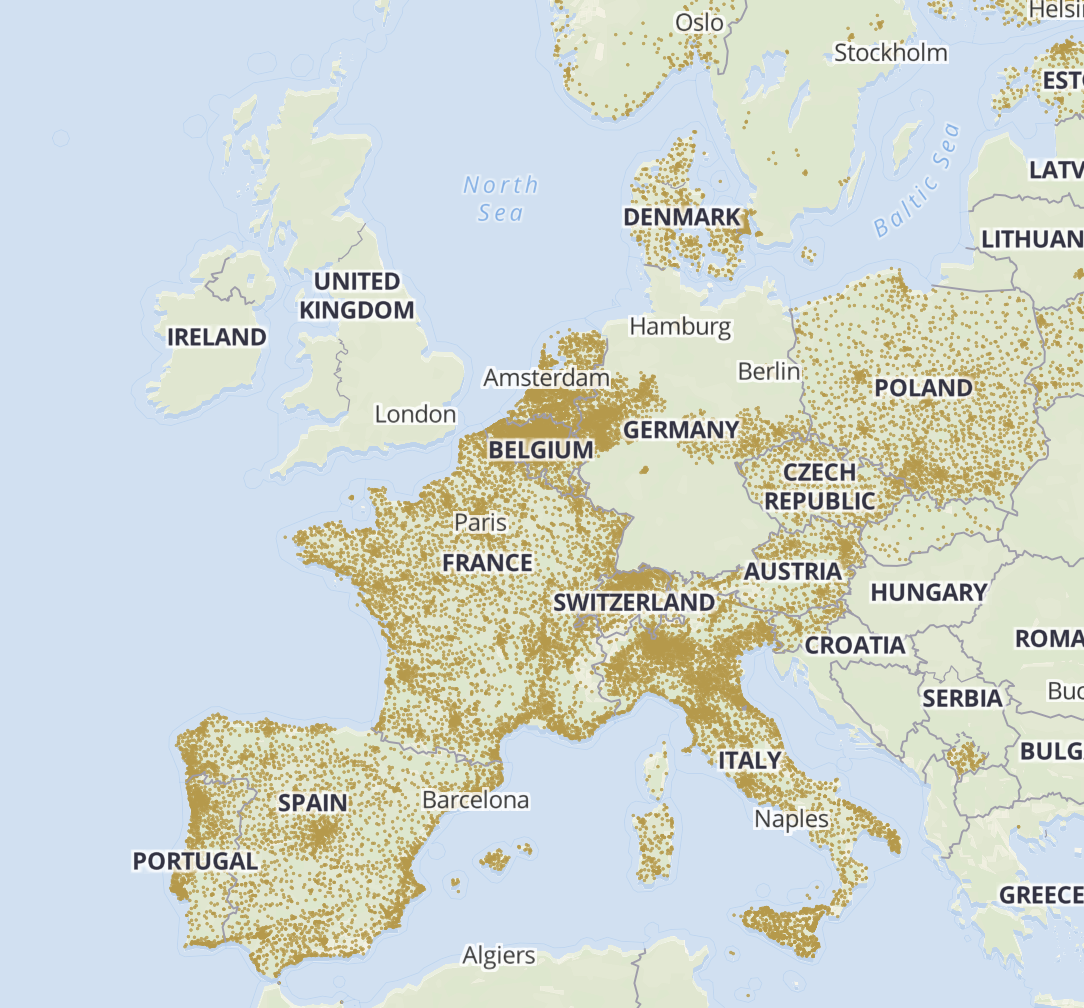
There is a website, OpenAddresses.io, that collects address data from around the world. The front page has a map that tells a tale.
Despite the UK having over 30 million addresses it looks empty and unoccupied.
Most of the rest of Europe is alight with dots of address data.
The map is a warning sign that, unlike other countries, the UK is failing to build vital 21st century infrastructure.
Address data is important
A little history is useful to help understand why addresses are so important.
Addresses were invented to help governments carry out public services like performing censuses, conscripting people into armies, and collecting taxes. Early addresses were written on houses.
People gradually realised that addresses could be useful to them as well as to their governments, so addresses got used more and more widely: to deliver post and parcels, to connect up water supplies, to find a local doctor, or to help us find our way around a strange town.
It seems inevitable that addresses have now become important to the digital services that we now rely on. An address is a vital piece of information that links together ordering a package on a website to the delivery driver finding your house.
As a result we increasingly store and exchange addresses as data within computers.
Authoritative address data is important
But if these computers had incorrect addresses then things would go wrong.
To reduce the chances of this happening the public sector agencies that were responsible for maintaining addresses started publishing lists of authoritative address reference data.
The type of box that CD-ROMs of UK address data used to come in
Authoritative address data should be as widely available as possible
But maintaining and publishing authoritative address data costs money and governments need to make a decision for how to pay for it.
There are several ways to do this. At the simplest level the costs could come from licence fees paid by organisations that use the data, registration fees paid by organisations that build properties, or from another form of taxation.
Some reference data is highly sensitive. Think of the location of domestic violence refuges. Societies rightly protect that kind of data due to the risk of harm.
But the list of addresses that exist in a particular place is less sensitive . It creates a low risk of harm to people, and creates more benefit as we make it easier for more people to use it.
Charging organisations to use the data works against that goal.
Other countries have moved to open address data
Because of the benefits of authoritative address data other countries have decided it should be openly available and free to use. They recover the costs from a combination of tax and registration fees. They have made free address data a public service.
Here is a list of countries in Northern and Western Europe. Twelve out of nineteen countries make address data available for free. The United Kingdom is one of only four countries that makes no data available for free.
This is what the map on the front page of the OpenAddresses.io websites shows.
Countries that have decided that openly available authoritative address data is a 21st century public service, and countries that have not.
Instead successive UK governments have told Ordnance Survey that they need to make a profit by selling licences for geospatial data, including address data, and when the Royal Mail was privatised in 2013 it was given the right to maintain and sell lists of postal addresses. Short-term decisions that could have long-term consequences.
These decisions create financial and legal barriers that make it hard for people to use address data.
The public sector feels the pain less because national government has paid £963m to be able to use geospatial data, including address data, for its own purposes. Businesses and civil society feel the pain more.
Address data is vital to the future
This is not just not about making it easier to deliver parcels today, it is about investing for the future.
Companies like Alibaba, Amazon, Baidu, Facebook and Google might spend billions researching and developing new technologies and services, but they also maintain boringly good reference data.
It is similar for many other governments. Outside of the UK, making address data widely available is seen as a complement to digital and artificial intelligence strategies. It is an investment in the future.
Unfortunately the UK does not seem to see it that way.
We seem to still see address data like the Enlightenment Age governments that wrote addresses on houses for their own use, rather than a digital age government that makes reference data available for everyone to use.
It does not have to be like this
In 2018 the UK government created a Geospatial Commission to promote the best use of geospatial data, like addresses.
The Commission could establish a new, sustainable funding model and support the public sector to publish address data that is accurate, regularly updated, and freely usable by anyone offering services to people in the UK. It could treat address data as a public service.
That would help the UK keep up with other countries and be a wise investment in the UK’s future.
Hello. This is the personal website of Peter K Wells. I do politics, policy and delivery to try to make data and technology benefit everyone. I also do bad jokes and music references.
This website stores cookies on your computer. These cookies are used to provide a more personalized experience and to track your whereabouts around our website in compliance with the European General Data Protection Regulation. If you decide to to opt-out of any future tracking, a cookie will be setup in your browser to remember this choice for one year.