You can send a form letter to your MP about the debate using the VoteFootball site but it is more likely to be effective if you send a personal letter using the WriteToThem site produced by the lovely people at MySociety. It is likely to only take 5 or 10 minutes. Write about what you know and feel. Be concise. Give links to more detail and evidence. Be polite. Ask for a specific action.
On 9 February the House of Commons will be debating the following motion:
That this House has no confidence in the ability of the Football Association (FA) to comply fully with its duties as a governing body, as the current governance structures of the FA make it impossible for the organisation to reform itself; and calls on the Government to bring forward legislative proposals to reform the governance of the FA.
Can I ask you to attend the debate and support the motion?
There have been many governance failures of the FA, and other English governing bodies. I am particularly concerned about the lack of representation for fans and the lack of action against the owners of football clubs who act against the interests of the game, the fans and the communities in which the clubs are rooted.
There are numerous current examples of fans protesting against and boycotting their clubs because of the actions of their owners. For example, Charlton Athletic, Coventry FC, Blackburn Rovers, Leeds United and my own Blackpool FC.
Reformed governance of the FA which provides transparency, accountability and gives power to fans will help alleviate the situation at Blackpool, and other clubs, and can reduce the chance of similar cases happening again.
Please support this motion to help make that happen.
Data is becoming increasingly important to our societies. We live in an age of data abundance and, without many of us realising, data has become a new type of infrastructure and a critical one at that. The age of data abundance has led to brilliant new services and can help our societies tackle challenges such as climate change and population growth, but it also creates risks to privacy and concentrations of power.
Societies need to be able to debate what this age of data abundance means for them. People need to make decisions about the relationship between individuals, communities, societies and data. We need to pick a future vision for our relationship with data and then make steps towards it. Many governments and societies are having this debate now.
In my job I put forward the Open Data Institute’s position on those decisions while also trying to encourage a more public debate. I want a debate because I, and the lovely people I work with, want the decision to be made by societies around the world.
To make this debate as broad and informed as possible, I need what I say to be understandable by as many people as possible. I try to use plain language and frequently test new language and concepts to see if they are understandable. Sometimes I test things through tweets or blogs, like this one, at other times by talking with people from differing backgrounds and perspectives.
By testing, listening and learning I have made some of the language more accessible but I’ve also realised that something was more important than I first thought: politics. Both my politics and that of others.
I was talking about the ideas in that blog with a left-wing British politican who stopped me mid-sentence and asked if I was a Blairite nowadays. No, I replied. “Then why are you using the language of Blair’s choice agenda?”, they asked.
Further testing of the language caused another person to recoil and suggest that if I kept talking about choices I might be accused of being a secret Thatcherite pushing the theory of public choice. Hmm….
I’d used the word ‘choice’ because I thought it was plain language but it was clear that the decision risked putting in place a political barrier for some of the other ideas in the blog. This is a problem.
Data is political
When thinking about and debating technology and data with other technologists it can be easy to fall into a trap of thinking that every decision can be based on empirical evidence, that there is a single right answer and that we can make that right answer a reality by designing and building the right technology. This is nonsense.
In our debates about data we need to decide issues of access, ownership, regulation and the relationship between citizens and the state. These are political decisions.
Whilst we might have individual opinions about data we need a state and legal system to help put decisions into practice. States will allow technologists to innovate and try things out but there comes a time when existing legislation will be more strongly applied or new legislation will be put in place as society’s needs change. This happened and continues to happen with road traffic, it will happen with data.
By broadening the debate we are helping that decision to be made democratically. Democracy might have seemed under strain in some countries in 2016 but as Churchill said:
Indeed it has been said that democracy is the worst form of Government except for all those other forms that have been tried from time to time
The “white heat of technology” makes me think of Harold Wilson and the 1960s UK Labour party. Because of my political history I have positive feelings about the phrase despite the speech being followed by the scrapping of several high-profile technology projects. Image copyright PA.
Some words carry a particular meaning in the present because they have been used in a political context in the past. Marx said it more poetically:
The tradition of all dead generations weighs like a nightmare on the brains of the living.
The word “choice” resonated amongst some people involved in British politics that I spoke to because of those traditions and their political history. It will have bought back nightmares for some and heavenly dreams for others.
Data is not about left or right wing politics
In economic terms each of these cakes is rivalrous: only one person can eat them. Cake is not like data, multiple people can use data at the same time. Picture of cake by Hani AlYousif, CC BY-NC-ND 2.0
Our societies and political systems are used to making political decisions about many types of resources, for example oil or water, but data has different qualities to the physical resources that are embedded in our political systems, debates and legislation.
To give two regularly used examples: data is non-rivalrous, unlike a piece of cake many people can use data at the same time, and data benefits from network effects, it becomes more valuable as more people use and maintain it.
These differences are one of the reasons the team at the Open Data Institute talk about data as analogous to roads:
Data is infrastructure. Just like roads. Roads help us navigate to a location. Data helps us make a decision.
The “data is roads” analogy breaks people out of the traditional mindset. It helps open their minds to thinking differently.
But it will be harder to get people to think about the decisions along that closed-open axis if our words and ideas cause them to think of old left and right wing political battles.
Much of the current debate about data is dominated by personal data: the stuff which is about identifiable people. Many people believe that there is an asymmetry of power and privacy as data about us is controlled by governments and corporations.
Tav Kotka, the Chief Information Officer of Estonia, recently gave a talk in which he broached the idea of adding a fifth freedom to the EU’s existing four freedoms for free movement of goods, workers, services and capital. The talk was mostly about personal data and the concept of personal data stores that could allow individuals to control how data about them is used.
Whilst I agree that more personal control over personal data is important the talk bought up memories of Margaret Thatcher and my teenage political nightmares. The talk did not mention society’s need to access and use that data. Taking back control of data by giving control to individuals misses out the challenges of digital inclusion and the role of other important parts of society like families, communities and nations. Different levels of control, rights and responsibilities are likely to need to given to these different groups. To give just one example vital medical research and national statistics need to use large amounts of personal data, this can’t be neglected or left solely to the decisions of individuals.
But, as I realised, this time I was the one allowing my political history to do the interpretation for me and I was the one who wasn’t listening to the underlying argument. Tav Kotka was using language that built on his political history while talking in English to a Finnish audience. Even though I work for a global organisation my initial reaction was from a UK perspective. My bad.
The political debate about data is happening now
The EU is currently discussing complex concepts such as data control and data ownership through the free flow of data initiative. Major geopolitical organisations, like the EU, can have a large impact on countries outside their membership, the UK government has committed to following current EU data protection regulation after it exits the EU. That EU debate involves politicians from multiple countries, each with their own rich histories and perspectives. There are many other debates in countries around the world.
If you want to help build a great future for data then as well as building new services you may want to get involved in either this or other multinational, national and local debates.
But if you do, remember to think about politics: both other people’s politics and your own. That way you will be best placed to help people think about the decisions not in terms of traditional left and right-wing politics but instead in terms more suited to the different challenges and possibilities of data.
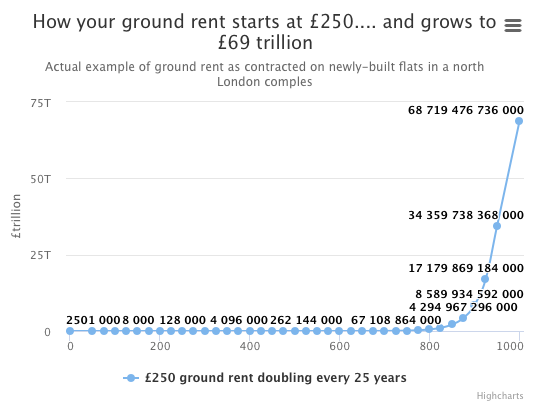
Phillip discussed various policy options to tackle the challenges. The options includes banning ground rents or limiting how much they could increase in value and many other subtle tweaks.
Hello, thank you for inviting me. I’m from the Open Data Institute (ODI). You may not have heard of us. (murmers of agreement)
We were founded 4 years ago by Sir Tim Berners-Lee, the inventor the web, and Sir Nigel Shadbolt. Our CEO is Jeni Tennison, she apologises for not being here. So do I as I’ve ended up creating an all-male panel. That’s bad.
We are global. We connect, enable and inspire people to innovate with data. Or “to get stuff done that make things better by being more open” as I sometimes say.
I am not a housing or leasehold specialist, my job is to get data to people who need it. Leasehold Knowledge Partnership are part of our current UK startup programme. They’ve been helping us understand the problems in leasing, we’ve been helping them understand whether more data can help.
Freeholds sold without leaseholders knowing ("who owns my house?"), others trapped with ever-escalating ground rents
When data is open and available for anyone to use it is easier for people to use it to make decisions and solve problems.
Take leaseholds. Let’s imagine if more information was open while respecting the privacy of homeowners.
People expect easy access to data in the web age. Many homebuyers use sites like RightMove and Zoopla as they look for a home. Opening up leasehold data would enable those services to help people make an informed decision. For example they could compare terms with other properties, leasehold or not, in the area and see what’s reasonable. Some of the cases Patrick mentioned happened because people lacked information when buying a home.
Phillip Rainey QC asks whether leaseholds are a means to an end (buying a flat) or are we inventing an asset class?
Conveyancers and estate agents would have access to more data too. They could get things done faster and give better advice to homebuyers.
Researchers would be able to model the market; help people understand how it is working and suggest improvements
Legislators would be able to get better information about problems, where legislation is needed or where soft power could be used to influence things
With better access to data government could test a policy idea, like the ones Phillip suggested, in a region before deciding whether to roll it out nationally
"If we can define the moon in legislation we can define ground rents and how they can be used"
Much of this data is available but it is locked away. In government offices, in the offices of house building firms, in law firms or in contracts held by leaseholders and freeholders.
Some of our big public registries and institutions – things like the Land Registry, Ordnance Survey, the Met Office — were created to make this type of information available to people who need it but it feels like they haven’t adapted to changing times and 21st century needs.
Getting this data open can take time and cost money. Not that much, technology can be cheaper than some people might tell you. But getting the data open and using it to change markets, like leasehold, can also affect business models. That’s usually more significant.
Phillip Rainey QC "Are we at risk of ossifying the housing market with new property on 999-year leases"
In closing I’d ask both the members of the APPG and all of the leasehold experts in the room to think about the power of the web, what people expect in the modern age and how the tools and techniques of the web and data can help build a better housing market. One that can reduce the number of cases like those that Patrick Collinson has written about over the last few months.
After the various speeches questions were asked by people in the room. The questions were from a more diverse group of people than the the all-male panel (grr!).
I was asked whether there was enough data available for someone in Ellesmere Port to get a reasonable view on whether their leasehold flat will be worthless in 10 years time. I’m checking that today.
Someone else raised the issue of freehold management companies surprising people with unnecessary administration fees — for example £250 for a simple bit of paperwork that is necessary if the homeowner wants to sell their home. That’s an issue my wife and I are well aware of having just sold our leasehold flat in London. We plan to blog on how data helped and where some data was missing.
Someone else asked whether we knew if the problem with leaseholds was bigger than in the 1970s. The answer from the panel was a bit vague but Phillip Rainey raised an important point. He said that the problem was getting worse because lawyers were producing new tighter leasehold clauses that benefitted the freeholder. He said that lawyers used the web to share these new clauses so they were all getting better in a way that made the situation worse for leaseholders.
You see technology can be used for good and bad and — as a very wise person once said — knowledge is power.
To help level out power imbalances we need to share the knowledge and the skills to use it with everyone.
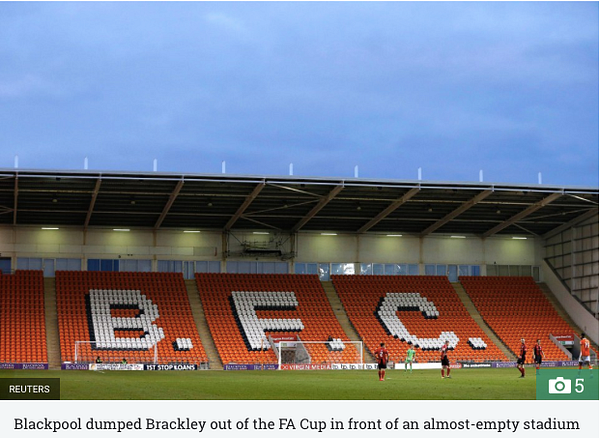
Blackpool football club is in a terrible state. Thousands of fans are boycotting the club until the owners, the Oyston family, go. We know that if we don’t get the Oystons out then they will keep damaging lives and could destroy the club.
Image copyright Reuters, snipped from that terrible excuse for a paper The Sun.
The reason we boycott
The boycotts are not about money. Yes, there is a wasted opportunity of a £90m windfall from Blackpool’s recent season in football’s top division and much of that windfall has been loaned from the club to other companies rather than spent on football. The terrible waste of that money is damaging the club but that is not the reason we boycott.
The boycotts are also not about being a laughing stock as the club fell 3 football divisions in 5 years and couldn’t even put out a full squad at the start of the 2014 season. The Oystons are currently in a legal battle with someone who owns 25% of the club. A legal battle that is bringing yet more shame on the club as allegations fly in the courtroom. Blackpool is a laughing stock because of the Oyston’s management of the club. We will not forget the shame but that is not the only reason why we boycott.
The boycotts are mainly because the Oyston family have abused fans; taunted them and taken legal action against them. An unknown number of legal actions are ongoing. These legal actions carry a large cost.
The real human cost of legal action
Fans from across the country have raised money to help Blackpool fans defend these legal actions but money is never everything.
Some individuals have lost their jobs, businesses are in jeopardy, relationships with partners have broken down and health has suffered.
they went on to say
some of the people caught up in this situation ha[ve] been seriously impacted — two cases of cancer, a stroke victim, depression, loss of a baby and an attempted suicide all in the last twelve months.
Devastating stuff.
These are some of the people that used to fill that stadium, who used to cheer on the team and travel around the country with other Blackpool fans.
This is not just a club being damaged, this is people’s lives being destroyed.
They don’t get it
Unfortunately too many other people either don’t realise or don’t care that the football club is acting this way. They are not speaking up to say that this must stop or taking any form of action to help get the Oystons to go.
The club and its employees didn’t comment on the legal action or the tales of the damage the legal action has caused to fans, instead they released “funny” Christmas videos. Some fans still go and put money in the club’s coffers rather than joining the boycott. The local paper tries to stay neutral and frequently reports on Blackpool as a normal football club when it should campaign for change. The local council and its leader stay curiously silent. The footballing authorities sit on their hands, rather than trying to save the club and help the fans.
I’d invite those people who still don’t get it to work with the fans who are both trying to stop the damage being done to our fellow fans and trying to save the club. There is a big job to do. Every voice, every pair of hands and every pair of feet can help.
It is also an urgent job. If you don’t help now and we don’t get the Oystons out soon then we may find ourselves with a much bigger task.
Building something new from the ashes that the Oystons leave behind.
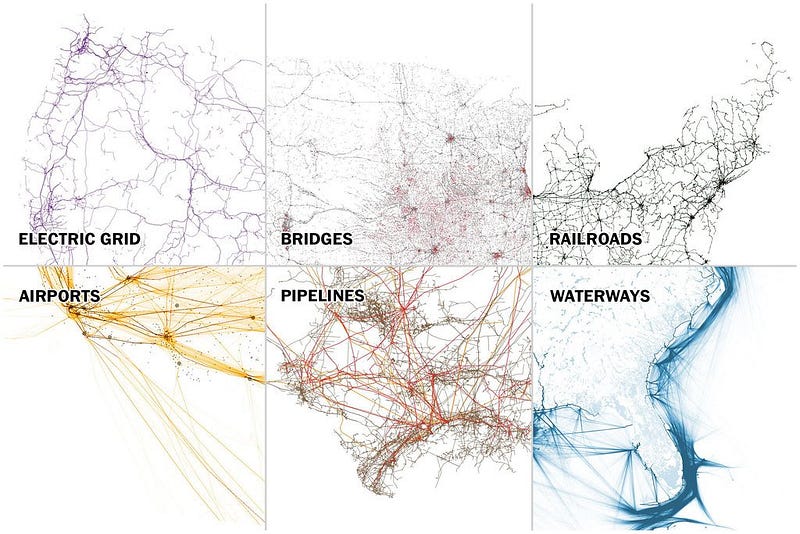
The Washington Post had an article the other day on six maps that show the anatomy of America’s vast infrastructure: the electric grid; bridges; pipelines; railroads; airports; and ports and inland waterways. The article has beautiful pictures of these big, important things that make it possible for society to work for as many people as it does.
All of the maps were created using data from OpenStreetMap. OpenStreetMap is brilliant. A map of the world that is collaboratively maintained and free for people to use. OpenStreetMap is also part of a new type of infrastructure, one made of data. That data infrastructure also underpins our society in the same way that other more visible bits of infrastructure do.
Data helps engineers understand where physical infrastructure is needed, what capacity is required and how to build it safely. Data, like maps or journey planners, helps people discover and use infrastructure. It does many more things too, even if some may seem a little weird.
Without data infrastructure, and without it being so easy to use, then the Washington Post might not have printed those beautiful pictures; engineers wouldn’t find it as easy to plan and build physical infrastructure; and people wouldn’t find it as easy to use that infrastructure.
A seventh map
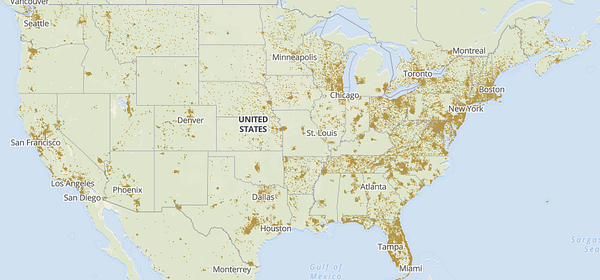
A map of open address data for the USA courtesy of openaddresses.io
As well as the six maps that the Washington Post chose they could have used this one from openaddresses.io. Every dot is an address.
It’s a bit patchier than the other maps that the Washington Post showed as some USA address data is not openly available. Either the data doesn’t exist or it us kept behind pay walls which makes it hard to use. This is a problem. Everything happens somewhere and addresses help us locate all of those somewheres wherever they are in the world. This data is vital infrastructure and must be freely available for anyone to use.
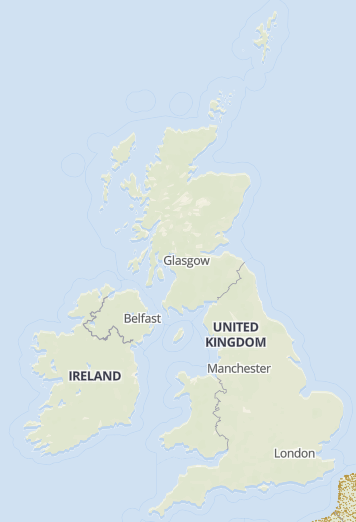
A map of open address data for the UK courtesy of openaddresses.io
In the title of this post I promised a blank map. It is not quite blank but there are no dots.
Address data for the UK is not openly available, it is locked behind paywalls. It is as if there were toll roads all over our road infrastructure. Just as fewer people would use roads if they had to pay a toll every few miles, fewer people use address data because of the paywalls. In both cases there is less social and economic impact.
Meanwhile the UK’s address data is not collaboratively maintained, like OpenStreetMap, and the quality suffers as a result. People who move into new build houses often discover that their address is missing from the lists stored in computers. They can’t order a pizza, a sofa or even register to vote. People know the address exists, it is the computers that don’t.
Data gets overlooked, even when a journalist is using it
Data infrastructure is part of the government’s responsibility in the same way as the other forms of infrastructure that the Washington Post wrote about. They are all vital infrastructure that underpins our society. They should be both protected and made widely available in exactly the same way.
Much of our data infrastructure is patchy or difficult to use. Things like maps, records of land ownership, ompany information, where and how we can vote.
Data infrastructure should also form part of the public debate alongside other forms of infrastructure. The danger is that data is misunderstood and overlooked, even when a journalist is using it to draw some beautiful pictures.
Both the EU referendum in the UK and the presidential election in the USA have generated a lot of debate over what influenced the results. They were close campaigns. There are many things that could have led to a different outcome. I’ve been particularly interested in the debate over the role played by technology, the web and data.
I think the debate is missing how politics risks becoming driven by data rather than informed by it.
Technology-driven progress, globalisation, fake news, social media, malicious and mischievous actors
Technology is a major strand in the debate about globalisation, nation states, jobs and inequality. The web and data are at their best when they are world-wide, open and know no boundaries but it is essential that we use technology-driven progress to build a better society for everyone.
Whilst debate about hacking and bots continues in other countries, such as Germany, this story seems to be at risk of slipping off the radar in the UK and USA. A more informed debate about their effects and purpose would seem useful.
But there’s a fourth element that I’m barely seeing debated at all. Data-driven politics.
Data-driven politics
Politics has always gathered and used data to help it make decisions. This data comes from door knocking, censuses, opinion polls, focus groups and election results. In our current age of data abundance there are ever more and cheaper ways for anyone to gather and use data. Some of the uses by political parties seem to be at risk of copying the worst excesses of online marketing.
In the UK Labour leadership contest in 2016 organisations such as Momentum and Saving Labour talked of capturing email addresses and the reach of their social media channels. Neither group has been open about who is in control of this data, whether it is secure from hacking or how it is used.
Following the UK’s referendum on the EU one of the Leave organisations, Vote.Leave, talked of its superior use of data and how it was used for targeted advertising. The BBC reported that:
“Their dream was of a system that could put information from Twitter, canvassing, polls, websites, apps, into one giant IT programme that would then churn out extremely sophisticated models that would reveal the areas most likely to vote Leave, down to the street.”
Other campaigns and political parties debunked their claims on twitter and proudly said their data tools collected more information. No one questioned whether either was appropriate or healthy for democracy.
The New Statesman reported on the plans of a UKIP funder to start a new political party saying he claimed that Leave.EU’s email database was “a goldmine to anyone doing digital campaigning”. No one asked if it was either legal or right to transfer this “goldmine” to a new political party.
In America the Trump campaign was talking about its heavy use of data before the campaign finished. One insider on the data team said:
“There’s really not that much of a difference between politics and regular marketing.”
I hope I’m not alone in thinking there should be a difference between politics and marketing.
This increase in the use of data to both listen to and influence people in political debates raises a number of issues.
There are biases in data and in how we use data
Data has biases. This might occur because there are gaps in how we collect data: for example ~10–20% of the UK and US population are not online because of issues such as cost, disability, location or motivation. Data also includes the biases in society such as those affecting gender and race. Bias can also occur through the people who decide how to analyse data and code the algorithms. People write code and people are biased.
If our political parties increasingly use the web and data to get them over the electoral winning line then they are likely to focus their efforts on winning over groups that are well represented in the data and predictable by the algorithms. Other people may be ignored.
National slogans, targeted adverts
The recent campaigns hint at a trend towards very broad brush national slogans (Make America Great Again!, Take Back Control) coupled with targeted campaigns aimed at particular interest groups.
Someone working in the car industry living in the Northeast of England might see an advert telling them that a political party is supporting car factories in Sunderland but see nothing else about that party’s policies or beliefs. The political party can see how that person responds to the advert — whether they comment, share, like, or retweet it — and use that data to tailor their next advert.
Some of these campaigns will come through official channels but targeted campaigns will come from through social media adverts, local (sub-brand in marketing speak) or unoffical channels. Coupled with the ongoing loss of funding for and trust in national journalism this will make it ever more difficult for a coherent national debate where a society makes an informed choice about its future. Instead political parties will tell different groups of people what they think they want to hear based on data.
We risk becoming more fragmented and the importance of values and principles in politics could become ever weaker as politics becomes more data driven.
Now some of this type of political advertising occurs already but technology, the web and data allow it to happen at a larger scale and at a cheaper cost. I can only imagine the voices in political campaigns saying that this is a race and that the process must become faster and more automated through “smart” algorithms. As we have already seen in other sectors these algorithms risk embodying and multiplying the biases in the data.
Use of data in political campaigns will influence how politicians govern when in office
Finally, there is an ongoing debate about the use of data by governments and the private sector. This debate concerns the rights and responsibilities that people and organisations have when data is collected and used. There are calls for greater control by people and more scrutiny by regulators.
This debate needs to include political parties.
If our political parties believe that the only way to get elected is through the use of data and algorithms then they will use them. If that use is not questioned and people are not held to account then that use could be normalised. Politicians might carry those normalised beliefs into office and it risks affecting how they govern and how they legislate.
Data-driven politics
Politics can be improved by new technology, the web and data.
The web offers ways for more people to be engaged in politics and it gives them more tools to influence politics. The web can help with a transfer of power from the centre to communities and people. Data can provide better evidence for policies and make it possible for us to trial new policies before they are implemented on a large scale and at a big cost. Better use of data can help improve public services and the economy.
These things can be dazzling. But we need to recognise the risks. Not just that some technology innovation is pointless but also that some uses of technology are actively harmful. That they can harm individuals and communities and that copied wholesale into politics they can damage democracy.
Rather than being driven by data we need to encourage politics to be informed by data, to be open about how it uses data and for political parties to use data and technology to help people engage with politics and make better decisions based on both evidence and their values and principles. It’s up to all of us, particularly those of us with knowledge of technology and data, to help make sure that this happens.
Everyone’s talking about automated cars and how they will make it cheaper and easier for us to get from place to place. As well as helping us travel they will change our cities by freeing up space, save lives by reducing the number of driving accidents and lead to the loss of millions of driving jobs with the associated impact on people and communities.
If you’re reading this I bet you’ve heard this talk. If you live in one of the test areas in America, UK, China and etcetera you may even have seen trials. There are skeptics, but I think that people will be able to gradually build ever safer and more automated cars. Once they do many people will choose to use them. Change is coming.
Making it easier and cheaper to move around, changing cities, saving lives, removing a type of job are complex things. There are many more secondary effects. Our policymakers need to consider the risks and benefits to help us get to a better society that includes automated cars and benefits everyone.
But I’m not seeing enough discussion of one important aspect of automated cars: data, and how security, privacy and openness can increase its impact.
Automated cars collect a lot of data
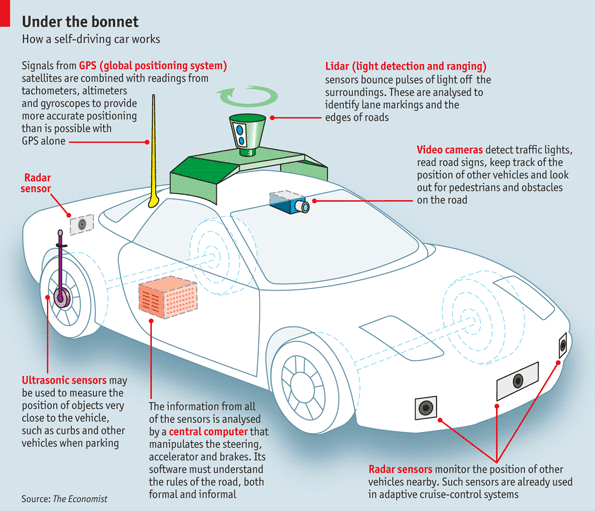
As well as transporting people and parcels automated cars will collect vast amounts of data. A human driver needs to look around to see street signs, the weather or cyclists. Similarly automated cars will need to collect data to make driving decisions.
This data includes such things as the car location, maps and video footage of the surrounding area, information about nearby traffic, accidents, weather information, the route of the car and information about any passengers or parcels that that are in the car.
That’s a lot of data, how do we get most value from it?
Security and privacy
The security of this data clearly needs to be considered. We need to protect the data collected by the car and the data that the car needs to be able to get to do its job. Car hacking is a real risk whilst an automated car is likely to be more dependent on access to data than a car driven by a human. Data is already an under-recognised piece of critical national infrastructure, automated cars will only increase the need to strengthen it.
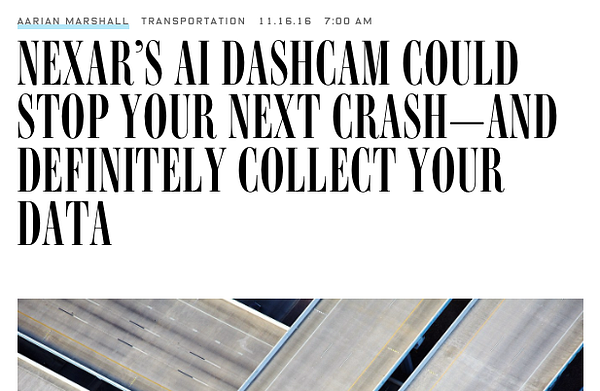
Silly Wired. Nexar, like any camera, isn’t just collecting your data it’s also collecting data about other people.
Privacy will also be an important consideration. If automated cars mishandle personal data about the people travelling in them or the people and things seen by their video cameras then some people will be damaged while other people may lose trust and choose not to use the cars.
Some of these issues will be explored by smartphone apps, like Nexar, that use the smartphone’s camera and microphone to collect data about car drivers, passengers, pedestrians and other cars.
But automated cars will collect far more data than a smartphone camera.
Automated cars will use data collected by other cars and people
Automated car manufacturers and policymakers should be thinking about security by design, privacy by design and how openness can help build the trust that will be needed to get the most impact from automated cars. Open can help in other ways too.
The data collected by cars is needed for them to do their job but automated cars will also use data provided by other things and people.
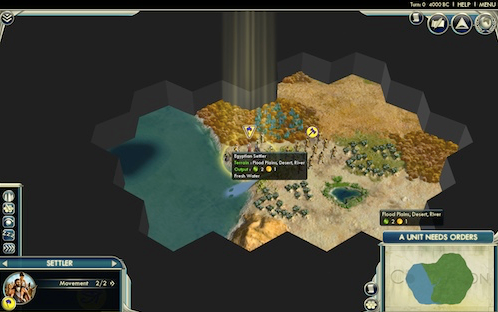
Automated cars won’t be like a starting character in the Civilization games. They’ll be able to see the full map. Civilization made by Firaxis Games, image from VentureBeat
An automated car will not wake up in a factory, blearily blink its headlights and then discover the world like a video game player constantly surprised by new things. The car will have a reasonably accurate map of the world, will get weather data (what sensible car would choose to drive into a hailstorm that might damage its paintwork?) and be able to share data with other cars.
Just as we hear of traffic jams from other people via radio alerts or smartphone apps like Waze, the people designing and building automated cars have planned for them to be able to share news about traffic congestion or improvements to their basic maps. Those improvements are vital because map data, just like any other data, is not always 100% accurate. Things change. An automated Google car driving down a street might discover that a road is blocked off, by sharing this with other Google cars it can make Google’s service more efficient.
This all sounds like good use of data, but it’s not good enough. We can and should do better.
Data should be as open as possible while respecting privacy
Werner Herzog’s first automated car looked a lot like a boat.
Mapping is a shared problem. All cars, automated or not, will benefit from better maps. As will pedestrians, cyclists, local authorities planning new infrastructure investments, etcetera. Collaboratively maintaining open mapping data between all of these people can reduce costs and improve quality. Facebook are happy to collaboratively maintain open mapping data as they recognise the value in this approach. Automated car manufacturers, mapping organisations and policymakers should be too.
Reducing accidents is another shared problem. The machine learning algorithms that will drive automated cars will learn faster and more accurately from more data. Sharing detailed data about the conditions in place when an accident occurred will save lives.
People will ask an automated car to drop them off at an address. That address may not be in the current list of addresses — perhaps it’s a new flat? — so the person may teach the automated car where it is. The address could then be sent to an open address register as a potential improvement to the data. The next automated car will know about it but addresses are vital for many other things from pizza delivery to an ambulance. We should be maintaining addresses as efficiently and openly as possible. Collaborative maintenance helps with that and openness means that anyone can use it.
There will be many other types of data collected by the car that when opened up in this way will improve transport services, save lives and make things better in other sectors.
Live weather conditions (something that the lovely folk at TransportAPI are working on). Air quality. Congestion data. Aggregated movement of people around a city. Etcetera.
This impact of opening up this data will be felt not just in better automated car services but in other services and sectors that use the same datasets. Automated car manufacturers are in the transport business, not the mapping or air quality business. Publishing the data openly will help them tackle shared problems and increase the impact of the data. Everyone benefits from better and more open data.
Automated car data should be secure, private and open by design
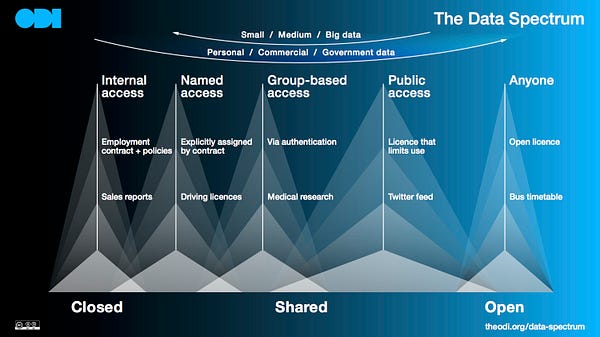
The Open Data Institute’s data spectrum. The most important things about data is who can access and use it. Mapping an automated car’s data against this data spectrum would be very interesting.
The transport sector has long been a leader in open data. The countries and organisations that have taken the lead in opening up this data have benefitted both from better services for people and through the creation of innovative new services like GoogleMaps and companies like CityMapper, Transport API and ITOWorld that create jobs and help get the data used.
As that seemingly inevitable next wave of change occurs with the rollout of automated cars that will improve transport, free up space, save lives by reducing accidents and impact jobs let’s make sure we don’t forget about the data infrastructure that is necessary for those cars do their job and can create so much value for the rest of our society.
Making that data infrastructure secure, private and open by design will benefit everyone.
If you want to chat about the thoughts in this blog then tweet or mail me.
If you enjoyed this story, we recommend reading our latest tech stories and trending tech stories. Until next time, don’t take the realities of the world for granted!
These are the approximate words I said at the launch of the new All-Party Parliamentary Group (APPG) on data analytics on 31 October. An APPG brings together representatives from different political parties from both the House of Commons and House of Lords to pursue a particular topic or interest. Daniel Zeichner MP’s speech from the launch is also online. Other speakers were from TfL, Experian, CompareTheMarket and the Institute for Environmental Analytics. In person I wandered off topic a bit based on audience reactions but I promise that there were no cat jokes.
It is based in London but the network is global. We have nodes and members on six continents and in every nation of the UK. We do research, train people, advise them, introduce them to people with similar interests, give them simple tools to help them publish and use data, incubate startups and encourage thinking on fundamental issues such as data infrastructure and how to use personal data in a way that creates trust. We do this with large businesses, startups, charities and governments. We are a global voice for the better use of data to deliver social, environmental and economic impact.
The ODI is a not-for-profit and was founded five years ago by Tim Berners-Lee and Nigel Shadbolt. Both of them are at the yearly ODI summit which takes place at the British Film Institute tomorrow.
Bringing people together to solve common problems
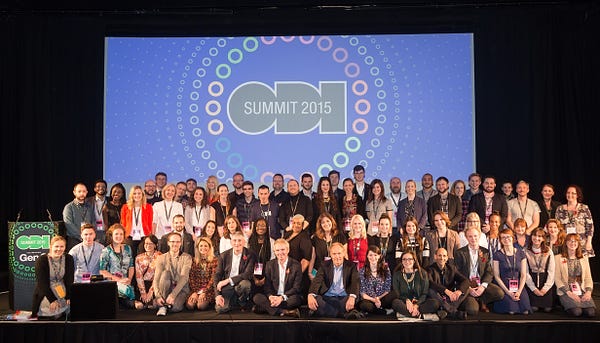
The ODI team at the 2015 summit. Don’t let anyone convince you that diversity in tech is impossible, it’s not. Image by Paul Clarke, CC-BY-SA.
The summit is kind of unique, as is the ODI. It brings together large corporates with charities and startups; people interested in global development and democracy with people interested in the latest smart cities and transport trends; people from local government, national government and reps from global institutions. The attendees and speakers come from around the world. They all believe that openness and data can benefit them and everyone else too. (you can watch a stream of many of the summit sessions)
Which brings me to this all-party parliamentary group on data analytics. I’m a big fan of democracy and I’m also a big fan of things that bring together people from different backgrounds such as elected representatives and peers from across the political spectrum to find common points of interest, or problems, where people can work together to get things done and make things better. It’s the type of approach we use to help bring together large sectors like banking and agriculture, another one will be announced tomorrow. I won’t spoil the surprise. (it was sports)
An age of data abundance
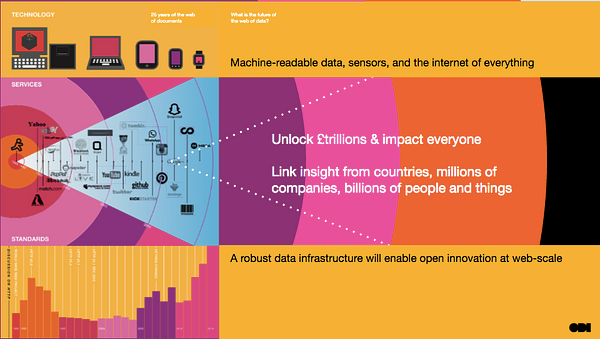
We are in an age of data abundance with billions more people and devices coming online. It’s ever cheaper to collect, use and publish data. A web of data is evolving that sits alongside and behind the web of documents which changed our lives when Tim Berners-Lee invented the web 20-odd years ago. Our experience from the last 5 years is that that data will create most value when it is as open as possible while respecting privacy: an open future. But the future is uncertain.
We need to work together to shape an open future because whilst the current wave of technology change has bought many benefits it also carries many risks. Privacy risks, monopoly risks, democratic risks. We need to overcome those risks and project a positive message to get to a good future.
Tim famously said “this is for everyone” when tweeting about the world wide web from the launch of the London Olympics in 2012. The type of open thinking that Tim showed when he gave away the web is going to be necessary if we are going to realise the brilliant potential of this new web of data to benefit everyone.
And that open thinking is what we hope to see from this all-party parliamentary group. As well as the rest of us we need government and legislators to play an active part in making this happen. Government can lead by example.
We need to provide data skills for citizens, business and policymakers, with policymakers using data both for evidence and as a tool to achieve their policy ends.
And we need to encourage open innovation. A bridge between academic research, public, private and third sectors, and a thriving startup ecosystem where new ideas and approaches can grow. Innovation that solves problems.
We describe this as the open future. A future where we’ve understood and tackled those risks, made data as open as possible and created benefits for citizens, businesses and government. Data for everyone.
There were questions
After we talked the audience asked questions covering a whole range of topics from data in manufacturing and engineering; trust in use of data; public sector reform; EU proposals for copyright and how that impacted on organisations holding data; and whether people should be paid when their data is used. A wide range, as you’d expect from something that connects together and underpins sectors across the economy.
The last two questions I found particularly interesting. Both of them seemed to come from applying models from the real world to something, data, which has different qualities. Data is non-rivalrous, it benefits from network effects, etcetera. That’s why the economics of data are different from other things and still being researched. The questions also seemed to come from an implicit assumption that we could use the concept of ownership in the physical sense of the word. We need to be careful in how we use the language of ownership to address questions about data. Physical world metaphors don’t readily fit the data world. And even our understandings and expectations of ownership in the physical world aren’t as simple as they seem. This blog from Ellen Broad is a good read and what I channeled in my response. I hope the APPG thinks about those questions and the concept of ‘data ownership’ deeply. Its members will be part of shaping the legislative environment that will help us get to that open future.
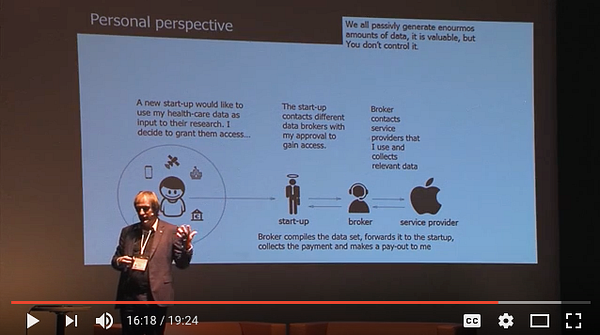
Approximate words from a talk at the Holyrood Connect: Data Forum in September 2016. Approximate as I tend to ad-lib in person as I see shocked, or occasionally, pleased faces in front of me. I also had a bad cold so ad-libbed even more than normal. The slides are also available online.
— — — –
Hi, I’m Peter. I do some stuff at the Open Data Institute (ODI). I’m here to talk about how an open city is a better city.
First some background and a couple of concepts: the data spectrum and data infrastructure. Then some current examples of data analytics in cities, and their limitations, followed by some UK examples of people building more open cities with more benefits. I’ll end up with some principles to help get you started and a bit about what’s coming in the future. Ok, background:
Background
The ODI was founded four years ago by people like Tim Berners-Lee and Nigel Shadbolt. It is headquartered in the UK but its team works around the world. There are currently 29 nodes in 18 countries. In the UK that includes places like Aberdeen, Leeds, Belfast, Devon, Bristol and Cardiff.
The ODI’s mission is to connect, equip and inspire people around the world to innovate with data. We believe in knowledge for everyone. We help the public sector, third sector, academia and businesses to get more impact from data. Last week there were research fellows in the office from Madrid and Singapore debating and sharing ideas about geospatial data and privacy, crowdsourcing and smart cities. In the last few weeks the HQ team have been doing stuff in the UK, in Malaysia, New York, Mexico and Tanzania.
Concepts
The ODI works across the data spectrum. Some of us worry about personal health records being “made open”. Some confuse commercial and personal data, or mix up “big data” with “open data”. To unpack data’s challenges and its benefits, we need to be precise about what these things mean. They should be clear and familiar to everyone, so we can all have informed conversations about how we use them, how they affect us and how we plan for the future. And it doesn’t have to be complicated. It can be simple. In one image. Whether big, medium or small, whether state, commercial or personal, the important thing about data is how it is licensed and who can use it. Closed so that it can only be used within one organisation, shared can only be used by some organisations (because of rules or price restrictions), or open data that can be used by anyone for any purpose.
The ODI works to improve data infrastructure. Data has become vital infrastructure over the last few years. It underpins transparency, accountability, public services, business innovation and civil society. Data such as statistics, maps and real-time sensor readings help us to make decisions, build services and gain insight. Data infrastructure will only become more vital as our populations grow and our economies and societies become ever more reliant on getting value from data.
I often hear people say that data is the new fuel or that it’s oil for the digital revolution. Daft analogies. Data doesn’t get burnt up when we use it, we can use it again and again and again. It doesn’t get extracted from the ground: unless it’s geological data. The analogy we use for data infrastructure is roads. Roads help us navigate to a location. Data helps us make a decision. Roads have signs and maps to tell us how to use them. So does data, well hopefully.
Lots of cities are improving data infrastructure
Now back to the theme of cities and data. Cities and local authorities around the world are using and improving data infrastructure. It may not feel like it sometimes, but they are.
Many public sector organisations are developing skills and creating more impact by using their own data to make better decisions. Whether it be where to spend money on social care, what time to pick up the bins or how to design a local authority website so that it’s easy to use. In each case the organisation is having to learn how to gather data, analyse it and use it to make a better decision.
These are all activities in the closed part of the data spectrum.
Half-spectrum doesn’t give you all the value.
We’re also seeing more and more public sector organisations work together and share data to make better decisions. Down in Manchester local authorities are sharing data to help vulnerable children. In London local authorities are sharing and analysing data to look for unlicensed houses of multiple occupancy, they can be unsafe places to live. This type of big data analytics takes inspiration from places like Chicago which has been using data about graffiti tags to tackle gang violence, or New York City and Amsterdam which have analysed data from across the city to work out what characteristics were the best indicators for fire and help prevent it.
These activities take place in the closed and shared part of the data spectrum.
All the data and all the open
But let’s go back a bit. When I talked about data infrastructure I said it underpins transparency, accountability, public services, business innovation and civil society.
All of the previous examples are about public services. The rest of the benefits of data infrastructure missing. There’s some business innovation — for example from data analytics companies selling into the public sector — but only a portion.
Why is that ? Let’s look again at the full data spectrum. We’re missing public data and open data.
At the ODI we say that cities, their businesses and their citizens get most impact from a data infrastructure that is as open as possible while respecting privacy. There’s lots of research showing this and there’s also practical examples. I’ll cover some in a bit.
It’s true you know.
The reasons that open data infrastructure creates most impact is due to the qualities of data. For example, it benefits from network effects. Data becomes more useful and creates more value as more people use and maintain it.
When you work openly and use as much open data as possible then more people can work together to solve problems, make decisions, find insights and build services. You benefit from network effects. You can build a better city. One that benefits everyone.
This is particularly true if you combine all the data — closed, shared and open — with all the open. Open culture. Open source. Open government. Open standards. Open innovation. Etcetera.
There’s lots of examples, here are some
Let’s take a few examples showing some different aspects.
First, Bath and Strava, the cycling app. Strava users cycling around Bath can choose to share their closed personal data with a community group called Bath:Hacked. That group preserve privacy, analyse the data and are working with the council to use it to improve cycling routes. Interestingly there’s anecdotal evidence that people are cycling and using the app more because they can see that the data they collect benefits the city and themselves. Win win. Meanwhile Bath:Hacked are sharing what they’re doing online.
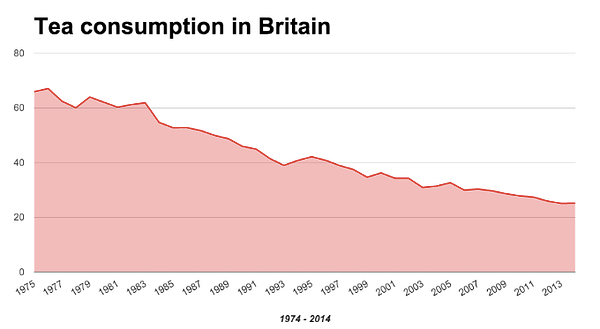
As a coffee drinker I am unsurprised by the decline in tea-drinking in Britain (source: Defra, ODI and Kiln)
There are two reasons for that. First, by opening up the knowledge for everyone other people can use it and other people can tell Bath how they are using it. People can learn with each other. Second, openness about how organisations secure and manage personal data builds trust. It can improve quality too. take Defra who recently did a privacy impact assessment in the open, with people outside the organisation commenting, before releasing diaries showing the diet habits of 150,000 households. They worked out by debating with their community that some of this data which would otherwise have all been kept closed could be made open for anyone to use. Transparency and open debate about personal data can make things better.
Another example, I was talking to someone from Devon council last week. They published a map of places where people could get help. Unfortunately the map was wrong. Because both the data and the source code were open a friendly person could fix it for them and send them the corrected version. Problem fixed within a few hours. Thank you friendly person.
Another. In places like Manchester and Leeds people from the public sector, private sector and civil society are working to build a low-cost open infrastructure for the internet of things. They’re helping each other using each other’s skills and experience as needed. On the infrastructure people will be able to build and deploy sensors to monitor air quality or the height of a river and anyone will be able to use the data to decide whether to place a new school near a road or a set of new houses by a river, whether to buy a house or whether to evacuate a house as the waters are rising…
These things cost money but they don’t need to cost the big money that so many projects with technology do. The cost of software, hardware and hence data is falling dramatically. You can now build an air quality sensor for less than £100, you can get a LIDAR sensor — a device that can measure distance using lasers — that used to cost tens of thousands of pounds for a few hundred pounds. (That’s part of the reason we’re hearing about automated cars so much. They need those sensors too). As much as possible of the data from that infrastructure will be open, that’s the culture of the community. That will allow other people to use it too for only the cost of allowing people to use the data that has already been collected. The infrastructure is designed for open.
And to continue the theme of culture. In Aberdeen the team in the council run hackathons open to anyone and learn innovative techniques from civil society businesses to help the council deliver other services. Those hackathons will also help with the Scottish government’s digital skills initiative that I was reading about on the train yesterday. An initiative that could also be supported by the new work that the Open Government Partnership are starting with the Scottish government.
Back to Leeds. The city council has funded ODI Leeds to act as a neutral space outside the council that can be used to convene businesses, academia, civil society and the public sector to understand and define problems; share data to explore ideas and then open the data as much as possible to allow people to build solutions. Those solutions could be built by new startups or established businesses. Arup, the global construction firm, use similar open innovation techniques working with startups to help improve how they build stuff. It’s like the data analytics examples we saw earlier but it uses the full spectrum.
In each of these cases we can see people from multiple sectors sector working together to solve common problems as openly as possible. In the process new businesses are built, there’s transparency and accountability, civil society are engaged, and there’s better public services too. All of the things our data infrastructure supports.
As you may have realised from these examples data infrastructure is not only about data. Data infrastructure includes datasets; the technology, training and processes that makes them useable; policies and regulation such as those for data sharing and protection; and the organisations and people that collect, maintain and use data. We can all see that the datasets may be from anywhere in the data spectrum. But the more open the data infrastructure, the more value it will create as more people can use it.
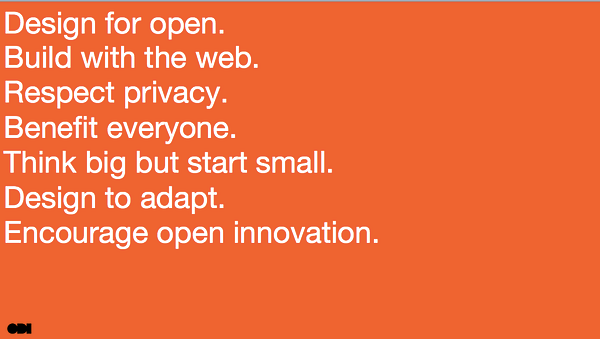
The first and last principles are key. Design for open and encourage open innovation.
Based on our experience we believe we need a number of things to work together to create the space for open innovation to happen: strategy, policy, training, technology, research, a tech community, and engagement. With that engagement you’re looking to build a receptive internal customer (for example a councillor in a city), a responsive tech community and an engaged civic community willing to work with you. With open innovation the best answers can come from anywhere. You just need to get started and have the courage to try.
Anyway, I hope that was interesting, and useful, but before I go I want to leave with you another thought as to why getting to grips with open and data is so important.
The web of data is coming.
Over the last 25 years we’ve all been building the web of documents. Billions of webpages linked together. It’s fabulous. But the billions of people, sensors and services that are connected to the web and the internet produce, publish and use data. A web of data is now evolving that sits alongside and behind the web of documents.
That might seem like a challenging thing and something we can’t control but I would encourage everyone to see it as an opportunity. By getting to grips with your data infrastructure and making it as open as possible you will be positioning your city and the businesses and citizens that live in it to thrive in that future. That sounds like a pretty important mission to be cracking on with. It’s about building for the open future.
An open city is a better city.
There’s countless other examples to demonstrate why an open city is better and to help you understand how to grow your city in a way that works for your problems and your challenges. But, as a start, I’d encourage all of you to pick a problem and get started. Work together with your businesses and citizens to solve that problem and start building that open city and make things better for everyone.
Hi, I’m Peter. I do some stuff at the Open Data Institute (ODI). The ODI was founded three years ago. It’s mission is to connect, equip and inspire people around the world to innovate with data. Its headquarters are in the UK but it works around the world.
I’m here to talk about open addresses in the UK. To understand the tale it’s useful to start off with a (shortened) bit of history.
Ancient history…
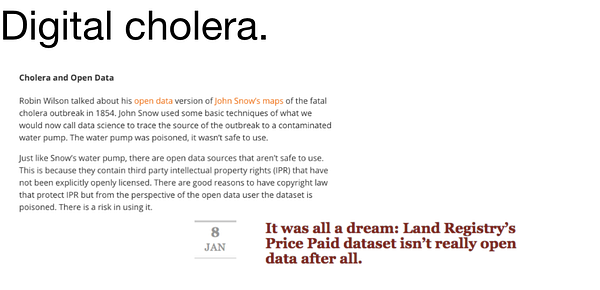
Addresses and other types of geospatial data were early targets for open data releases. They are vital datasets that make it possible to build many, many services and products. Way back in 2006 Charles Arthur and Michael Cross wrote in the Guardian to ask the UK government to “give us back our crown jewels”. They pointed out the complex arrangements for maintaining address data and how the data was sold to fund those complex arrangements. They even pointed out the issues it generated for the 2001 census.
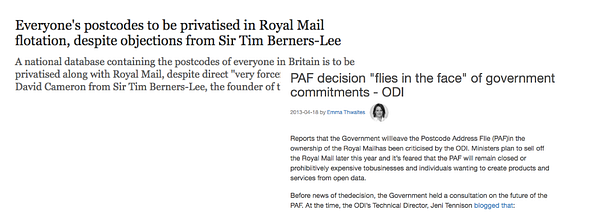
But it was a pyrrhic victory. Whilst government released many thousands of datasets the promised address data was not one of them. In 2013 the Royal Mail was privatised along with its rights to help create and sell that address data. The complex arrangements that were pointed out in 2006 just got more complex. And, in the meantime, another census happened with the inevitable, and costly, need to build another new address list.
We looked at funding models. We started off with £383k of funding from the Cabinet Office. We got some extra funding from BCS (thank you). We knew that we would need to be able to show people what our services would look like before we could start bringing in funding from the users of address services.
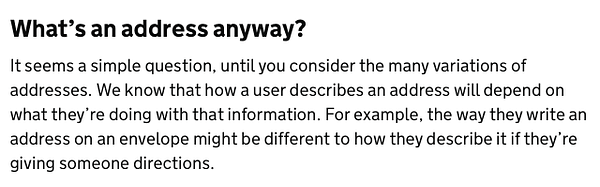
From talking with potential users of those services we learnt about the challenges of address entry on many websites. User research supported our theory that moving to free-format address entry would both make life easier for many people and lead to better quality address data going into organisations. We built a working demo of that service.
We knew we needed to gather address data. Following on from the discovery phase we built a model that would allow any organisation or individual to contribute their own address data; that would allow anyone to add large sets of open data containing addresses if they followed guidelines and confirmed that they were legally allowed to publish that address data as open data; and put in place a takedown policy to investigate and remove any infringing data. For the legally minded, we were set up to host the data. This was important. In the past people had been threatened with legal action by the Royal Mail over address data and the hosting model provided a defence.
We didn’t want to spend the limited grant funding on more and more legal advice or court battles (sorry lawyers…). So we concentrated on other approaches.
We used clean open data sets and statistical techniques to multiply the address data we already had. For example, “if house number 1 exists and house number 5 exists then house number 3 probably exists”.
We started developing a collaborative maintenance model. People could use our address services to both improve their own services and improve the address data that everyone was using. The model would enable us to learn and publish new address information (such as alternative addresses — like Rose Cottage rather than 8 Acacia Avenue and new addresses) as people started to use them. This would increase the speed of publishing new information and improve data quality. By crowdsourcing data through APIs the data would get better as more people used it.
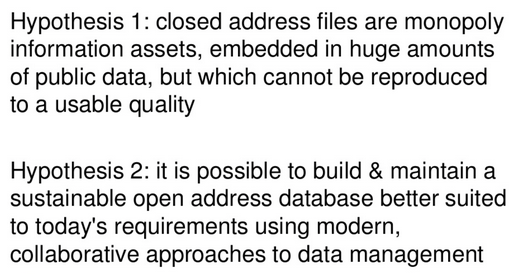
But all this time the clock was ticking. There was limited funding. From the beginning we knew that we were testing two hypotheses.
Two hypotheses. Both are true.
Unfortunately we discovered that both hypotheses were true. We could build much better address services using modern approaches, but the intellectual property issues would keep hindering us.
A report was published: to share the lessons of what worked, and what didn’t. As you’ll see in the report even with all of our mitigations against intellectual property violations in place, Open Addresses was only able to find one insurer who would provide it with cover for defence against Intellectual Property infringement claims. The insurers were too concerned that the Royal Mail would take legal action to protect their revenues from address data.
Someone else would have to take up the challenge of opening up address data and making things better for everyone.
Meanwhile…
While Open Addresses was happening so were other things. Lots of things. I’m obviously interested in the data ones.
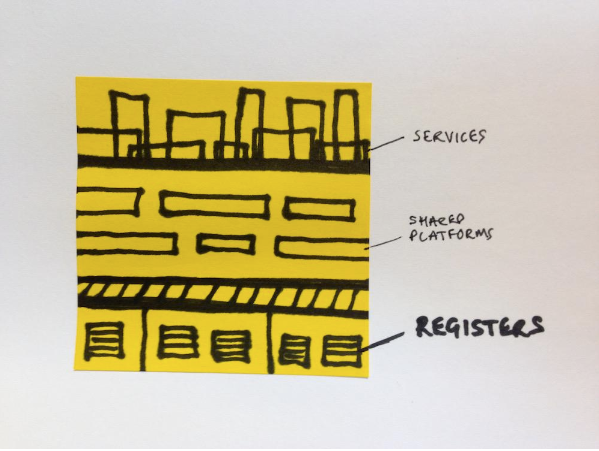
The ODI was thinking about who owned our data infrastructure. Data is infrastructure to a modern society. Just like roads. Roads help us navigate to a location. Data helps us make a decision.
Spot the infrastructure in this excellent picture by Paul Downey.
It is important to understand that this is about exploring options. As Open Addresses had learnt UK addresses are pretty complex. We have centuries of legacy to deal with.
Whilst not all of the work is in the open (remember, the arrangements for UK address data are complex commercially and legally) it is clear that many government organisations — such as the Cabinet Office, Ordnance Survey, BEIS and Treasury — are working together to explore the options and business case for an open register. Good ☺
Will the address wars ever end?
All of the above is what I said in the talk at the BCS addressing update seminar. At the end the audience debated some of the issues raised. The legal issues seemed to confuse some people — derived database rights are tricky. Eventually I was asked the most important question: will this new UK government initiative to create an open address register succeed?
The honest answer is “I don’t know” but I do trust the people working on it. They are good and there is clear political will to get this problem sorted. With good people and political support it’s possible to do hard things. I choose to be optimistic. I think they’ll succeed. Good ☺
The web of data is coming.
It is important for the UK that they do. We need to build for the future web of data.
Data infrastructure is a competitive advantage in the 21st century. We need to move on from old licensing and funding models that don’t make the best use of the qualities of the web and data.
If you enjoyed this story, we recommend reading our latest tech stories and trending tech stories. Until next time, don’t take the realities of the world for granted!
Hello. This is the personal website of Peter K Wells. I do politics, policy and delivery to try to make data and technology benefit everyone. I also do bad jokes and music references.
This website stores cookies on your computer. These cookies are used to provide a more personalized experience and to track your whereabouts around our website in compliance with the European General Data Protection Regulation. If you decide to to opt-out of any future tracking, a cookie will be setup in your browser to remember this choice for one year.